Introduction
US healthcare is running on fumes. The AAMC projects a shortage of up to 86,000 physicians by 2036, while nearly 74 million Americans live in primary-care shortage areas. Meanwhile, administrative burden keeps climbing — 80% of physicians say AI is relevant for billing codes and visit notes, yet most clinical teams are still handling these tasks manually.
AI agents are emerging as a practical answer. Not chatbots that answer FAQs, but autonomous systems that schedule appointments, route patient calls, complete documentation, and coordinate follow-up — without a human triggering every step.
That adoption pressure is showing up in the numbers. According to MarketsandMarkets, the global AI agents in healthcare market will grow from $1.11B in 2025 to $6.92B by 2030, a 44.1% CAGR — with North America holding the largest share.
What follows breaks down five leading AI agent developers for healthcare in 2026 — what they build, who they serve best, and the criteria that separate a capable implementation partner from a generic software vendor.
Key Takeaways
- AI agents execute multi-step workflows — scheduling, triage, documentation, RCM — not just respond to questions
- HIPAA compliance, EHR/EMR integration capability, and real healthcare deployments are baseline requirements
- The right developer depends on your size, use case, and whether you need a platform or a custom-built solution
- For startups and SMBs, custom development partners offer more flexibility — often at a third of US team costs through nearshore delivery
- This list covers five developers spanning custom builds, safety-first agents, enterprise platforms, and workflow-focused products
What Are AI Agents in Healthcare?
AI agents in healthcare are intelligent, semi-autonomous systems that automate and execute multi-step clinical, administrative, and operational tasks. Unlike a chatbot that responds to a scripted prompt, an agent can reason through a workflow — routing a patient call, triggering a scheduling link, flagging a follow-up, and logging the interaction in an EHR — without human initiation at each step.
McKinsey describes these systems as virtual workers that combine reasoning with generative and predictive capabilities to perform complex workflows — including identifying appropriate sites of care, coordinating case management, and streamlining discharge follow-up.
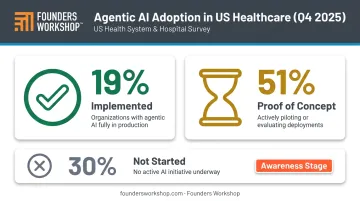
Despite that capability, deployment remains limited. McKinsey found that by Q4 2025, only 19% of US healthcare organizations had implemented agentic AI, while 51% were still in proof-of-concept. Organizations that move now — before the market standardizes — will have a measurable head start on competitors still evaluating vendors.
Top AI Agent Developers for Healthcare in 2026
These developers were selected based on healthcare domain expertise, compliance posture, integration capability, and real-world deployment track record.
Founders Workshop
Founders Workshop is an Arizona-based custom software and AI development firm founded in 2008, with 200+ solutions delivered for startups and SMBs across industries including healthcare. Its AI-first 5D Process (Discovery, Definition, Development, Deployment, and Dedicated Support) takes healthcare ideas from concept to market-ready product in a structured, low-waste sequence.
What sets it apart for healthcare buyers is the combination of custom flexibility and cost efficiency. Rather than forcing clients into a platform with fixed workflows, Founders Workshop builds AI agents shaped around a client's actual operational problems: automating patient intake at a specialty clinic, building documentation support tools for telehealth platforms, or connecting AI workflows to legacy EHR systems.
Its nearshore Latin American delivery model cuts development costs by up to two-thirds compared to US-only teams, without sacrificing timezone alignment or communication quality.
The leadership team (CEO Vincent Serpico, CPO Wayne Neale, and COO Michael Vanderslice) each brings 30+ years of entrepreneurial experience. They've collectively owned and operated 31 businesses, which means healthcare startup clients get strategic counsel alongside technical delivery. Wellpsyche, a healthcare client, has relied on Founders Workshop for staff augmentation support for eight years, growing from startup through scale.
| Category | Details |
|---|---|
| Key Healthcare Use Cases | Custom AI agents for patient communication, scheduling, clinical documentation support, administrative workflow automation, and telehealth platforms |
| Compliance & Integration | HIPAA-aligned architecture; EHR/EMR integration support; custom API development for legacy system connectivity |
| Best Fit For | Healthcare startups, digital health SMBs, and growing clinics needing custom-built AI agents at cost-efficient nearshore rates |
Hippocratic AI
Hippocratic AI is a US-based safety-first AI agent company founded in 2023, purpose-built for non-diagnostic, patient-facing workloads. Its agents handle post-discharge follow-ups, care coordination, chronic disease support, pre-op preparation, and patient education , keeping clinical staff focused on higher-acuity work.
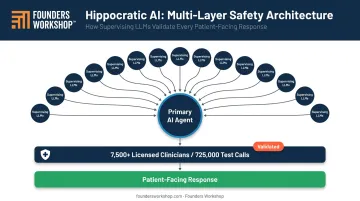
The differentiator is architecture. Hippocratic uses a multi-LLM supervision model with 19 LLMs overseeing the primary model, with output validation against a panel of more than 7,500 licensed US clinicians across 725,000 test calls. This architecture gives clinical leadership and risk committees a concrete basis for evaluating how the system maintains guardrails.
Real-world deployment supports the positioning. Universal Health Services deployed Hippocratic AI agents for post-discharge engagement at Summerlin Hospital Medical Center and Texoma Medical Center, contacting thousands of patients with an average satisfaction rating of 9.0/10.
| Category | Details |
|---|---|
| Key Healthcare Use Cases | Post-discharge follow-up, patient education, care coordination, chronic condition support, staff augmentation for non-diagnostic workflows |
| Compliance & Integration | HIPAA de-identification practices stated; BAA availability not publicly verified — confirm directly; strong clinical governance architecture |
| Best Fit For | Health systems and clinical programs that prioritize regulatory defensibility and tight clinical oversight |
Hyro
Hyro is an enterprise conversational AI platform founded in 2018, focused on healthcare organizations that need AI agents deployed at scale across voice, chat, and SMS. Its agents handle patient access, appointment scheduling, call deflection, intake, and routing across multiple service lines and departments.
The platform is trusted by 45+ health systems, and its deployment outcomes are among the most concrete in the market. At Intermountain Health, Hyro reduced call abandonment by 85% and improved speed-to-answer by 79%. Baptist Health reported nearly $1M in savings within three months with 79% call deflection for selected service categories. Tampa General Hospital saw average wait times drop 58% (from 6.2 minutes to 2.4 minutes) after deploying Hyro's voice agents.
For large health systems managing thousands of daily patient interactions across multiple departments, that kind of breadth matters more than custom-tailored builds.
| Category | Details |
|---|---|
| Key Healthcare Use Cases | Patient access automation, appointment scheduling, call deflection, FAQ handling, intake routing across departments |
| Compliance & Integration | HIPAA-compliant agents; SOC 2 compliant; integrates with major EHR and contact center platforms |
| Best Fit For | Large health systems and enterprise provider groups with mature IT governance and high patient interaction volumes |
Puppeteer AI
Puppeteer AI is a healthcare-focused AI voice agent builder designed for mid-market clinics and specialty practices. Its catalog covers inbound patient calls, appointment scheduling, outbound reactivation, post-visit follow-ups, intake, triage, benefits checks, and after-hours coverage , with both ready-to-deploy and custom-build options.
The workflow-first approach is practical: Puppeteer starts each engagement with a structured discovery workshop that maps current processes, identifies friction points, and defines success metrics before any build begins. That front-loaded scoping reduces implementation risk and speeds time to measurable value.
Outcomes from a 20+ sleep apnea clinic deployment illustrate the model (vendor-reported, not independently audited):
- 3,924 patient conversations initiated
- 1,768 scheduling links sent, with a 45.1% confirmation rate
- 1,500+ patients rescheduled, generating $2.1M in new revenue
The specificity makes these figures useful as directional benchmarks even without third-party verification.
| Category | Details |
|---|---|
| Key Healthcare Use Cases | Inbound patient calls, appointment scheduling, outbound reactivation, post-visit follow-ups, intake, basic medical Q&A |
| Compliance & Integration | HIPAA compliant; SOC 2 Type 2; integrates with scheduling systems, EHR, and CRM platforms |
| Best Fit For | Mid-market clinics, specialty groups, and digital health teams that need fast deployment with operational reporting |
IBM Consulting (watsonx)
IBM Consulting is a global technology services firm with deep US healthcare presence, deploying its watsonx AI platform for clinical documentation support, administrative automation, and health data analytics. The platform handles document extraction, classification, summarization, and workflow automation, with watsonx Orchestrate providing the agent layer for repetitive-task automation.
IBM's enterprise footprint is both its strength and its constraint. For large integrated delivery networks already operating within IBM's ecosystem, the combination of an established AI platform, HIPAA-ready controls, and SOC 2 certification across most regions makes it a defensible enterprise choice.
The Providence deployment is the clearest proof of scale: an IBM watsonx-powered HR agent that reduced hiring-manager administrative time by 90% across 51 hospitals.
Organizations outside the IBM ecosystem should weigh platform dependency carefully before committing.
| Category | Details |
|---|---|
| Key Healthcare Use Cases | Clinical documentation automation, administrative workflow support, EHR-integrated decision support, predictive patient risk analytics |
| Compliance & Integration | HIPAA-ready controls; SOC 2 certified in most regions; integrates with major EHR platforms — verify current HITRUST scope directly |
| Best Fit For | Large healthcare enterprises and integrated delivery networks already within or open to the IBM technology ecosystem |
How We Chose These AI Agent Developers
A common mistake healthcare buyers make is evaluating AI vendors on demo quality, brand recognition, or feature lists — rather than on what actually determines deployment success.
Gartner predicts at least 30% of GenAI projects will be abandoned after proof of concept, citing poor data quality, weak risk controls, escalating costs, and unclear business value. In healthcare, the stakes are higher. Compliance gaps and failed integrations create operational and regulatory exposure on top of the wasted budget.
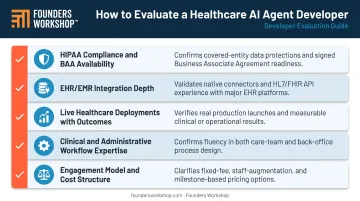
Evaluation criteria used for this list:
- Published HIPAA compliance documentation with confirmed BAA availability
- Demonstrated EHR/EMR integration with major platforms — not just a feature claim
- Live healthcare deployments with attributable outcomes, not adjacent industry case studies
- Technical depth for scoping and building specific clinical or administrative workflows
- Engagement model that matches the buyer's organizational size and complexity
Cost structure and scalability also factored in. Startups and SMBs can't absorb enterprise pricing, so this list includes partners offering nearshore delivery or usage-based models alongside larger platforms.
Conclusion
The right AI agent developer for healthcare isn't necessarily the largest or most recognized name. It's the one whose compliance posture, integration depth, workflow expertise, and delivery model align with your actual operational problems and growth stage.
Start with one workflow where delays, manual effort, or patient friction are already visible and costing you. Set clear success metrics before engaging any vendor. Then pressure-test proposed solutions against your real EHR environment and governance requirements — not just a demo environment — before committing.
For healthcare startups and growing clinics that match those criteria but need custom-built AI without enterprise-scale budgets, Founders Workshop is worth evaluating. The firm brings an AI-first development process, healthcare workflow experience, and nearshore Latin American delivery at roughly one-third of typical US development costs.
It's built for organizations that need production-ready solutions shipped — not prolonged pilots. Reach out for a discovery conversation to explore what's possible for your specific workflows.
Frequently Asked Questions
What is the difference between a healthcare AI agent and a healthcare chatbot?
A chatbot responds to prompts with scripted or retrieved answers. An AI agent executes multi-step workflows autonomously : routing a patient request, triggering a scheduling link, updating an EHR record, and escalating when needed. For operational healthcare tasks, agents deliver more value than information retrieval alone.
How much does it cost to build or deploy a healthcare AI agent?
Off-the-shelf platforms typically run mid-five to six figures annually; custom builds range from roughly $80,000 to $350,000 for a full MVP, with nearshore delivery cutting costs by up to two-thirds compared to US-only teams. Enterprise deployments with deep EHR integrations run considerably higher.
What compliance certifications should a healthcare AI agent developer have?
Look for HIPAA readiness with a signed BAA, audit logging, data encryption, and SOC 2 Type II certification. Enterprise deployments benefit from HITRUST certification as well — verify current scope with any vendor, since certification status can change.
Can small clinics and healthcare startups benefit from AI agents, or are they only for large health systems?
AI agents deliver value at any organizational size when applied to the right workflow. Smaller organizations often see faster results because operational pain points are easier to identify and scope. Custom development partners with nearshore delivery models make implementation economically viable without requiring an enterprise budget.
How long does it typically take to deploy a healthcare AI agent?
Ready-made platforms for specific workflows (scheduling, triage, call deflection) can go live in 3 to 8 weeks. Custom-built agents with deep EHR integrations typically take 2 to 5 months, depending on architecture complexity, integration scope, and compliance review cycles.
What are the highest-value use cases for AI agents in healthcare right now?
The strongest early use cases based on measurable ROI include:
- Revenue cycle management: prior auth, eligibility checks, and claims automation
- Patient access and scheduling: call deflection, routing, and appointment confirmation
- Post-visit follow-up: automated outreach and care coordination
- Clinical documentation: note generation, coding assistance, and visit summaries
- Back-office automation: intake, benefits verification, and administrative processing