Introduction
Last-mile delivery is where logistics economics get ugly. According to Capgemini's research, last-mile costs represent 41% of overall supply chain costs, averaging $10.10 per delivery — while customers typically pay only $8.08. Operators absorb that difference on every single drop.
The problem compounds at scale. Traffic patterns shift by the minute. Customers miss delivery windows. Drivers call out. Static route plans locked in the night before don't survive contact with a Tuesday morning in any major metro area.
AI changes this by moving last-mile operations from reactive and dispatcher-managed to predictive and continuously recalculating — rerouting in real time based on live traffic, failed attempts, and shifting capacity. For startups and SMBs building or scaling delivery operations, that capability is now accessible without enterprise-grade infrastructure.
This article breaks down how AI works in last-mile operations, where the real ROI shows up, what implementation obstacles look like, and how to build these capabilities without overengineering the starting point.
Key Takeaways
- Last-mile delivery eats 41% of supply chain costs — and static planning makes it worse as volume grows
- AI delivers real operational value through route optimization, predictive ETAs, automated exception handling, and smarter dispatching
- Data fragmentation and poor workflow integration are the real implementation barriers, not the algorithms
- BCG's 10-20-70 framework puts 70% of AI transformation success on organizational adoption, not the technology itself
- SMBs and startups don't need enterprise infrastructure — focused use cases with the right data foundation deliver early, measurable returns
What AI in Last-Mile Delivery Actually Means
AI-powered last-mile delivery uses machine learning, optimization algorithms, and real-time data streams to continuously manage how orders are routed, dispatched, tracked, and communicated to customers. The contrast with traditional systems is direct: static rule-based planning sets a route and holds it; AI treats every delivery window as a live variable.
The more important distinction is where AI sits in the operation.
AI creates value only when it's embedded into operational workflows — not when it sits in a reporting dashboard generating insights nobody acts on fast enough to matter. The difference between AI as a decision system and AI as an analytics layer is the difference between operational change and expensive noise.
For last-mile specifically, that means:
- Routing intelligence feeds directly into the driver's app
- Predictive ETAs trigger customer SMS notifications automatically
- Exception flags route to the dispatcher's queue — not a weekly report
The point isn't sophistication. It's integration. AI that informs a workflow delivers results; AI that observes one delivers reports.
Why Last-Mile Delivery Is So Costly and Complex
The economics don't scale cleanly. Urban congestion, fragmented drop density, labor volatility, and tight delivery windows all compound as order volume grows. You can't simply add trucks and maintain unit economics.
The Operational Uncertainty Problem
Dispatch plans made hours ahead of delivery assume conditions that rarely hold. Traffic shifts. A customer isn't home. A driver runs 20 minutes late at stop three and that delay cascades through seven more stops. Without real-time visibility, teams can't intervene until SLAs are already broken.
Most operations are still working with delayed or partial road visibility — which means the default mode is firefighting rather than prevention.
The Hidden Cost of Failed Deliveries
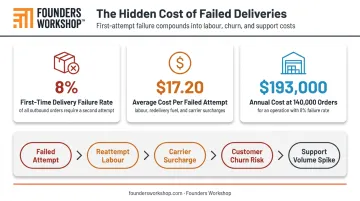
Loqate's research on US deliveries found that 8% of first-time deliveries fail, at an average cost of $17.20 per failed attempt. For a mid-sized operation running 140,000+ orders annually, that's roughly $193,000 in failed-delivery costs alone — before accounting for reattempt labor, customer churn, or the support volume that follows.
Returns amplify the pressure. The NRF projects $849.9 billion in US retail returns in 2025, with 19.3% of online sales being returned. Reverse logistics that aren't planned alongside forward delivery flows add cost at every stop.
ESG Adds Board-Level Pressure
Inefficient routing is no longer just a logistics KPI. MHI's 2024 Industry Report identifies sustainability and ESG as priority concerns now shaping supply chain decisions at the board level. Excessive fuel consumption and unnecessary miles driven require disclosure — putting route efficiency on executive agendas, not just operations dashboards. That's the environment in which AI-driven routing is getting serious budget attention.
How AI Improves Last-Mile Delivery Operations
Smarter Route Optimization
Traditional routing locks plans overnight. AI continuously recalculates based on live traffic, weather, new orders mid-shift, vehicle type, and driver availability. The result is fewer miles driven, less fuel burned, and more drops per hour without adding fleet capacity.
UPS's ORION system illustrates the scale of what's achievable: per BSR's case study, ORION reduced routes by 6 to 8 miles per driver per day, with projected savings of 100 million miles and 10 million gallons of fuel annually across the US network. Dynamic ORION extended this by updating routes throughout the day based on traffic and pickup commitments — not just at the start of shift.
Predictive ETAs and Intelligent Dispatching
ML models trained on historical delivery patterns and real-time signals generate tighter delivery windows and proactively rebalance driver loads before delays cascade. Capgemini found that 73% of consumers prioritize convenient delivery time slots over speed — yet only 19% of firms made time-slot specification a top priority. That's a significant gap AI closes directly.
The dispatcher role shifts with this capability. Instead of manually resolving delays as they emerge, teams move into exception oversight — reviewing flagged anomalies rather than managing every problem from scratch.
Automated Exception Handling
At scale, manual triage becomes a bottleneck. AI flags anomalies — missed deliveries, address errors, vehicle issues — as they occur, triggering automatic rerouting or reassignment and pushing customer notifications without dispatcher intervention. The practical result: the same dispatch team can handle a materially larger delivery operation without adding headcount.
Warehouse-to-Door Coordination
AI doesn't just optimize the road segment. Synchronizing pick-pack timing, inventory readiness, and outbound dispatch with last-mile capacity reduces dwell time at the warehouse and cuts failed handoffs. Proactive customer updates — "your delivery is 4 stops away" — reduce reattempt rates by keeping recipients informed and ready to receive.
Reverse Logistics Integration
Returns can't be treated as an afterthought when 19.3% of online orders come back. AI handles the reverse flow by:
- Clustering return pickups with active forward delivery routes
- Predicting return volumes ahead of scheduling windows
- Integrating reverse flows into daily driver assignments automatically
The outcome is lower cost per return — without dedicated return runs or added fleet capacity.
Top AI Use Cases for Last-Mile Delivery
| Use Case | Core Benefit | Key Metric |
|---|---|---|
| Real-time route optimization | Fewer miles, less fuel, more drops/hour | UPS: 6–8 miles saved per driver/day |
| Failed delivery prediction | Prevent reattempts before trucks leave | $17.20 avg cost per failed attempt (Loqate) |
| Smart driver allocation | Match drivers to zones by skill and familiarity | Reduces reactive rebalancing after failures |
| Predictive delivery windows | Narrow ETAs, improve first-attempt success | 73% of consumers prioritize time slots |
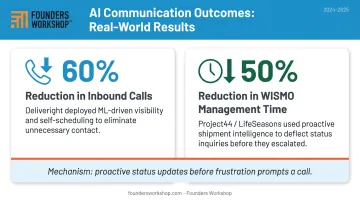
| Automated customer communication | Cut inbound support volume | Deliveright: 60% fewer inbound calls; project44/LifeSeasons: 50% less WISMO time |
The automated communication row is worth unpacking. Proactive updates don't just improve customer experience — they directly reduce the operational load on support teams.
Deliveright achieved a 60% reduction in inbound calls after deploying ML-driven visibility with self-scheduling options. Project44's work with LifeSeasons cut WISMO management time by 50%. In both cases, the mechanism was the same: customers got accurate status updates before frustration prompted a call.
Common Challenges When Implementing AI for Delivery
Data Fragmentation
Last-mile AI depends on unified inputs: order management, TMS, WMS, fleet telematics, traffic feeds, and customer interaction history. When these sources are siloed, incomplete, or delayed, models generate unreliable outputs — and dispatchers default to manual overrides, which eliminates the efficiency gains AI was deployed to create.
Data readiness must be assessed before any AI tool is deployed. A Gartner survey of senior supply chain leaders identified technology integration as a primary roadblock to scaling AI — and that finding holds at every company size, not just enterprise.
Workflow Integration Gaps
AI must be embedded inside dispatch and routing workflows. When routing intelligence doesn't feed the driver app in real time, or when predictive ETAs don't trigger customer notifications automatically, the result is analytical output with no operational impact.
This integration layer is frequently harder to build than the models themselves. The AI decision has to close the loop — each step dependent on the last:
- Flag the exception
- Update the route
- Notify the driver
- Message the customer
Any break in that chain and the value leaks out.
Organizational Adoption
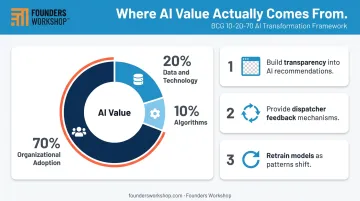
BCG's research validates what most implementations learn the hard way: 70% of AI transformation value comes from people and processes, with only 10% from algorithms and 20% from data and technology. Dispatchers who distrust opaque recommendations will override them. Drivers who ignore updated routes negate the optimization.
These aren't optional add-ons — they're operational requirements:
- Build transparency into AI recommendations so dispatchers understand the reasoning
- Provide feedback mechanisms so overrides inform future model behavior
- Retrain models as traffic patterns and demand shift over time
How to Build AI Capabilities Into Your Last-Mile Operations
Step 1 — Assess Operational and Data Maturity
Before selecting any tool or writing any code, map where your delivery data lives, how reliable it is, and which systems need to be connected. Identify the highest-friction failures in your current operation: missed deliveries, overtime, reattempt rates, dispatcher overload.
This foundation determines what's buildable now versus what requires infrastructure investment first. Skipping this step is why most implementations underperform.
Step 2 — Prioritize High-Impact, Narrow Use Cases
Don't attempt to AI-enable everything at once. Start with one or two use cases tied directly to cost or service KPIs:
- Route optimization — measurable in fuel cost and on-time delivery rates
- Failed delivery prediction — measurable in reattempt cost and first-attempt success rate
- Automated customer communication — measurable in inbound support volume
Run a controlled pilot in one region or delivery type. Validate the savings before scaling. This builds internal proof that speeds up buy-in across the organization.
Step 3 — Build or Integrate With AI-Native Systems
There's a meaningful architectural difference between embedding AI into dispatch workflows and layering analytics on top of them. Embedded AI closes the loop: a routing decision flows directly into the driver app and customer notification. Analytics layers produce reports that require humans to act on insights after the window for intervention has passed.
For startups and SMBs building delivery-tech products, this architectural choice is where custom development adds the most value. Founders Workshop works with early-stage companies to design and build AI-first software systems (logistics and operational applications included), using their 5D Process to take products from concept to market-ready. It's structured for teams that need to move fast without standing up large in-house engineering organizations.
Step 4 — Plan for Continuous Optimization
Once your system is live, the work isn't done. Deploying AI is not a one-time event — traffic patterns shift, demand fluctuates seasonally, and new delivery zones rarely match your training data. Models drift without maintenance.
Build feedback loops into the system from day one: exception logs that inform retraining, performance dashboards that track model accuracy over time, and dispatcher feedback mechanisms that surface edge cases the model hasn't seen. As the system matures, the team's role shifts naturally: manual dispatchers become exception managers, overseeing a system that handles routine decisions automatically.
Frequently Asked Questions
What is AI for last-mile delivery?
AI in last-mile delivery uses machine learning and real-time data to manage routing, dispatching, ETAs, and customer communication dynamically. It replaces static, rule-based planning with decision systems that adapt to live conditions — not overnight assumptions.
What is the 10-20-70 rule in AI, and how does it apply to last-mile delivery?
BCG's 10-20-70 framework holds that 10% of AI value comes from algorithms, 20% from data and technology, and 70% from organizational adoption. For last-mile delivery, that 70% — how well dispatchers, drivers, and workflows actually use the system — is where implementations succeed or fail.
Which jobs in last-mile delivery are least likely to be replaced by AI?
Roles requiring physical presence, real-world judgment, and relationship management are the least at risk: delivery drivers navigating novel situations, field supervisors, and customer-facing roles. AI primarily automates planning, dispatching, and communication tasks — not the physical execution layer.
How long does it take to see ROI from AI in last-mile delivery?
Measurable returns are possible within three to six months when deployment targets route optimization or failed-delivery prediction. Timelines depend heavily on whether data pipelines and system integrations are ready before go-live.
What data is needed to implement AI in last-mile delivery?
Core requirements include order management data, TMS and WMS feeds, fleet telematics, traffic and weather inputs, and customer interaction history. Data quality and unification matter far more than data volume alone.
Can small businesses and startups use AI for last-mile delivery?
Yes. SMBs and startups can see real returns by starting with focused use cases — route optimization or automated customer communication — and using purpose-built or custom-developed tools rather than enterprise platforms. The primary barrier is data readiness and clear operational goals, not company size.