
The gap between what you need to build and what you can afford to hire is real, and it's widening. Offshore IT staff augmentation isn't a novel concept — but most conversations about it stay abstract, focused on "global talent access" rather than the specific efficiency gains that actually move the needle for a growing business.
This article focuses on the concrete operational advantages: what offshore augmentation does for your cost structure, your hiring speed, and your team's flexibility — and how to make those advantages compound over time rather than evaporate after the first quarter.
Key Takeaways
- Nearshore IT staff augmentation embeds skilled developers — typically from Latin America — directly into your team, while the provider handles HR, payroll, and compliance
- Cost reduction is the most immediate gain — nearshore Latin American teams can cost roughly one-third of US hiring when total employment costs are factored in
- Speed-to-talent eliminates the 6-12 week hiring gap that stalls sprints and delays product launches
- Flexible capacity lets you scale up for a launch and scale back without severance, recruiting waste, or fixed overhead commitments
- Results improve significantly when augmented developers are onboarded with clear KPIs and treated as genuine team members — not outside contractors
What Is Offshore IT Staff Augmentation?
Offshore IT staff augmentation means hiring skilled technical professionals from another country through a staffing partner — and they work as a direct extension of your existing team. They use your tools, follow your workflows, attend your standups, and report to you. The provider handles the administrative side behind the scenes.
How It Differs from Outsourcing
The distinction matters more than most people realize:
| Factor | Staff Augmentation | Outsourcing |
|---|---|---|
| Who owns priorities? | You | The vendor |
| Who manages the work? | You | The vendor |
| Integration with your team | Full — they're your team | Separate — they're a contractor |
| Accountability | Direct | Through deliverable specs |
| Flexibility | High | Lower — scope-bound |
In outsourcing, a vendor owns the deliverable and manages their own process. In augmentation, the offshore professionals are your team members. That distinction determines whether you get genuine operational efficiency or just a service delivery relationship.
The point isn't to "have offshore staff." It's to close skill gaps, accelerate delivery, and reduce costs so the business ships faster. For US companies working with nearshore Latin American teams — same timezone, shared language, cultural alignment — that efficiency compounds further. Teams that approach it this way get lasting results; teams that treat it as a one-time staffing fix rarely do.
Key Efficiency Advantages of Offshore IT Staff Augmentation
The advantages below are tied to measurable operational outcomes — cost, speed, capacity, and agility. They're most impactful when the augmentation model runs as an ongoing operational strategy, not a short-term patch.
Advantage 1: Significant Cost Reduction Without Sacrificing Technical Quality
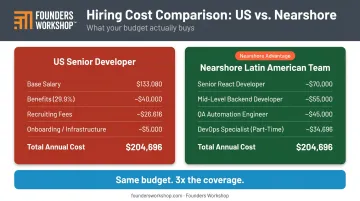
Hiring a senior software developer in the US isn't just a salary decision. The Bureau of Labor Statistics reports that private-industry benefits averaged 29.9% of total compensation as of December 2025, with professional and technical services running $74.63/hour in total employment cost — wages plus benefits combined.
That's before recruiting fees, onboarding time, or any office infrastructure.
The staffing partner absorbs administrative overhead — payroll, benefits, local labor law compliance — while the client pays a predictable monthly rate. Budget that would otherwise fund a single US senior engineer now covers multiple specialists.
For nearshore Latin American models, the savings go further. Founders Workshop positions their nearshore augmentation at one-third the cost of US-based teams, a figure demonstrated across long-term client engagements.
Their eight-year partnership with WellPsyche — where nearshore staff supported the company from startup through scaling — shows how this compounds over time rather than delivering a one-time win.
KPIs impacted:
- Cost per developer/hour
- Total development budget burn rate
- Time-to-productive-hire
- Overhead cost per team member
- Recruitment spend per role
When this advantage matters most: Post-funding buildouts, rapid scaling phases, or any situation where you need to extend technical runway without taking on equity obligations or large fixed payroll commitments.
Advantage 2: Faster Access to Specialized IT Talent, On Demand
One of the most expensive inefficiencies in software development has nothing to do with writing bad code. It's the gap between identifying a need (mobile developer, AI engineer, DevOps specialist) and actually getting that person productive on your team.
CompTIA's State of the Tech Workforce report shows tech occupations are projected to grow at roughly 2x the overall employment rate, with about 350,000 annual replacement openings each year. That demand pressure means quality engineers aren't sitting idle waiting to be hired.
A delayed hire doesn't just create an empty seat. It typically means:
- Existing team members cover roles outside their expertise
- Sprint velocity drops as coverage gaps compound
- Product deadlines shift, sometimes by weeks or months
- McKinsey has documented that delayed product launches cost companies billions in aggregate across industries
Reputable providers maintain pre-vetted networks across technology stacks. Founders Workshop, for example, can begin work in as little as two weeks, compared to three to six months for a traditional in-house hire. The provider handles sourcing and technical screening upfront; you skip directly to integration.
KPIs impacted:
- Time-to-hire
- Time-to-productive-contribution
- Sprint velocity
- Feature delivery rate
- Release cycle frequency
- Skill coverage gaps per quarter
When this advantage matters most: Product launches, major version releases, or when a specific technical capability (AI integration, cloud migration, mobile development) is needed mid-project and can't wait for a traditional search.
Advantage 3: Scalable Team Capacity Without Administrative Overhead
In-house teams create fixed capacity. When a major feature ships and you need fewer engineers, you can't easily scale back without severance costs, legal exposure, or the organizational complexity of layoffs. Scaling up carries the same friction — weeks of recruiting before you see any output.
Offshore augmentation separates team size from long-term headcount commitments. You can add specialists for a sprint cycle or a major launch, then scale back when the work is done, without the financial or organizational friction that makes in-house adjustments so costly.
SHRM's 2025 benchmarking data shows organizations allocate an average 26% of their total HR budget to recruiting alone. Add benefits administration, compliance management, and workforce overhead, and the administrative load on a growing tech team is substantial. Augmentation providers absorb that entire infrastructure.
The client's responsibility stays focused on product direction and delivery outcomes, not workforce management.
KPIs impacted:
- Headcount flexibility ratio (planned vs. actual team size adjustments)
- Overhead cost per productive developer hour
- Project ramp-up time
- Administrative hours spent on workforce management per month
Best fit: Startups under funding constraints, SMBs managing fluctuating project loads, and teams navigating new product lines where scope and required skills are still evolving.

What Happens When Offshore Augmentation Is Missing
The pattern is predictable. A company tries to scale technically through traditional local hiring. Recruiting timelines stretch out. Critical roles stay vacant for two to three months. Senior engineers get pulled into tasks outside their expertise to cover gaps — and quality degrades while the root cause (an unfilled seat) sits unaddressed.
The costs compound quickly:
- Recruiting budgets drain without guaranteed results — average cost-per-hire approaches $4,700 according to SHRM, and that figure climbs substantially for technical roles
- Missed deadlines create downstream losses in revenue, investor confidence, and market positioning
- Fixed overhead becomes unsustainable during slower periods, when a fully in-house team still requires the same payroll commitment
There's also a harder ceiling that rarely gets named directly. Without flexible augmentation capacity, many SMBs and startups hit a wall on what they can build and ship — limited not by market demand or product vision, but by the availability and affordability of local technical talent.
That constraint has a real cost: delayed launches, slower iteration cycles, and opportunities handed to competitors who staffed up faster.
How to Get the Most Efficiency from Offshore IT Augmentation
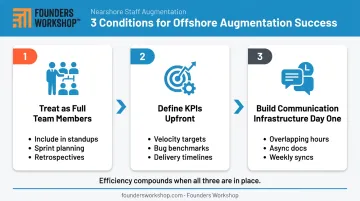
Offshore augmentation delivers compounding efficiency when three conditions are consistently met:
- Treat augmented staff as genuine team members — include them in standups, sprint planning, and retrospectives. Teams that isolate offshore staff into a separate workflow see the productivity gap widen over time, not close
- Define KPIs and deliverables upfront — sprint velocity targets, bug rate benchmarks, feature delivery timelines. Vague expectations produce vague results regardless of where the developer sits
- Build communication infrastructure on day one — overlapping work hours, async documentation practices, and weekly syncs shouldn't be improvised after the engagement starts
Partner Selection Is Where Efficiency Is Made or Lost
The right provider brings more than available developers. They bring pre-vetted talent, a structured placement process, and accountability mechanisms that protect quality over time.
Founders Workshop's model puts US-based business analysts and project leads in charge of strategic direction and client communication, while nearshore Latin American developers handle technical delivery. Keeping communication onshore and execution nearshore eliminates the timezone gaps and handoff delays that cause most augmentation engagements to stall.
The Ramp Period Is Not Optional
Efficiency gains are not immediate. The first two to four weeks are an investment in knowledge transfer and workflow alignment. Teams that push for immediate output and skip this phase typically see quality and speed benefits erode within a few months — not because the offshore model failed, but because the foundation was never set.
Use the ramp period to document systems, clarify ownership, and establish communication rhythms. That groundwork pays dividends for every sprint that follows.
Conclusion
Offshore IT staff augmentation drives efficiency through three compounding mechanisms: cost reduction that frees budget for growth, on-demand access to specialized talent that eliminates hiring delays, and flexible capacity that removes administrative overhead. Each factor improves output quality and financial sustainability on its own — but the real gains come when all three work together.
The companies that see sustained efficiency gains are the ones treating augmentation as an ongoing operational strategy: clear KPIs, structured communication, and a partner who takes integration as seriously as sourcing. Those that treat it as a one-time staffing patch get a one-time result. The difference between a temporary fix and a compounding advantage comes down to how deliberately the engagement is structured from day one.
Frequently Asked Questions
What is offshore staff augmentation?
Offshore IT staff augmentation is a model where companies hire skilled technical professionals from another country through a staffing partner. Those professionals work as an integrated part of the client's existing team under direct client management, while the provider handles payroll, compliance, and HR administration.
How much can businesses typically save with offshore IT staff augmentation?
Latin American nearshore teams typically deliver savings of 60–70% compared to fully-loaded US developer costs. That gap widens further when you factor in recruiting fees, benefits (averaging 29.9% of compensation per BLS data), and administrative overhead — costs a staffing partner absorbs on your behalf.
What is the difference between offshore and nearshore staff augmentation?
Offshore refers to hiring from distant regions with 8–14 hour time zone gaps, such as Eastern Europe or South Asia. Nearshore means hiring from closer regions — for US companies, that's typically Latin America — with overlapping work hours, stronger cultural alignment, and comparable cost savings. For most US teams, nearshore delivers the better day-to-day working relationship.
How quickly can an offshore IT team be onboarded and productive?
With pre-vetted talent, initial placement typically happens within two weeks. Full productivity follows in another two to four weeks, covering knowledge transfer, workflow alignment, and tooling setup — so budget roughly six weeks from kickoff to full stride.
What are the biggest risks of offshore IT staff augmentation and how are they managed?
The primary risks are communication gaps, quality inconsistency, and data security. Managed well, each is addressable: overlapping work hours close the communication gap, defined KPIs and code standards enforce quality, and NDAs plus role-based access controls protect sensitive data. Nearshore arrangements reduce communication friction considerably versus far-offshore alternatives.
How do you maintain quality and accountability with an offshore IT team?
Quality is maintained through defined KPIs — sprint velocity, bug rates, code review outcomes — combined with regular standups, integration into the same project management tools as the in-house team, and treating offshore staff as full team members rather than external contractors. Clear structure — defined roles, documented standards, and consistent check-ins — drives accountability regardless of where the team is located.