Introduction
When a major storm knocks out power for thousands of customers simultaneously, every one of them reaches for the phone. Contact centers at large utilities can field millions of inbound calls annually — PSEG, for example, operates with over 750 active agent licenses just to keep pace. Yet J.D. Power's 2026 U.S. Utility Digital Experience Study found overall utility digital satisfaction at just 616 out of 1,000, and nearly one-third of utilities still lack a mobile app.
Those numbers reveal a real gap between what customers expect and what most utilities deliver. Billing disputes, outage updates, payment processing, service requests — these interactions happen at scale every day, and routing them all to live agents isn't sustainable.
Conversational AI addresses this directly — a practical tool for reducing wait times, containing call volume, and delivering consistent responses across every channel.
Key Takeaways
- Conversational AI uses NLP-powered virtual agents to automate billing, outage, payment, and service request interactions across voice, chat, and SMS
- 24/7 automated support deflects routine inquiries from live agents, reducing cost per contact and improving response times
- Proactive outage communication moves providers from reactive to proactive, with multi-touch outage updates linked to measurably higher customer satisfaction scores
- Process automation handles payment processing, account updates, and meter submissions end-to-end
- Maximum ROI comes from deep integration with billing systems, CRM, and outage management tools — not from standalone FAQ bots
What Is Conversational AI in Energy Services?
Conversational AI refers to NLP-powered systems — chatbots, voice bots, virtual agents — that understand natural language and engage customers in real-time dialogue. Unlike rule-based chatbots that follow fixed decision trees, these systems interpret intent, pull live account data, and complete interactions contextually.
Where It's Applied in Energy
In energy services, conversational AI touches two distinct areas:
Customer-facing interactions:
- Billing inquiries and payment processing
- Outage status updates and restoration estimates
- Service activation and disconnection requests
- Meter reading submissions
- Account updates and service address changes
Internal workflows:
- Field technician support and dispatch coordination
- Compliance documentation retrieval
- Internal knowledge base queries
Conversational AI isn't a technology deployed for its own sake. Its purpose is to reduce friction — for customers who need answers quickly, and for operations teams managing high transaction volumes without scaling headcount to match. The strongest deployments start with a clear problem: which interactions are repetitive, time-sensitive, and currently handled by staff who could be doing higher-value work.
Key Advantages of Conversational AI in Energy Services
The advantages below reflect operational outcomes energy companies actively track: cost, efficiency, customer satisfaction, and service reliability. Each one maps to KPIs that contact center leaders and operations executives already monitor.
24/7 Intelligent Customer Support at Scale
AI-powered virtual agents handle routine customer inquiries — billing questions, payment processing, service activations, meter reading submissions — around the clock, without live agent involvement.
The mechanics are straightforward: NLP interprets customer intent (for example, "Why is my bill so high this month?"), retrieves relevant account data from integrated systems, and completes the interaction. No queue, no hold time, no agent required.
This matters because the workload is substantial. According to McKinsey, 50–60% of all customer interactions remain transactional — routine queries that follow predictable patterns and don't require human judgment. In utilities specifically, billing-related calls account for 7–10% of total contact volume, and at one central U.S. utility, just 5% of customers drove 60% of all payment-assistance calls.
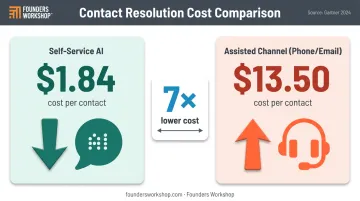
Gartner's 2024 benchmark puts the median cost per contact at $1.84 for self-service versus $13.50 for assisted channels like phone and email. Deflecting even a fraction of high-volume routine calls produces measurable savings.
Resolution speed matters too. J.D. Power found gas utility business customers who resolved issues in 10 minutes or less scored 863/1,000 on satisfaction — versus 817 for those spending over an hour.
KPIs impacted: first-contact resolution rate, average handle time, call containment rate, CSAT, cost per interaction
When it matters most: billing cycle peaks, post-storm call surges, seasonal usage spikes — when volume jumps and human capacity hits its ceiling
Proactive Outage and Crisis Communication
Most energy providers are reactive during outages: customers call in, agents answer, wait times spike. Conversational AI flips that dynamic.
AI systems handle both sides of the communication gap during an outage:
- Cross-reference account data to identify customers in affected service areas
- Trigger outbound SMS or voice notifications before customers pick up the phone
- Answer inbound status calls automatically with estimated restoration times pulled from live outage management systems
J.D. Power's 2025 Electric Utility Business Customer Satisfaction Study found that 74% of business customers experienced a power outage, and those receiving five or more points of contact during an outage scored 699 on safety and reliability satisfaction — 210 points higher than customers who received no information.
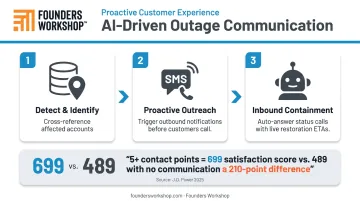
A 210-point swing. That difference comes from communication frequency, not how fast the lights came back on.
There's also a containment benefit that pays off immediately during major events. When thousands of customers lose power simultaneously, the contact center becomes overwhelmed within minutes. Conversational AI absorbs that inbound spike — answering outage status queries automatically — while freeing agents to handle escalations and complex cases.
KPIs impacted: inbound call deflection rate during outage events, customer retention rate, outage-related complaint volume, average response time
When it matters most: weather-related outages, infrastructure failures, and large planned maintenance windows affecting concentrated customer populations
Operational Cost Reduction Through Process Automation
Conversational AI doesn't just answer questions — it completes transactions. A customer can make a payment, update their service address, submit a meter reading, or schedule a technician visit entirely through an AI interaction, with no agent involved and no manual data entry required.
This works through API integration. Virtual agents connect to billing systems, CRM platforms, and outage management tools — enabling end-to-end transaction completion without routing customers to a live agent.
One leading energy company, after integrating an AI voice assistant with its back-end workflow, reduced billing call volume by approximately 20% and cut customer authentication time by up to 60 seconds per interaction — documented by McKinsey.
At scale, the numbers are harder to ignore. DEWA's AI assistant Rammas handled 2 million inquiries in 2024 — up 10% year-over-year — and has autonomously processed over 9.2 million customer inquiries since its 2017 launch. Replicating that volume through human-only service would require hundreds of additional agents.
Beyond cost, automated data capture reduces errors. Meter readings submitted through guided chat interactions are more accurate than manually transcribed calls, which reduces billing disputes and the downstream cost of resolving them.
KPIs impacted: cost per contact, agent utilization rate, billing dispute rate, self-service adoption rate, operational overhead as a percentage of revenue
When it matters most: providers managing high transaction volumes, seasonal demand fluctuations, or growth without proportional headcount budget increases
What Happens When Conversational AI Is Missing
The status quo has measurable costs. The ACSI 2025 Energy Utilities Study reported residential energy utility satisfaction at 74/100, with call-center satisfaction declining to 73. Those scores reflect customers waiting on hold, missing outage updates, and hitting systems that can't complete basic transactions.
Specific consequences include:
- Agent capacity erosion — when 50–60% of interactions are transactional and handled manually, skilled agents spend their shifts on work that offers no customer relationship value
- Outage communication failures — reactive-only communication during service disruptions accelerates complaint volume and damages trust that takes months to rebuild
- Scaling costs that compound — without automation, adding customer service capacity means adding headcount proportionally, making efficient growth difficult to sustain
- Digital satisfaction gaps — J.D. Power found only 16% of utility digital experiences delivered proactive guidance, personalized usage data, or bill-reduction strategies
Customers now benchmark their utility's digital experience against the best apps they use daily — and the gap is hard to ignore.
How to Get the Most Value from Conversational AI in Energy Services
Deployment decisions matter as much as the technology itself. Three principles separate high-ROI implementations from average ones:
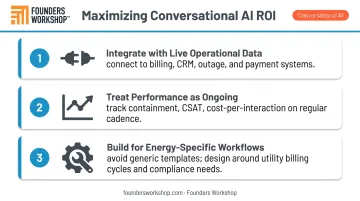
1. Integrate with live operational data An AI that can only answer FAQ-style questions is a glorified search bar. Maximum value comes from connecting the virtual agent to billing systems, outage maps, payment processors, and CRM platforms via APIs. That integration is what separates an AI that answers questions from one that actually resolves them.
2. Treat performance as ongoing, not fixed Track call containment rates, CSAT, cost-per-interaction, and escalation paths on a regular cadence. AI performance improves with iteration — understanding where handoffs to live agents happen too early (or too late) is how the system gets better over time.
3. Build for energy-specific workflows, not generic templates Off-the-shelf conversational AI tools are built for horizontal use cases. They weren't designed around utility billing cycles, outage management systems, regulatory compliance requirements, or the specific call patterns of energy customers. For providers with unique workflows, legacy system constraints, or state-level compliance obligations, a custom-built solution delivers a far better outcome.
Founders Workshop applies a structured 5D Process (Discovery, Definition, Development, Deployment, and Dedicated Developer support) that translates complex operational requirements into market-ready AI solutions. The approach starts with understanding the specific realities of the energy business, not adapting a generic template around them.
Post-deployment, the Dedicated Developer phase (80–160 hours/month) supports continuous refinement as the system learns from real interactions and operational data.
Conclusion
Conversational AI earns its place in energy services by solving problems that don't have easy staffing solutions: contact volumes that spike without warning, customers who want outage updates at 2 a.m., and billing inquiries that tie up agents for calls that rarely require human judgment. The operational and financial case is straightforward:
- Handles high contact volumes without adding headcount
- Delivers accurate, proactive communication across billing, outages, and service requests
- Reduces per-interaction costs without degrading service quality
None of these advantages arrive fully formed on day one. They compound as the system connects more deeply with operational data, takes on more nuanced request types, and builds a track record of real customer interactions to learn from.
The energy companies that see the strongest long-term results treat conversational AI as a capability to develop, not a tool to install. That means iterating on conversation flows, expanding integrations over time, and measuring outcomes against real service benchmarks — not just launch metrics.
Frequently Asked Questions
What is conversational AI in the energy sector?
Conversational AI refers to NLP-powered virtual agents — chatbots, voice bots, SMS assistants — that handle customer interactions by understanding intent and responding contextually. In energy services, they manage billing inquiries, outage updates, payment processing, and service requests across phone, web chat, and SMS channels.
How does conversational AI reduce costs for energy companies?
It automates high-volume routine interactions — billing questions, payments, account updates — that would otherwise require live agents. Gartner benchmarks the cost gap at $1.84 per self-service contact versus $13.50 for assisted channels. Deflecting a significant share of routine volume produces direct, measurable savings.
Can conversational AI handle outage-related customer calls?
Yes. AI systems can proactively notify customers in affected areas via SMS or voice, and simultaneously handle inbound outage status queries — including estimated restoration times — without live agent involvement. This contains call volume during the highest-pressure events.
What is the difference between a rule-based chatbot and conversational AI?
Rule-based chatbots follow fixed decision trees and break down outside pre-scripted scenarios. Conversational AI uses NLP and machine learning to understand natural language and context, making it capable of handling varied, unpredictable queries — including follow-up questions, rephrased requests, and mid-conversation topic shifts.
How long does it take to implement a conversational AI solution for an energy company?
Timeline depends on integration complexity, legacy system environments, and regulatory requirements. A custom-built solution typically takes 3–6 months from discovery to deployment, delivering substantially better fit with energy-specific workflows than off-the-shelf alternatives.
Is conversational AI in energy services secure and compliant with data regulations?
Properly built solutions use end-to-end encryption and role-based access controls to meet applicable compliance standards. Energy companies handling payments should verify PCI-DSS v4.0.1 compliance, and solutions should align with relevant federal and state data privacy regulations from the outset.