
That math breaks down fast on extended engagements. The global staff augmentation market reached $122.54 billion in 2025 and is projected to hit $201.53 billion by 2032, which signals how many companies have already figured out that augmented teams beat full-time hires for scaling technical capacity without the overhead.
What most budgets miss: pricing for long-term augmentation isn't a single number. It's a function of engagement model, geography, seniority, and project complexity — and picking the wrong structure can quietly inflate your total spend by months 6 or 9.
This article breaks down typical cost ranges, the variables that move the number most, and which pricing models actually hold up over a 12+ month engagement.
Key Takeaways
- Long-term IT staff augmentation typically costs $4,000–$24,000/month per developer, depending on model and region
- For extended projects, retainer and dedicated team structures consistently outperform time-and-materials pricing on total cost
- Geography is the biggest cost lever: nearshore Latin American teams deliver 30–65% savings versus U.S. onshore rates, with same-timezone collaboration
- Hidden costs — onboarding, attrition, compliance — can add 15–30% to your real total if not planned for upfront
How Much Does IT Staff Augmentation Cost for Long-Term Projects?
There's no flat rate. Costs vary dramatically based on engagement model, team size, developer seniority, and geography — and for long-term projects, these variables compound over time.
Two mistakes come up constantly in budget planning:
- Budgeting only for the monthly rate without accounting for ramp-up time, attrition risk, and compliance overhead
- Assuming the cheapest hourly rate produces the cheapest 12-month outcome — it rarely does
Typical Cost Ranges by Region
The table below uses Clutch's software development pricing data as a reference point, estimated at 160 billable hours per month.
| Tier | Hourly Range | Est. Monthly/Developer | Notes |
|---|---|---|---|
| Nearshore (Latin America, Eastern Europe) | $25–$99/hr | $4,000–$15,840 | Wide range depending on country, seniority, and vendor |
| Offshore (Asia, Africa) | $25–$49/hr | $4,000–$7,840 | Lower coordination costs embedded in rate; excludes client PM, onboarding, compliance |
| Onshore (U.S./Canada) | $100–$149/hr | $16,000–$23,840 | Justified for compliance-heavy industries or on-site requirements |
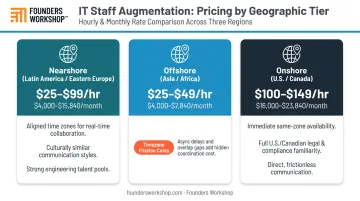
The offshore range looks appealing until you factor in timezone friction and coordination overhead. Rice Business research found that a one-hour increase in temporal distance reduced synchronous communication by 11% — a real cost that doesn't show up on any invoice.
Long-Term vs. Short-Term Cost Dynamics
Extended engagements (6+ months) carry different economics than short-term contracts. Vendors typically offer volume pricing for longer commitments, ramp-up costs spread across more months, and teams that stabilize over time deliver more output per sprint — lowering the effective cost per feature shipped.
Total cost of ownership (TCO) is the right metric for long-term planning. Hourly rate is just one input. TCO for an augmented team typically includes:
- Monthly developer rates (the visible line item)
- Onboarding and ramp-up time (often 2–4 weeks per developer)
- Client-side project management and coordination overhead
- Compliance costs (contracts, IP agreements, local labor law considerations)
- Attrition risk and replacement costs if turnover occurs
Key Factors That Drive IT Staff Augmentation Costs
Pricing in long-term staff augmentation is shaped by technical, geographic, and operational variables. Understanding each one prevents budget surprises at month six.
Developer Seniority and Role Complexity
Seniority is one of the clearest cost drivers. According to Robert Half's 2026 salary data, U.S. compensation benchmarks look like this:
- Software Engineers: $109,250–$175,500 (midpoint $142,000)
- DevOps Engineers: $118,000–$173,750 (midpoint $145,750)
- AI/ML Engineers: $134,000–$193,250 (midpoint $170,750)
These are salary figures, not augmentation bill rates — but they illustrate the seniority gap that translates directly into rate differences across vendors.
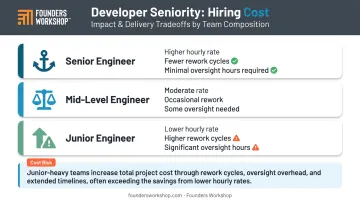
For long-term projects, skimping on seniority is a false economy. Junior-heavy teams produce more rework, require more oversight, and slow delivery on complex builds. Most 6–12 month engagements benefit from anchoring the team with at least one or two senior engineers.
Tech Stack and Specialization
In-demand specializations carry meaningful premiums. Dice's 2025 Tech Salary Report found that tech professionals responsible for AI solutions earn 17.7% more than peers not working in AI. Robert Half data puts AI/ML Engineers approximately 20% above general software engineers at the midpoint.
DevOps and cybersecurity premiums are less consistent. BLS data shows Information Security Analysts ($124,910 median) earning slightly less than Software Developers ($133,080 median), so the premium depends heavily on role, seniority, and market.
Budget for a specialization premium on AI/ML work specifically. For DevOps and cloud, evaluate candidates individually rather than assuming a blanket 30–50% markup.
Geographic Location
This is the single biggest lever in a long-term budget. Using Clutch's ranges:
- Nearshore/offshore at $25–$49/hr = roughly 17–49% of U.S. onshore rates
- Nearshore at $50–$99/hr = roughly 34–66% of U.S. rates
The common claim that Latin America costs "one-third of U.S. rates" is accurate at the lower end of the nearshore range. Well-qualified nearshore teams often come in at 35–65% of U.S. rates depending on the country, seniority, and vendor.
For long-term projects with daily standups and iterative delivery, timezone overlap has a real cost. Price in async communication overhead before comparing headline rates.
Project Scope, Team Size, and Duration
Larger teams, defined scopes, and longer commitments unlock better vendor pricing. Most vendors offer volume discounts or reduced per-seat rates at 6+ month commitments.
Under-scoping at the start is one of the most common causes of mid-engagement rate renegotiation. If scope expands significantly in month four, expect pricing conversations.
Pricing Models for Long-Term IT Staff Augmentation
The billing structure governs how risk is distributed, how flexible you can be, and how predictable your monthly spend will be. That calculus shifts significantly for projects running 6–18+ months.
Time and Materials (T&M)
You pay for hours worked, typically billed at an agreed hourly rate per role. T&M works well when requirements are still evolving: discovery phases, prototyping, early product exploration.
Without strong governance, scope drift accumulates month over month — making T&M a poor primary model for a 12-month build. Where it does work long-term: as a supplement for ad-hoc needs within a larger retainer or dedicated team arrangement, not as the core billing structure.
Monthly Retainer
A fixed monthly fee for a defined allocation of developer time. This model delivers cost predictability and team continuity, which matter enormously when you're 8 months into a build and shipping features weekly.
The tradeoff is governance. Retainers require clear SLAs and deliverable expectations — paying for 160 hours/month and using 90 is a budget leak.
Founders Workshop structures its nearshore staff augmentation around this model, giving startups and SMBs access to a senior Latin American development team at roughly a third of U.S. costs with same-timezone collaboration. Their 8-year engagement with WellPsyche shows what a well-managed retainer looks like at scale.
Dedicated Team Model
A full-time team (developers, QA, PM, designer) exclusively assigned to your project and billed monthly. The vendor handles payroll, benefits, and retention. You direct the work.
Cost structure: monthly fee = (team composition × per-role rate) + vendor management fee
The vendor absorbs HR overhead. The client manages backlog, priorities, and delivery quality.
This model is ideal for multi-year product development or companies building a core software platform where deep team integration compounds in value over time.
Hybrid Model
A retainer or dedicated team for the core workload, with T&M or hourly-bucket arrangements for surge sprints or specialized skills brought in for one phase.
This is the most practical structure for long-term projects with variable complexity. You get cost predictability on the base team and flexibility when requirements spike.
Fixed-Price for Long-Term Projects
Fixed-price contracts are generally a poor fit for extended engagements, since requirements evolve too much over 12+ months. Where fixed-price can work: clearly defined phases within a larger program (for example, a fixed-price discovery or MVP phase), not the full multi-month engagement.
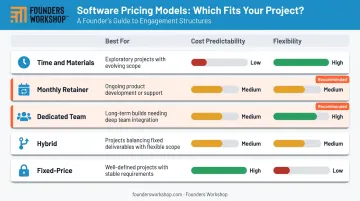
| Model | Best For | Cost Predictability | Flexibility |
|---|---|---|---|
| Time & Materials | Evolving requirements, ad-hoc work | Low | High |
| Monthly Retainer | Ongoing teams, feature delivery | High | Medium |
| Dedicated Team | Multi-year builds, platform development | High | Medium |
| Hybrid | Long projects with variable scope | Medium–High | High |
| Fixed-Price | Defined phases (discovery, MVP) | Very High | Low |
Hidden Costs and Common Pricing Mistakes
Onboarding and Ramp-Up Time
New augmented developers don't hit full productivity on day one. They need time to understand the codebase, get access provisioned, and learn the team's working rhythm. This ramp-up period is a real cost that won't appear in any monthly rate quote.
On a short project, onboarding eats a large percentage of total hours. On a 12-month engagement, the same cost gets amortized across many more months — which is one reason long-term engagements have better economics. Vendors with pre-vetted, project-ready teams (who can start contributing quickly) reduce this burden considerably.
Attrition and Replacement Risk
Developer turnover mid-project is one of the most disruptive and underbudgeted costs in long-term augmentation. When a developer exits at month five, you lose their context, their codebase familiarity, and their workflow integration.
What to require in contracts:
- Named-backup provisions
- Defined notice periods (minimum 2–4 weeks)
- Knowledge transfer obligations before exit
Vendors who invest in their own talent retention — development plans, competitive benefits, team culture — keep attrition low. On a 12-month commitment, that's worth a modest premium.
Compliance and Regulatory Overhead
Regulated industries face additional cost layers. IBM's 2024 report put the global average cost of a data breach at $4.88 million, the direct result of inadequate vendor security controls.
For healthcare (HIPAA), fintech (PCI DSS), or platforms undergoing SOC 2 review, budget for:
- Security review and audit evidence preparation
- Vendor access control documentation
- Legal oversight of data handling agreements
- Potential compliance training for augmented staff
Offshore teams without robust compliance infrastructure can generate substantial unexpected costs in long-term engagements. Nearshore vendors with direct U.S. regulatory exposure — teams that have already delivered healthcare or fintech platforms — already understand HIPAA audit requirements and PCI DSS controls, reducing the expensive training cycles that erode your budget.
How to Estimate and Optimize Your Long-Term Staff Augmentation Budget
Start with TCO, Not Hourly Rate
A practical planning model for a 6–18 month engagement:
- Base cost: monthly rate × team size × engagement duration
- Add 15–20% buffer for ramp-up, scope expansion, and compliance overhead
- Add client-side overhead: PM time, security review, tool/access costs
- Add contingency: attrition or rework risk
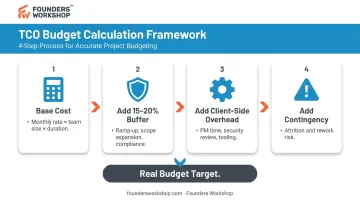
This gives a real budget target, not an optimistic one.
Match Model to Project Phase
The most effective structure for long-term engagements:
- Start with a short T&M discovery phase (2–4 weeks) to clarify scope, team composition, and technical requirements
- Transition to a Retainer or Dedicated Team model for the build phase — cost predictability over the bulk of the engagement
That discovery-first approach is how Founders Workshop structures its 5D Process — clients scope requirements before committing to a full development team. The Discovery phase runs 2–4 weeks and directly informs team composition and budget, reducing the scope ambiguity that leads to mid-project renegotiations.
Evaluate Vendors on Value, Not Just Rate
Extremely low hourly rates often mask real inefficiencies:
- Poor communication requiring more client PM time
- High attrition generating repeated ramp-up cycles
- Rework from under-specced developers
None of these show up on a rate card. By month ten, they surface in your delivery timeline and your total invoice.
Evaluate vendors on:
- Team seniority and role composition
- Process maturity and governance approach
- Timezone alignment with your internal team
- Track record with similar-length engagements
Frequently Asked Questions
What is the pricing model for staffing?
The most common IT staff augmentation models are hourly/T&M, monthly retainer, dedicated team, fixed-price, and hybrid. For short-term or evolving work, T&M fits well. For engagements of 6+ months, retainer or dedicated team structures offer better cost predictability and team continuity.
What is a good staff cost ratio?
For most SMBs and tech-focused startups, labor costs run 15–35% of revenue — though the target varies by growth stage. Nearshore augmentation helps reduce this ratio by eliminating benefits, recruiting overhead, and full-time employment costs. Vendors bundle those into the bill rate, which typically runs well below the fully-loaded cost of an equivalent U.S. hire.
How do you reduce staffing costs?
The highest-impact moves are:
- Choose nearshore over onshore talent for comparable quality at lower rates
- Use a retainer or dedicated team model for long-term work instead of premium hourly rates
- Pre-scope projects clearly before committing to avoid costly mid-engagement changes
Is staff augmentation considered outsourcing?
Yes — staff augmentation is a form of outsourcing, but it differs from managed services because the client retains direct management control over the augmented staff. The vendor supplies the talent; the client directs the work, priorities, and delivery.
What is the best pricing model for a long-term IT project?
Monthly retainer or dedicated team for engagements of 6+ months. Both deliver cost predictability, team consistency, and the deep workflow integration that makes a long-term engagement genuinely more productive over time.
How does nearshore staff augmentation compare to offshore in terms of cost?
Nearshore rates (Latin America) are higher than deep offshore (Southeast Asia), but the gap narrows when you factor in coordination overhead. Overlapping timezones and stronger communication alignment reduce the hidden management costs that make cheap offshore teams expensive over a 12-month run.