Introduction
Margins are tightening. Skilled workers are harder to find than ever. Supply chains remain unpredictable. And the competitors gaining ground aren't necessarily bigger — they're operating smarter.
Traditional automation helped manufacturers standardize repetitive tasks, but it was built for stable conditions. Fixed rules don't handle equipment that behaves unexpectedly, orders that change overnight, or suppliers that go dark without warning.
AI agents work differently. They're autonomous software systems that monitor conditions across your operation, decide on the best response, act on it, and adapt as circumstances change — all without waiting for a human to intervene. They also connect systems that have long operated in silos, turning fragmented data into coordinated action.
This article covers what AI agents actually are in a manufacturing context, where they deliver the highest impact, the measurable business case for deploying them, and how to start without overextending your organization.
Key Takeaways
- AI agents are autonomous systems that monitor production data and act on it — unlike rule-based automation that breaks when conditions change.
- Top use cases include predictive maintenance, quality inspection, supply chain optimization, and production scheduling.
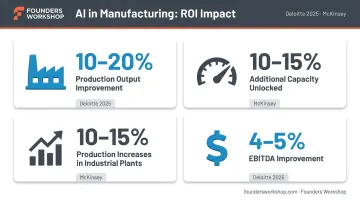
- Deloitte's 2025 smart manufacturing survey found AI implementations deliver 10–20% production output gains and 10–15% unlocked capacity.
- Start with one focused use case, prove ROI, then scale — don't attempt enterprise-wide deployment from day one.
What Are AI Agents in Manufacturing?
An AI agent in manufacturing is an autonomous software system that continuously collects data from sensors, machines, and enterprise platforms, then applies machine learning and reasoning to make decisions and trigger actions — without waiting for human instruction. That autonomy is what separates them from traditional automation.
Rule-Based Systems vs. AI Agents
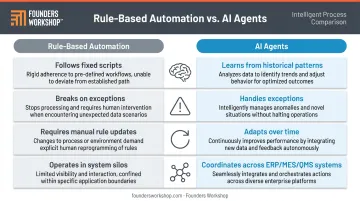
Traditional automation follows scripts. Program a machine to stop when temperature exceeds a threshold, and it will stop — every time, under every condition, regardless of whether stopping makes sense in context. Change the process, and someone has to rewrite the rule.
AI agents behave differently:
- They learn from historical patterns, not just programmed thresholds
- They handle exceptions that fall outside pre-defined conditions
- They adapt as operating conditions evolve over time
- They coordinate across systems — connecting ERP, MES, and QMS data so decisions reflect the full operational picture
Breaking Down Operational Silos
Most manufacturers don't have a data problem. They have a data fragmentation problem. Quality data lives in one system, maintenance records in another, scheduling in a spreadsheet, and inventory in an ERP that doesn't talk to any of them.
A single AI agent can bridge all of that. It pulls sensor readings from the shop floor, cross-references production schedules from the MES, checks parts availability in the ERP, and coordinates a maintenance response — all without manual handoffs between departments. The result is decision-making that reflects the full operational picture, not just one slice of it.
Key Use Cases: Where AI Agents Transform Manufacturing Operations
Predictive Maintenance
Unplanned downtime is expensive. Siemens Senseye's 2024 research found it costs the world's 500 largest companies approximately $1.4 trillion annually — equal to 11% of total revenues. In automotive manufacturing, a single idle production line can cost more than $2.3 million per hour.
Predictive maintenance agents address this by continuously monitoring equipment sensors — vibration, temperature, pressure, acoustics — and detecting anomaly patterns that precede failures, not just failures themselves.
What makes these agents genuinely useful beyond alerting:
- Verify parts inventory before scheduling maintenance
- Check production schedules to find the least disruptive maintenance window
- Auto-generate work orders in the maintenance management system
- Alert the right technicians with relevant equipment history and diagnostic context
The same Siemens research found predictive maintenance users achieved 50% less unplanned downtime, 40% lower maintenance costs, and 55% higher maintenance staff productivity. Those aren't incremental gains.
Quality Control and Defect Detection
Manual inspection has a structural limitation: humans fatigue, and sample-based inspection misses defects that occur between samples. AI vision agents inspect every unit at full production speed.
A 2023 peer-reviewed study published in PMC reported 99.86% inspection accuracy on casting product image data. Research linked to NIST found Mask R-CNN defect detection achieving 0.957 mean average precision on casting datasets — performance that holds up in production-setting conditions.
Beyond catching defects, quality control agents analyze why defects are occurring:
- Correlate defect patterns with upstream variables (machine settings, material batches, shift timing)
- Identify which process inputs are most predictive of quality failures
- Recommend specific parameter adjustments to prevent recurrence
- Automatically log quality data for regulatory audits and continuous improvement programs
The result is a shift from reactive inspection to process control — catching the conditions that cause defects before they repeat.
Supply Chain and Inventory Optimization
Static forecasting models fail in volatile conditions — and supply chains have been volatile for years. AI agents analyze order patterns, seasonal trends, supplier lead times, and external disruption signals continuously, adjusting inventory levels before stockouts or excess carrying costs accumulate.
McKinsey research found AI-driven forecasting can reduce supply chain forecast errors by 20–50% and cut product unavailability by up to 65%.
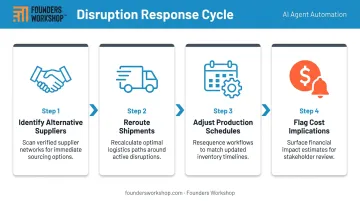
When disruptions hit — a supplier delay, a transportation issue, a sudden demand spike — these agents respond faster than any manual process:
- Identify alternative suppliers that meet spec and lead time requirements
- Reroute shipments based on real-time logistics data
- Adjust production schedules downstream to reflect updated material availability
- Flag cost implications so procurement can make informed decisions quickly
Production Scheduling and Planning
46% of manufacturers in Deloitte's 2025 survey reported moderate to significant challenges filling planning and scheduling roles. AI scheduling agents reduce dependence on those hard-to-find specialists by handling the combinatorial complexity of balancing order priorities, machine availability, workforce capacity, material readiness, and customer deadlines simultaneously.
The contrast with static scheduling is stark. When a machine goes down unexpectedly or a customer changes an order, a human planner needs hours to manually rebuild the schedule. An AI agent recalculates the optimal sequence in seconds.
Deloitte cited a commercial aerospace manufacturer where a cloud-based production control application increased throughput by 10–15%. A defense prime's assembly-line constraint resolution command center reduced mean time to constraint resolution by 26% — the kind of measurable improvement that compounds across a full production year.
Workforce Augmentation and Knowledge Management
AI agents don't replace frontline workers — they make them more effective. On the shop floor, that means surfacing the right information at the right moment: troubleshooting guidance when a machine behaves unexpectedly, spec references during setup, process instructions for less experienced operators.
The knowledge capture opportunity is just as significant. As experienced workers retire, decades of institutional knowledge walk out with them. AI agents can preserve and redistribute that knowledge through on-demand guidance tailored to each employee's skill level and task.
In practice, this looks like:
- Answering machine-specific troubleshooting questions in real time
- Walking newer operators through setup procedures step by step
- Surfacing historical repair records and failure patterns on demand
- Capturing expert decisions as structured knowledge before experienced workers leave
With 1.9 million manufacturing jobs projected to go unfilled by 2033 if current talent gaps persist (per NAM), AI-assisted knowledge transfer isn't optional — it's a continuity requirement.
The Real Business Benefits of AI Agents in Manufacturing
The aggregate case is compelling. Deloitte's 2025 smart manufacturing survey found implementations delivered 10–20% production output improvement and unlocked 10–15% additional capacity. McKinsey found industrial processing plants applying AI saw 10–15% production increases alongside 4–5% EBITDA improvement.
Beyond throughput, the benefits compound across multiple dimensions:
Quality and compliance:
- Lower scrap rates and reduced rework costs
- Fewer warranty claims and customer complaints
- Automatic quality documentation for regulatory audits
- Continuous improvement data captured without manual logging
Workforce productivity:
- Deloitte found smart manufacturing implementations delivered up to 20% employee productivity improvement
- AI reduces dependence on specialized roles that are increasingly difficult to hire
- New hires reach competency faster with AI-assisted onboarding and guidance
The Cost of Waiting
The manufacturers deploying these systems now aren't waiting to see if AI proves out. They're building operational advantages — in yield rates, scheduling precision, and supplier response times — that grow harder to close the longer a competitor waits. Every month of delay is a month of production data, quality insights, and process improvements that early adopters are banking and late movers aren't.
How to Get Started with AI Agents in Your Manufacturing Operation
Step 1: Choose the Right Use Case First
Don't start with technology selection. Start with the operational problem that costs you the most — unplanned downtime, high defect rates, chronic inventory imbalances. Then ask: do we have sufficient data to train an agent on this problem?
Predictive maintenance and quality control are strong starting points because:
- Data is typically available (sensor logs, inspection records)
- ROI metrics are clear and measurable
- The cost of the problem is well-understood
Step 2: Assess Your Data Readiness
AI agents require clean, accessible, consistent data. Before selecting any solution, conduct an assessment:
- What data exists, and in which systems?
- How complete and accurate is it?
- Can it be accessed programmatically via APIs or exports?
- What gaps need to be addressed before an agent can operate reliably?
McKinsey found that 46% of COOs cite limitations in data or IT/OT systems as a top barrier to AI adoption. Data readiness isn't a checkbox — it's the foundation everything else depends on.
Step 3: Deploy Narrowly, Then Scale
A phased approach reduces risk and builds stakeholder confidence:
- Launch one agent for one process at one facility
- Measure carefully against defined KPIs for 90–180 days
- Refine the implementation based on what the data reveals
- Expand only after demonstrating measurable ROI
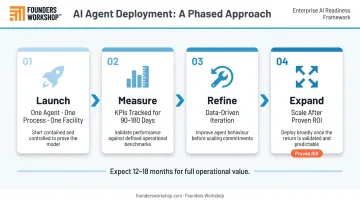
Expect 12–18 months to see full operational value as agents learn your specific patterns. Rushing deployment without data readiness or change management is a leading cause of failure. Gartner found that fewer than half of AI pilots ever reach production for exactly this reason.
Step 4: Decide Between Custom and Off-the-Shelf
Generic SaaS platforms work well for straightforward use cases with standard data models. But manufacturers with legacy systems, proprietary workflows, or complex ERP/MES integration requirements often find that off-the-shelf tools require significant customization anyway — at the cost of control and flexibility.
Custom-built AI agents make more sense when:
- Your processes don't map cleanly to a generic platform's assumptions
- You need deep integration with existing systems (ERP, MES, SCADA, IoT infrastructure)
- You want to own the logic and data rather than depend on a vendor's roadmap
For manufacturers whose needs fall into that custom category, Founders Workshop builds AI agents tailored to existing operations — no in-house AI team required. Their 5D Process moves most solutions from discovery to deployment in 3–6 months, with engagements that can start in as little as two weeks.
Frequently Asked Questions
What are AI agents for the manufacturing industry?
AI agents in manufacturing are autonomous software systems that monitor production data, make decisions, and take actions across processes like maintenance, quality control, scheduling, and supply chain — without requiring constant human input. Unlike traditional automation, they learn from operational data and adapt to changing conditions rather than breaking down when conditions fall outside pre-programmed rules.
What is the best AI for manufacturing?
The best AI depends on the specific use case. Predictive maintenance, quality vision systems, and supply chain optimization each use different AI approaches and have different data requirements. Evaluate solutions based on data compatibility, integration capability with your existing systems, and a clear ROI metric — not brand recognition.
How do AI agents differ from traditional automation in manufacturing?
Traditional automation follows fixed, pre-programmed rules and requires human intervention when conditions fall outside those rules. AI agents learn from operational data, adapt to new situations, and make autonomous decisions in real time — which matters most on production floors where unexpected conditions are routine, not rare.
Can small and mid-sized manufacturers implement AI agents?
Yes. SMBs implement AI agents successfully by starting with one focused use case, ensuring basic data infrastructure is in place, and working with implementation partners who can configure solutions without requiring a large internal AI team.
What manufacturing processes benefit most from AI agents?
Predictive maintenance, quality control, production scheduling, and supply chain/inventory management offer the highest-impact starting points. They share common traits: high data availability, clear ROI metrics, and significant cost consequences when managed reactively or manually.
How long does it take to implement AI agents in manufacturing?
Simple use cases with solid data foundations can show initial results in weeks. Full operational value typically takes 12–18 months as agents learn your specific patterns and integrate into daily workflows — which is why data readiness has to come before deployment, not after.