What we can tell you is that costs in 2026 range from roughly $25,000 for a lean MVP to well over $500,000 for a complex enterprise platform. According to Clutch's June 2026 pricing data, the average custom software project runs about $132,480 and takes around 13 months.
The bigger problem isn't the price range — it's what happens when people misunderstand it. Founders underbudget and stall mid-build. Others overpay for features they won't need for two years. Many are blindsided by ongoing maintenance costs they never factored in.
This guide covers realistic pricing tiers, the factors that drive costs up or down, what your money actually goes toward, and how to build a budget that holds through completion.
Key Takeaways
- Custom software in 2026 typically costs $25,000–$500,000+, depending on scope, complexity, and where your team is located
- Biggest cost drivers: number of features, integrations, team seniority, and platform requirements
- Ongoing maintenance runs 15–25% of the original build cost per year — a cost most new clients overlook when budgeting
- Nearshore Latin American teams can cut costs by roughly two-thirds versus U.S.-based teams
- A tightly scoped MVP is the most budget-efficient starting point for founders validating a new product
How Much Does Custom Software Development Cost in 2026?
There's no catalog price for custom software. The global application development software market is projected to reach $309.53 billion in 2025, which gives you a sense of how much activity — and how much variability — exists in this space.
Cost depends on what you're building, who builds it, where they're located, and how complex the requirements are. Getting it wrong in either direction creates real problems: underbudgeting leads to incomplete builds and emergency pivots, while choosing the cheapest quote often results in technical debt that costs more to fix than the original savings.
Here's how pricing typically breaks down by tier:
Small / MVP Tier: $25,000–$80,000
If you're validating an idea or building a first version before seeking funding, this is your range.
Typically includes:
- Core feature set only (no extras)
- Basic UI design using standard components
- Single platform (mobile or application, not both)
- Minimal third-party integrations
- Small team of 2–4 people
Founders Workshop has delivered MVP builds starting around $25,000, though their typical managed engagement begins at $80,000 once a full cross-functional team (designer, developers, QA, project manager) is involved.
Mid-Range Tier: $80,000–$250,000
Best for SMBs building a scalable product or replacing a manual process with a real system.
Typically includes:
- Multiple user roles and permission levels
- Custom design and brand-aligned UI
- Several third-party integrations
- Multi-platform support (software + mobile)
- Dedicated QA and testing
- Team of 4–7 people
Enterprise / Complex Tier: $250,000+
For established businesses building mission-critical infrastructure — think compliance-heavy platforms, legacy system replacements, or multi-system integrations.
Typically includes:
- Advanced business logic and workflows
- High-volume scalability architecture
- Complex data migration from legacy systems
- Regulatory compliance features (HIPAA, SOC 2, etc.)
- Large cross-functional team with ongoing development cycles
Founders Workshop has handled projects that approached $1 million after two years of active development. That trajectory is common: enterprise software budgets need to account for ongoing iteration, not just the initial build.
The ranges above cover the three main tiers — but cost also shifts significantly depending on what type of software you're building. The table below maps common project types to their typical ranges:
Cost Ranges by Common Software Type
| Software Type | Typical Range | Notes |
|---|---|---|
| MVP / Prototype | $25,000–$80,000 | Core features only, single platform |
| Internal Business Tool | $50,000–$150,000 | Depends on integrations |
| SaaS Platform | $100,000–$350,000+ | Multi-tenant adds complexity |
| Healthcare App | $150,000–$500,000+ | Compliance requirements drive cost |
| Enterprise Integration | $100,000–$300,000+ | Varies by number of systems |
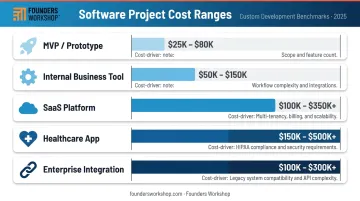
Ranges reflect general industry patterns. Your actual quote will vary based on scope, team location, and complexity.
Key Factors That Affect Custom Software Development Cost
Pricing isn't arbitrary. It reflects a combination of technical decisions, team structure, and business requirements. These are the variables that move the needle most.
Project Scope and Complexity
The number of screens, user types, workflows, and edge cases directly multiplies development hours. Consider a login feature: basic username/password authentication is a day's work. Add two-factor authentication and it's a few days. Add SSO/OAuth with enterprise identity provider support and you're looking at weeks — plus ongoing maintenance as provider specs change.
A simple task manager and a multi-tenant SaaS platform may both sound like "software," but they require fundamentally different levels of architecture, testing, and documentation.
UI/UX Design Requirements
Design typically accounts for 10–25% of total project cost. The range reflects how much custom work is involved — standard UI component libraries sit at the low end, while fully custom design systems built from scratch sit at the high end.
Customer-facing products (consumer apps, client portals) generally require more design investment than internal tools. If your users are your customers, the interface quality directly affects retention.
Third-Party Integrations and APIs
Every integration — payment processors, CRMs, EHR systems, legacy databases — adds both upfront development work and ongoing maintenance risk. Well-documented modern APIs (Stripe, Twilio) are relatively quick to connect. Proprietary or poorly documented systems, especially older enterprise software, can easily double or triple the integration timeline — and that cost is routinely underestimated in initial quotes.
Technology Stack and Platform Choices
Decisions about languages, frameworks, cloud providers, and native vs. cross-platform development affect both upfront build time and long-term maintainability. Building native iOS and Android apps separately costs more than a cross-platform approach, but may deliver better performance for certain use cases.
AI-assisted development tools are shifting output rates in measurable ways — but the gains aren't uniform. The research tells a mixed story:
- A GitHub-controlled experiment found developers completed a coding task 55% faster using GitHub Copilot
- A McKinsey study with 40+ developers found generative AI cut some task times in half — though gains shrank for complex work
- A 2025 METR study found experienced developers on large, real-world repositories were actually 19% slower with AI tools
The productivity benefit is real for well-scoped tasks. It's not a blanket cost reduction.
Development Team Composition and Expertise
Team seniority directly affects both hourly cost and delivery speed. A senior-heavy team costs more per hour but typically ships faster with fewer costly mistakes. A junior-heavy team may have lower rates but require more oversight and rework.
U.S. salary benchmarks for key roles (BLS, May 2024 data):
| Role | Median Annual Salary |
|---|---|
| Software Developer | $133,080 |
| UI/UX Designer | $98,090 |
| QA Engineer | $101,800 |
| Project Manager | $100,750 |
| Business Analyst | $101,190 |
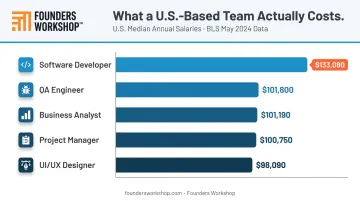
Senior software engineers at top companies report total compensation exceeding $250,000 (Levels.fyi, 2026). These figures explain why a fully U.S.-based team is expensive — and why team location is one of the most significant levers on project cost.
The Full Cost Breakdown: What You're Really Paying For
The development quote is not the total cost. Custom software has distinct cost categories (some one-time, some recurring) that all need to be in your budget.
Discovery and Planning
One-time. Thorough scoping, requirements documentation, and architecture planning before development begins prevents far more expensive rework later. Skipping this phase is the most common reason projects exceed budget.
Founders Workshop's Discovery phase (2–4 weeks) produces goal definitions, feature prioritization, integration requirements, technology recommendations, and a business model review before a line of code is written. It's what converts a vague idea into a scoped build.
Design and Development
One-time (core build). This is typically 60–75% of initial project cost and covers UI/UX design, front-end and back-end development, QA testing, and deployment.
The quality of work here (code architecture, documentation, test coverage) determines how expensive the software will be to maintain and extend for years afterward. Cutting corners creates compounding costs downstream.
Infrastructure and Hosting
Recurring. Cloud hosting, security monitoring, and compliance infrastructure are ongoing costs that start at launch and scale with usage. For healthcare or fintech applications, compliance infrastructure (HIPAA, PCI-DSS) adds meaningful cost that most vendor quotes exclude entirely.
Plan for these separately in your budget. A rough starting point: $200–$2,000/month depending on traffic, storage, and compliance requirements.
Maintenance, Bug Fixes, and Ongoing Development
Recurring. Post-launch maintenance typically runs 15–25% of the original build cost annually, covering bug fixes, security patches, dependency updates, and minor feature changes. This is separate from new feature development, which is an additional ongoing cost.
Unmaintained software is expensive — what costs $500 to fix today can easily reach $10,000 after two years of accumulated vulnerabilities and outdated dependencies.
Founders Workshop's D5 support retainers start at $625/month for light maintenance and scale up based on hours needed — a practical way to budget this as a predictable line item rather than a surprise.
Nearshore, Offshore, or In-House: How Team Location Shapes Your Budget
Where your team is located is one of the single largest variables in total project cost. Hourly rates vary dramatically by region:
| Region | Typical Hourly Rate |
|---|---|
| United States / Canada | $100–$250/hr |
| Western Europe (UK, Germany) | $100–$250/hr |
| Western Europe (Spain, Portugal, Czech Republic) | $50–$100/hr |
| Eastern Europe (Poland, Romania) | $20–$99/hr |
| Latin America | $20–$100/hr |
| India / South/Southeast Asia | $20–$50/hr |
Source: GoodFirms 2026 Custom Software Development Cost Survey and Clutch June 2026 provider data.
Each model comes with real tradeoffs:
- Offshore (India, Southeast Asia): Lowest rates, but time zone gaps, variable English proficiency, and quality inconsistencies typically demand more oversight than most U.S. clients anticipate
- U.S.-only: Seamless communication and cultural alignment, but the highest cost — in-house teams run $750,000–$1 million annually in salaries and benefits
- Nearshore (Latin America): Similar time zones to the U.S., strong English proficiency, cultural alignment, and rates roughly one-third of U.S. market rates
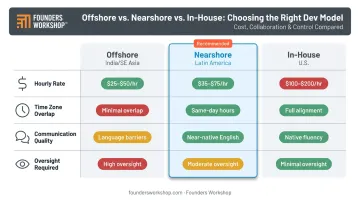
Founders Workshop uses a hybrid model: U.S.-based business analysts and project managers handle client communication, requirements, and product strategy, while nearshore Latin American developers, designers, and QA engineers execute the build. This eliminates the coordination friction that makes pure offshore development expensive in practice.
Before choosing based on rate alone, consider:
- Do you have the technical depth to verify the quality of work being delivered?
- What legal protections do you have if the engagement goes sideways?
- Do the time zone gaps create delays that offset the savings?
How to Estimate the Right Budget for Your Custom Software Project
The more specific you can be before talking to a vendor, the more accurate your estimate will be. Vague scope produces vague estimates — and vague estimates almost always run over.
Before any vendor conversation, define:
- Who will use the software and what they need to accomplish
- Must-have features vs. nice-to-have features (be honest about this)
- Platforms required (web, iOS, Android, or all three)
- Integrations needed and whether those systems have public APIs
- Any compliance requirements (HIPAA, SOC 2, GDPR)
- Timeline constraints and what's driving them
Common budget mistakes to avoid:
- Focusing only on the build cost and ignoring hosting, maintenance, and future features
- Over-specifying the first release instead of starting with an MVP
- Choosing the cheapest quote without evaluating how the vendor handles scope changes
- Skipping the 10–20% contingency buffer — something unexpected always happens
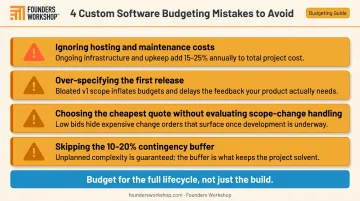
A structured scoping process is what separates accurate estimates from expensive surprises. Founders Workshop's 5D Process walks clients through discovery and definition before a single line of code is written, so the budget you're quoted reflects real scope — not a vendor's best-case assumption.
Frequently Asked Questions
How much does custom software development cost in 2026?
Typical ranges run from $25,000 for a lean MVP to $500,000+ for complex enterprise platforms. The average project per Clutch's 2026 data is around $132,000. Cost depends primarily on project scope, feature complexity, and where your development team is located.
What is the cheapest way to build custom software?
Start with a tightly scoped MVP covering only must-have features. Use a nearshore development team to reduce hourly rates by 50–70% versus U.S.-based teams. Leverage AI-assisted development tools where applicable to reduce labor hours on standard tasks. Avoid multi-platform builds until the core product is validated.
How long does custom software development take?
Small MVPs typically take 1–3 months, mid-range projects 3–6 months, large projects 6–12 months, and enterprise builds 12–24 months. Founders Workshop's full process from Discovery to Deployment typically runs 3–6 months for an MVP.
Is custom software worth the cost compared to off-the-shelf solutions?
Custom makes sense when your workflows are genuinely unique, you need competitive differentiation, or scalability requirements exceed what packaged software can handle. Off-the-shelf is more practical when you're solving a standard business problem, budget is constrained, or you need something deployed in weeks rather than months. AI tooling is making custom software faster and more feasible than ever — but off-the-shelf remains the right call for many use cases.
What is the difference between fixed-price and time-and-materials contracts?
Fixed-price works best when scope is fully defined upfront — you know exactly what you're building and changes are unlikely. Time-and-materials is better for evolving requirements where flexibility matters more than cost predictability. With fixed-price, the vendor absorbs scope risk; with time-and-materials, that risk sits with you — but so does the flexibility to change course. Any project with meaningful complexity typically warrants the latter.
How much does ongoing software maintenance cost after launch?
Plan for 15–25% of your original build cost per year, covering bug fixes, security patches, and dependency updates. A $100,000 build typically needs $15,000–$25,000 annually to stay healthy. Skipping maintenance doesn't eliminate these costs — it defers them with interest, as security vulnerabilities and outdated dependencies compound over time.