The institutions winning that trust aren't just bigger — they're faster and more available. And the gap between them and everyone else is widening.
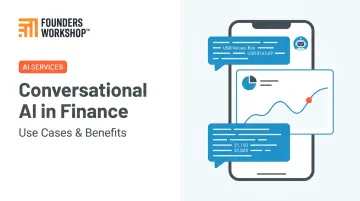
Conversational AI in finance is no longer an enterprise-only advantage. Challenger banks, fintech startups, and credit unions are deploying it at scale, with measurable outcomes. This article covers what conversational AI actually is (and isn't), where it creates the most value in financial workflows, the benefits that move real KPIs, and how to implement it without building on a fragile foundation.
Key Takeaways
- Conversational AI understands intent, maintains context, and handles multi-step financial tasks — far beyond what scripted chatbots can do
- High-value use cases: customer onboarding, fraud alerts, loan eligibility, transaction monitoring, and internal compliance support
- Verified ROI: one international financial services firm handles 500,000 conversations annually, resolving over 50% without human intervention, saving €2 million per year
- 72% of banking customers say personalization influences their bank choice — conversational AI is the delivery mechanism at scale
- Every US financial firm under regulatory oversight benefits from built-in interaction logging — CFPB and federal banking guidelines increasingly expect documented AI touchpoints
What Is Conversational AI in Finance?
Conversational AI is a system that understands natural language, maintains context across a full interaction, and takes action — not just a system that matches keywords to pre-written responses.
The Distinction That Actually Matters
Most financial firms have deployed some form of chatbot. Few have deployed true conversational AI. The difference:
| Feature | Rule-Based Chatbot | Conversational AI |
|---|---|---|
| Input handling | Keyword matching, menu selection | Natural language understanding |
| Context retention | None — each message is isolated | Full conversation memory |
| Multi-turn capability | Limited to decision trees | Handles complex, back-and-forth dialogue |
| Action completion | Answers questions | Submits forms, triggers alerts, escalates with context |
| Failure mode | Breaks outside its script | Routes intelligently when confidence is low |
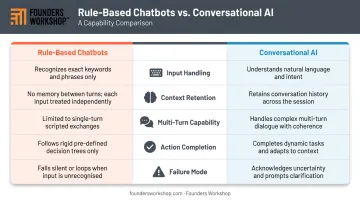
This distinction matters because many financial firms are deploying rule-based bots and describing them as AI. When those systems fail a customer mid-fraud-dispute, the damage isn't just to that interaction — it erodes trust at the exact moment it's most fragile.
That's precisely where conversational AI earns its place. It reduces friction during the moments that carry the most weight — a first loan application stalled by a simple question, a fraud alert at 2 a.m. with no agent available. The difference between a system that can handle those moments and one that can't is measurable in both customer retention and liability exposure.
Key Use Cases of Conversational AI in Finance
Conversational AI delivers measurable results in specific, high-volume workflows — not generic Q&A. These are the use cases where live deployments are proving it out.
Customer Support and Fraud Alerts
A customer noticing an unfamiliar charge at midnight doesn't want hold music. They want an immediate, intelligent response that can verify the transaction, freeze the card if needed, and initiate a dispute — all without waiting for business hours.
According to CGI's verified case study, one international financial services firm's conversational AI chatbot handles 500,000 conversations annually, with over 50% resolved without human intervention and only 6% requiring a live representative. That's not theoretical capacity — it's documented performance.
Capital One's Eno assistant handles fraud alerts and transaction lookups in real time. Across deployments, conversational AI absorbs high-frequency, high-anxiety queries that previously created call center bottlenecks.
Client Onboarding and KYC
Onboarding abandonment is a serious revenue leak. Signicat's research found that 68% of European consumers had abandoned a financial application, with the highest abandonment among 25-to-34-year-olds — the most valuable long-term customer segment.
Conversational AI addresses this by guiding applicants through identity verification and document submission via natural dialogue, reducing the friction that causes drop-off. Automated data capture also satisfies FinCEN's guidance that digital credentials and electronic verification are acceptable identity methods under Customer Identification Program rules. Compliance and conversion end up pointing in the same direction.
Loan Eligibility and Mortgage Inquiries
Loan applications follow the same abandonment pattern as account opening. Conversational AI collects applicant data through dialogue, connects to backend scoring systems, and delivers eligibility insights in real time — giving borrowers answers rather than instructions to call back.
Rocket Companies' AI implementations demonstrate what's achievable: Rocket Logic automated identification and classification of 70% of the 1.5 million documents received monthly, reducing team-member interactions with a loan by nearly 25% year over year. Their Synopsis tool is projected to save approximately 60,000 team-member hours annually through AI-assisted call transcription and analysis.
Transaction Monitoring and Proactive Alerts
The most mature conversational AI deployments have shifted from reactive support to proactive engagement. Bank of America's Erica has surpassed 3 billion total interactions, assisting nearly 50 million users — with more than 1.7 billion of those interactions being proactive, personalized insights rather than responses to customer-initiated queries.
Erica's numbers illustrate where the category is moving: AI that engages customers before they reach out, surfacing savings opportunities, flagging unusual activity, and flagging upcoming bills without waiting to be asked.

Internal Knowledge and Compliance Support
Conversational AI isn't only for customers. Compliance teams, loan officers, and customer-facing staff can query internal policy documentation, product rules, and regulatory guidance through natural language — getting consistent, accurate answers rather than digging through shared drives.
Internal deployments typically support use cases such as:
- Compliance teams querying regulatory rules without digging through legal documentation
- Loan officers pulling current product guidelines mid-call
- Onboarding staff verifying KYC requirements in real time
- Customer service reps checking escalation policies without supervisor intervention
The result: fewer inconsistent answers across teams and less time spent on manual lookups during live customer interactions.
Key Benefits of Conversational AI in Finance
24/7 Availability and Elastic Scalability
Financial events don't follow business hours. Rate announcements, fraud alerts, tax deadlines, and market volatility all generate contact center spikes — and a human-staffed support model absorbs those spikes as a cost problem.
Conversational AI provides a consistent response layer regardless of time zone, staffing levels, or volume. Unlike adding headcount, scaling the AI layer doesn't require incremental cost per interaction.
KPIs impacted:
- First response time
- After-hours resolution rate
- Call containment rate
- Cost per interaction
This matters most for high-volume retail banking products, insurance, mortgage servicing, and any fintech without 24/7 staffing capacity.
Cost Reduction Through Automated Resolution
The CGI case establishes a concrete benchmark: 500,000 conversations annually, over 50% resolved without human intervention, €2 million saved per year. The key metric is containment rate — the percentage of interactions that close within the AI layer without escalation.
Rocket Companies shows what this looks like at scale from a different angle: reducing team-member loan interactions by nearly 25% and saving 60,000 hours annually through AI call analysis. These aren't chatbot metrics — they're what AI-assisted financial workflows deliver in production.
KPIs impacted:
- Cost per resolved interaction
- Agent escalation rate
- Headcount required per unit of service volume
- Annual operational cost
Growth-stage fintechs feel this most acutely. Support volume scales with customer acquisition — but with conversational AI handling routine interactions, that relationship doesn't have to be linear.
Compliance-Ready Auditability and Personalization
Every conversational AI interaction creates a structured, timestamped record. For compliance teams, this is a structural advantage over phone-based or manual channels where record quality depends on agent note-taking.
The regulatory environment is moving in one direction. EU AI Act Article 50 requires disclosure whenever AI systems interact with consumers. The CFPB has separately warned that poorly designed finance chatbots can deliver inaccurate information and create consumer protection risks. Building auditability in from the start isn't optional; it's the baseline.
Accenture's 2025 Banking Consumer Study found 72% of banking customers say personalization influences their bank choice. Yet only 3% currently use personalized tools their bank offers. Conversational AI bridges that gap directly, using individual transaction history and behavior to shape every interaction.
KPIs impacted:
- Compliance audit preparation time
- Customer satisfaction scores
- Cross-sell/upsell conversion
- Error rates in regulatory communications
What Happens When Financial Firms Ignore Conversational AI
The CFPB confirmed that all 10 of the largest U.S. commercial banks have already deployed chatbots. The competitive baseline has moved.
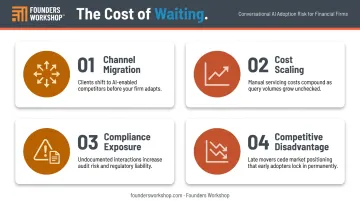
Firms still running legacy IVR trees and manual processes are actively frustrating customers at precisely the moments trust is most fragile — account disputes, fraud alerts, loan inquiries. The compounding consequences:
- Channel migration: Customers default to branch visits and hold queues, or switch to competitors offering self-service resolution
- Cost scaling: Every interaction still requires a human — support costs grow linearly with volume rather than flattening
- Compliance exposure: Interaction records become dependent on agent note quality rather than structured, auditable logs
- Competitive disadvantage: Fintech competitors who deploy earlier gain compounding advantages in data, satisfaction scores, and operational margins that compound over time
Bank of America's Erica reached 50 million users and 3 billion interactions by 2025 — a scale no manual support operation can match. For firms that haven't started, the gap isn't just in technology — it's in the customer data, satisfaction scores, and cost structures that early movers have already built.
How to Successfully Implement Conversational AI in Finance
Start Narrow, Then Expand
The strongest early deployments focus on 3–5 repeatable, high-volume tasks before attempting broader automation. Account balance inquiries, fraud alerts, loan status updates, and payment reminders are good starting points — well-defined, high-frequency, and low-risk if the AI produces an imperfect response.
Rocket's approach illustrates this: they applied AI to bounded, measurable workflows first (document classification, loan interaction reduction, call transcription) before expanding scope.
Integrate Before You Launch
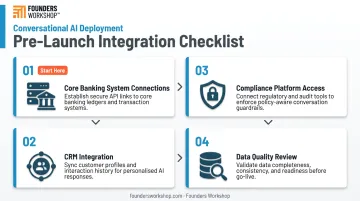
Conversational AI is only as accurate as the data it can reach. Before deployment, prioritize:
- Core banking system connections — real-time account data is non-negotiable for most financial use cases
- CRM integration — customer history makes responses accurate and personalized
- Compliance platform access — especially for disclosure requirements and audit logging
- Data quality review — address inconsistencies before they surface in customer conversations
Design the Escalation Path as a Feature
The handoff from AI to human agent — with full conversation context transferred — determines whether customers trust the system. A poorly designed escalation that forces customers to repeat themselves undoes every efficiency gain.
Build escalation as a deliberate design decision, not a fallback. Specify the triggers (complexity threshold, sentiment signals, specific intents), the context payload that transfers, and the agent experience on the receiving end.
For fintech founders and SMBs building these systems from scratch, the escalation architecture, integration decisions, and compliance requirements are often the pieces that stall early builds. Working with a development partner that has both AI integration experience and financial product context can cut weeks off the path to production.
Founders Workshop's 5D Process — from Discovery through Deployment and into ongoing Dedicated Developer support — is built around exactly these decisions, ensuring that compliance logging, data connections, and escalation flows are designed in from the start rather than retrofitted later.
Measure What Matters
Track from day one:
- Containment rate: interactions resolved within the AI layer
- Escalation frequency: triggers for human handoff
- Resolution rate: interactions fully resolved (vs. abandoned)
- CSAT scores: pre- and post-deployment comparison
- After-hours resolution: a direct measure of availability value
Treat the AI as a product that improves with each iteration, not a system that's finished when it launches.
Frequently Asked Questions
How is AI used in the financial services industry?
AI in financial services covers customer support automation, fraud detection, loan processing, personalized financial guidance, and internal knowledge management. Conversational AI handles the dialogue layer across these functions — the interface customers and staff use to access all of it.
Which AI is best for financial services?
The right choice depends on use case, compliance requirements, and existing infrastructure. Most financial institutions combine NLP-based conversational AI for customer interactions with predictive and generative AI for analytics, underwriting, and content generation.
What is the difference between a chatbot and conversational AI in finance?
Chatbots follow pre-written scripts and fail outside their decision trees. Conversational AI understands intent, maintains context across a full multi-turn conversation, and can complete transactions or escalate with full conversation context transferred to the receiving agent.
How does conversational AI improve customer service in banking?
It provides 24/7 availability, faster resolution for routine queries, consistent and auditable responses, and the ability to personalize interactions based on individual account history — without requiring a human agent for every interaction.
What are the risks of using conversational AI in financial services?
Key risks include inaccurate or noncompliant responses, data security vulnerabilities, model drift, and poor escalation handling. Governance frameworks, human-in-the-loop oversight, and mandatory AI disclosure (required under EU AI Act Article 50) address these concerns.
How long does it take to implement conversational AI for a financial services product?
Timelines depend on scope and integration complexity. A focused pilot covering 3–5 use cases can reach production in weeks to a few months; full-scale deployment with core banking integration typically takes several months end to end.