The sequence matters. Product design isn't the final coat of paint on an MVP — it's the architecture that determines whether users stay or leave.
This guide covers what product design services for startups actually include, why timing is everything, how to choose the right partner, and what it realistically costs.
Key Takeaways
- Product design services cover UX research, user flows, wireframes, prototypes, visual UI, and developer handoff — not just aesthetics
- Fixing design problems before development is far cheaper than rebuilding after launch
- Agencies, freelancers, and in-house designers serve different stages and needs — and the wrong choice costs time and money
- US-based agency rates average $100–$149/hour; nearshore alternatives cut that by 30–50% while staying in your timezone
- The best partners bring structured process, startup-speed execution, and real runway awareness
What Are Product Design Services for Startups?
Product design is the end-to-end discipline of turning an idea into a tested, buildable product. It spans user research, information architecture, interaction design, visual UI, prototyping, and developer handoff — not just making things look good.
Many founders conflate three distinct disciplines and end up spending money in the wrong place:
- Product design — how the product works as a system: flows, structure, logic
- UX design — usability and how users move through the product without friction
- Branding — identity, visual language, and market perception
Spending on branding before the product works is a common early-stage mistake. Investors aren't looking at your logo — they're trying to understand your product.
The 4 Pillars That Drive Everything
Effective product design integrates four elements simultaneously:
- User research — understanding who you're building for, what they need, and where they struggle
- Usability — reducing friction so users reach their goals with minimal cognitive effort
- Aesthetics — visual coherence that builds trust and reduces cognitive load
- Functionality — design that maps to what the product actually does, not what looks clever in Figma
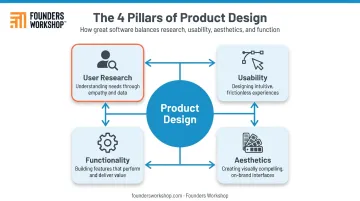
These aren't sequential steps. They inform each other continuously throughout the design process.
When Product Design Services Become Critical
Understanding those four pillars helps clarify when to bring in outside expertise. You need a product design engagement when:
- You're about to write the first line of code on an MVP
- Onboarding is confusing users and you don't know why
- Investors keep questioning the product experience in pitch meetings
- Churn is high but your core value proposition is sound
That last scenario — high churn with a solid value prop — is usually a design problem masquerading as a product problem. Users aren't leaving because the idea is bad. They're leaving because the experience doesn't communicate the value fast enough.
Early-Stage Founders Benefit Most
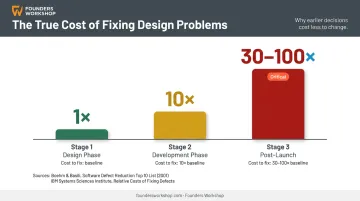
A foundational software engineering paper by Boehm and Basili states that post-delivery fixes are often 100x more expensive than fixing problems during requirements and design phases — though the multiplier varies by system type. IBM's internal research puts the post-release figure at a more conservative 30x. Whether the true cost is 30x or 100x, the implication is the same: fixing design flaws before a single line of code is written is dramatically cheaper than rebuilding after launch.
Why Product Design Can Make or Break Your Startup
Poor product design kills startups. Users abandon confusing products before they ever reach your core value. Google research found that as mobile page load time increases from 1 second to 10 seconds, bounce probability rises 123%. That's pure friction creating abandonment before a user ever experiences your product's value.
The Business Case for Design Investment
The McKinsey Design Index studied 300+ companies over five years and found that top-quartile design-mature companies achieved 32 percentage points higher revenue growth and 56 percentage points higher total returns to shareholders than industry counterparts. The McKinsey data is enterprise-level, but the mechanism applies at every stage: design maturity reduces friction, improves activation, and builds user trust faster.
Design-led products consistently show better metrics across:
- Higher onboarding completion rates
- Lower early-stage churn
- Stronger investor confidence during pitches
- Faster time to demonstrated product-market fit
The Equity Trap
Many first-time founders solve the design and development problem by giving away equity to a technical cofounder. It seems practical — expertise without upfront cash. But the cost is steep.
A technical cofounder typically takes up to 50% equity. A capable product design and development partner requires none. Founders Workshop, for example, positions itself as a no-equity alternative: founders retain full ownership while still getting expert execution across design, development, and go-to-market strategy.
How Design Timing Affects Fundraising
Retaining ownership means little if you can't secure funding — and that's where design timing becomes critical. Investors evaluate product experience as proof of execution ability. A polished, user-tested prototype demonstrates product-market thinking before revenue exists. Y Combinator has noted directly that including even a rough demo matters — the difference between nothing and something is significant in an application context.
Founders who show up to investor meetings with a clickable prototype — rather than a slide deck — demonstrate they can ship. The Founders Workshop Definition phase produces exactly that: prototypes built to secure stakeholder buy-in, letters of intent from customers, and seed funding before a single line of production code is written.
What's Included in Product Design Services: The Core Deliverables
UX Research and Discovery
Before any design decisions are made, a good process starts with understanding who you're building for.
Core research deliverables include:
- User interviews to surface real pain points and mental models
- Competitive analysis to identify gaps and opportunities
- Jobs-to-be-done mapping to define what users are actually trying to accomplish
- Persona development to align the team on the target user
This phase defines what to build. Skipping it means designing solutions for problems you've assumed rather than validated.
Wireframes and Information Architecture
Wireframes define structure, navigation hierarchy, and user flows before any visual design begins. They're deliberately low-fidelity — the goal is validating layout and logic with real users before anyone spends time on visual polish.
This phase prevents expensive redesigns. If a core flow is broken, it's far faster and cheaper to fix a wireframe than a finished UI.
Interactive Prototypes and Usability Testing
High-fidelity prototypes are clickable, realistic simulations of the product. They look and feel like the real thing without requiring any engineering.
Usability testing at this stage catches UX errors before a single sprint begins. Founders Workshop builds clickable prototypes during the Definition phase specifically so founders can test with real users, present to investors, and validate the concept before committing engineering resources.
Visual UI Design and Design Systems
Visual design covers typography, color, iconography, spacing, and component states. A design system organizes these into a reusable component library with documentation that keeps the product visually consistent as it grows.
Figma's enterprise case study with HP reported a 50% development-time reduction for specific projects using a mature design system, with the system saving 500% more time than it took to create. The principle applies at any scale: reusable components cut repeated design and front-end work on every feature you ship.
Developer Handoff and Implementation Support
A polished Figma file without proper handoff specs is half the job. A complete handoff includes:
- Annotated design files with spacing, states, and interaction notes
- Design tokens for consistent implementation across components
- Asset exports ready for engineering
- Interaction specs for animations and transitions
- Synchronous QA support during implementation
Without these, engineers fill in the blanks themselves — and those judgment calls slow sprints and inflate costs.
Agency, Freelancer, or In-House Designer? Choosing the Right Model
The Three Models Compared
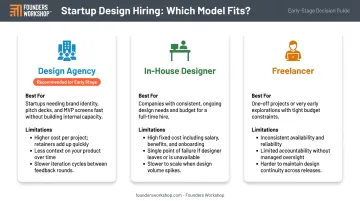
| Model | Best For | Limitations |
|---|---|---|
| Design Agency | Pre-seed through Series A; speed matters | Higher cost; varies in startup fit |
| In-House Designer | Post-product-market fit; stable design patterns | 6–12 weeks to hire; wrong timing for early stage |
| Freelancer | Defined, single-discipline tasks | Needs strong internal direction; rarely owns full product experience |
Why a Full-Service Firm Often Wins at Early Stage
For pre-product-market fit startups, a combined design and development firm eliminates the coordination overhead of managing separate vendors. Design decisions get made with engineering constraints in mind from day one, so what gets built matches what was designed.
Founders Workshop is built around this model. Their 5D Process runs Discovery, Definition (design), and Development through a single integrated team. The same Product Development Manager who oversees design also coordinates with engineering — which means decisions carry through to the final build without getting lost in handoffs. For first-time founders, that continuity matters: there's one team accountable for the full path from concept to shipped product.
A Simple Decision Framework
- Under 12 months of runway, no design culture yet → agency or full-service partner
- Reached product-market fit with stable design patterns → hire in-house
- Strong internal direction and a defined, bounded scope → freelancer
Product Design Pricing: What Startups Should Budget
The Three Pricing Models
- Project-based MVP design sprints — Pre-seed to seed engagements covering research through developer handoff for a defined scope. According to Clutch's June 2026 UX/UI pricing data, UX/UI projects typically cost $10,000–$49,999, with an average project cost of ~$85,000 and a 10-month timeline.
- Monthly retainers — Best for products still evolving post-launch. Clutch benchmarks average $8,895/month for ongoing UX/UI work.
- Discovery-only sprints — Lower-cost engagements (2–4 weeks) to validate direction before committing to a full build. A practical risk-reduction step for founders still validating product direction before committing to a full build.
Geography Significantly Affects Price
US-based agency hourly rates average $100–$149/hour. Nearshore Latin America-based teams commonly show $25–$49/hour on Clutch, with vendor-published benchmarks reporting 30–50% labor cost savings versus US hiring — while maintaining timezone alignment and English-language collaboration.
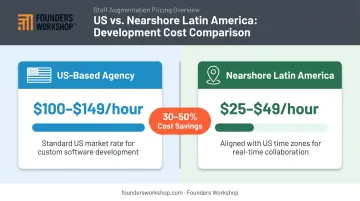
That cost gap is exactly what Founders Workshop's nearshore model is built on: US-based business analysts handle strategy and oversight, while Latin American development talent delivers at roughly one-third the cost of equivalent US teams.
Evaluate Pricing Against ROI, Not Just Cost
The real budget question isn't the hourly rate — it's what it costs to ship the wrong product and rebuild from scratch.
Before engaging any design partner, define 3–5 measurable success metrics:
- Onboarding completion rate
- Activation rate (users reaching the "aha moment")
- Trial-to-paid conversion
- Day-7 and Day-30 retention
- Support ticket volume related to confusion
These metrics let you evaluate the ROI of design investment in concrete terms — and give your design partner a clear definition of success to work toward.
Frequently Asked Questions
How much does it cost to hire a product designer?
Cost varies significantly by model and geography. US agency rates average $100–$149/hour; project-based UX/UI work typically runs $10,000–$49,999. Nearshore models offer 30–50% savings with comparable quality. The real risk isn't the design budget — it's the cost of building the wrong product.
Is product design still in demand?
Yes, and growing. The BLS projects 7% employment growth for software developers and digital designers from 2024 to 2034, with roughly 14,500 openings per year. As software markets get more competitive, user experience has become a primary differentiator — not a finishing touch.
What are the 4 pillars of product design?
User research, usability, aesthetics, and functionality. Effective product design integrates all four simultaneously — they're not sequential steps, and treating them that way is how products end up visually polished but functionally broken.
What is included in product design services for startups?
The core deliverables are UX research, user flows, wireframes, interactive prototypes, visual UI design, design systems, and developer handoff. Together, these cover the full path from validated concept to a product that engineers can actually build.
When should a startup invest in product design services?
Before any development begins — ideally. The most common and costly mistake is starting with engineering before the product experience has been validated. Design problems found in wireframes cost hours to fix; the same problems found in production cost weeks.
What's the difference between product design and product development?
Product design determines what to build and how it should work — research, UX, prototyping, and visual UI. Product development builds it: engineering, QA, and deployment. The two work best when integrated from the start, which is why combined design-and-dev firms typically outperform fragmented vendor setups at the early stage.