Introduction
Building a mobile app in 2026 isn't optional for most businesses — it's expected. But for US founders and SMBs, the math rarely works out cleanly. The Bureau of Labor Statistics projects 15% employment growth for software developers through 2034, with a 2024 median wage of $133,080. Local hiring cycles stretch 3–6 months. And bringing on a technical co-founder can mean surrendering 30–50% equity.
That's the gap nearshore mobile app development fills — specifically with Latin American teams. You get the same time zones and familiar business culture at significantly lower cost, without the overnight delays that come with offshore teams in Asia or Eastern Europe.
This guide gives you what you need to make a smart decision — and find the right partner to build it.
Key Takeaways
- Nearshore = development teams in nearby countries (LATAM for US companies), 0–3 time zones away
- Cuts development costs significantly while keeping teams in sync during your workday — no 3am standups required
- LATAM developer ecosystems are large and growing fast (Brazil: 5.4M+ GitHub developers; Mexico: 1.9M+)
- You can onboard a nearshore team in as little as 2 weeks — vs. 3–6 months to hire locally
- AI-assisted development is compressing MVP timelines further in 2026
What Is Nearshore Mobile App Development?
Nearshore mobile app development means outsourcing the design, development, and launch of a mobile application to teams in geographically nearby countries — typically within 0–3 time zones — rather than hiring locally (onshore) or working with distant overseas teams (offshore).
For US companies, Latin America is the primary nearshore region. Mexico, Colombia, Brazil, and Argentina are the dominant players — and the appeal comes down to four practical factors:
- Overlapping working hours with US time zones
- Strong English proficiency across technical roles
- Cultural familiarity with American business norms
- Developer rates well below US market costs
Deloitte identifies Latin America as an attractive region for scaling tech talent through nearshoring, and the developer headcount supports that assessment.
How Big Is LATAM's Developer Talent Pool?
According to GitHub's Octoverse 2024 report, the four primary nearshore countries show strong and growing developer communities:
| Country | GitHub Developers | YoY Growth |
|---|---|---|
| Brazil | 5.4M+ | 27% |
| Mexico | 1.9M+ | 21% |
| Argentina | 1.1M+ | 22% |
| Colombia | 1M+ | 25% |
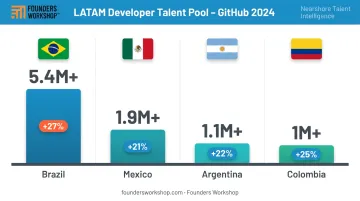
These figures reflect GitHub participation broadly, not mobile-specific roles. Even so, 20–27% year-over-year growth across all four countries points to a talent market that's actively expanding — not plateauing.
Key Benefits of Nearshore Mobile App Development
Cost Savings Without the Quality Trade-Off
US software developer wages averaged $133,080 annually in 2024 (BLS). Factor in benefits, recruiting costs, and the 3–6 month hiring runway, and building even a small in-house mobile team becomes expensive fast — often $750,000 to $1 million per year when fully loaded.
Nearshore LATAM teams don't require that investment. Firms like Founders Workshop, an Arizona-based software development company operating since 2008, provide nearshore Latin American staff augmentation at roughly one-third the cost of equivalent US teams — with no equity required and teams that can start in as little as two weeks.
Clutch's 2026 app development pricing data shows most reviewed app projects fall between $10,000–$49,999, with hourly rates commonly at $25–$49. GoodFirms pegs overall app build ranges from $15,000 to $500,000+. Your exact savings depend on project scope and team model — but for most US companies, nearshore LATAM rates land at roughly 30–40 cents on the dollar.
Real-Time Collaboration via Time Zone Alignment
This is where nearshore beats offshore decisively. Working with a team in India or Eastern Europe means critical feedback loops happen 12+ hours apart. Questions asked at end-of-day don't get answers until the next morning — a small friction that compounds into real delays over a 3-month development sprint.
LATAM teams don't have that problem. Here's the actual business-hour overlap on any given US workday:
| US Time Zone | Mexico City | Bogotá | São Paulo | Buenos Aires |
|---|---|---|---|---|
| Eastern (UTC-4) | 6 hours | 7 hours | 7 hours | 7 hours |
| Central (UTC-5) | 7 hours | 8 hours | 6 hours | 6 hours |
| Mountain (UTC-6) | 8 hours | 7 hours | 5 hours | 5 hours |
| Pacific (UTC-7) | 7 hours | 6 hours | 4 hours | 4 hours |
That's enough overlap to run daily standups, resolve blockers same-day, and participate in live Agile sprint reviews — without anyone working at midnight.
Access to Specialized Mobile Talent
That real-time collaboration only pays off if the team behind it has the right skills. Mobile-specific expertise — Swift, Kotlin, Flutter, React Native — is genuinely scarce in local US markets, especially for startups competing against large companies for the same engineers. LATAM's growing developer communities offer access to a wider pool of pre-vetted mobile engineers without the recruiting war.
AI tooling is increasing what those teams can deliver. GitHub's Copilot research found developers completed coding tasks 55% faster with AI assistance, and 88% reported improved productivity. Stack Overflow's 2024 survey found 76% of developers already use or plan to use AI tools. A nearshore team running AI-first workflows can effectively compress a 12-week mobile build into 8 — the same budget, faster delivery.
Faster Time to Market
Hiring locally takes 3–6 months before a single line of code gets written. Nearshore onboarding takes as little as 2 weeks.
For an MVP where timing matters, those missing months can mean the difference between launching before a competitor or after them.
Founders Workshop structures this through a Discovery phase (2–4 weeks) followed by a Definition phase (4–6 weeks) before a single line of production code is written — keeping the total path from idea to working MVP around 4–5 months.
Nearshore vs. Offshore vs. Onshore: Which Model Fits?
No model is universally right. Here's an honest comparison:
| Factor | Onshore (US) | Nearshore (LATAM) | Offshore (Asia/E. Europe) |
|---|---|---|---|
| Hourly cost | $100–$250+ | $40–$80/hr | $20–$50/hr |
| Time zone overlap | Full | 4–8 hours | 0–3 hours |
| Communication ease | Highest | High | Lower |
| Speed to market | Slower (hiring) | Fast (weeks to start) | Variable |
| Cultural alignment | Same | Strong | Often challenging |
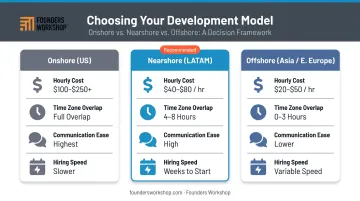
Choose nearshore when:
- Budget doesn't support US dev rates but the project requires real-time iteration
- Mobile UX demands rapid feedback loops — and mobile UX almost always does
- You need specialized skills — Flutter, React Native, AI integration — not easily found locally
- Time to market matters
Offshore may work when:
- The project is low complexity with minimal need for back-and-forth iteration
- Budget is extremely constrained and async communication is acceptable
- You have a detailed spec and minimal change tolerance
Onshore is worth it when:
- You're in a regulated industry with strict data residency requirements
- The project involves proprietary IP that requires tight contractual control under US jurisdiction
- The client relationship demands physical presence
For most US founders and SMBs shipping a first or second mobile product, nearshore delivers the cost savings of offshore without sacrificing the real-time collaboration that iterative mobile development requires.
How Much Does Nearshore Mobile App Development Cost in 2026?
Cost Ranges by App Complexity
Based on data from Clutch and GoodFirms 2026:
| App Tier | Observed Cost Range | Typical Timeline |
|---|---|---|
| Simple MVP | $15,000–$50,000 | 3–6 months |
| Mid-complexity app | $50,000–$150,000 | 5–9 months |
| Enterprise-grade app | $100,000–$500,000+ | 9–18+ months |
Clutch notes that post-launch maintenance typically runs 15–20% of the initial build cost annually, a cost many founders don't budget for upfront.
Key Cost Drivers
- Feature complexity: Basic CRUD functionality vs. real-time data, payments, AI features, or third-party integrations
- Platform choice: Cross-platform frameworks (Flutter, React Native) can reduce development time compared to building separate native iOS and Android apps
- Team seniority mix: Senior engineers cost more per hour but often write faster, cleaner code with fewer revision cycles
- Engagement model: Fixed-price works for well-scoped MVPs; time-and-material suits evolving roadmaps; staff augmentation fits ongoing feature development
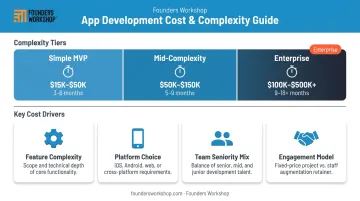
To put those ranges in context: Founders Workshop's fully managed engagements typically run $80,000–$350,000 for 3–6 months of work. That's a fraction of the $750,000–$1M annual cost of maintaining an equivalent in-house team.
Hidden Costs to Watch For
These inflate total project spend more often than the hourly rate does:
- Poor time zone alignment → delayed feedback → rework
- Inadequate QA → post-launch bug fixes at emergency rates
- Unclear IP ownership → legal disputes mid-project
- Vendor switching costs if the relationship breaks down
Nearshore arrangements address the first two risks by design — overlapping time zones keep feedback loops tight, and QA is built into the engagement structure. IP ownership and vendor lock-in, however, come down to contract language regardless of which model you choose.
The Nearshore Mobile App Development Process: From Idea to Launch
Discovery and Planning
This phase prevents the most expensive mistake in software development: building the wrong thing. A well-run discovery process defines product vision, technical feasibility, scope, and roadmap before any code is written.
At Founders Workshop, Discovery takes 2–4 weeks and is led by a Project Champion — a seasoned entrepreneur who helps de-risk the project upfront. Sessions cover:
- Goal definition and business model alignment
- User feature prioritization and integration requirements
- Tech stack recommendations
- Optional: market validation, competitive analysis, and initial UX wireframes
The deliverable is a clear, agreed-upon roadmap — scope, priorities, and success criteria documented before development spend begins.
Design, Prototyping, and Architecture
This is where the app takes visible shape. UI/UX design, interactive prototyping, and technical architecture decisions happen in parallel during the Definition phase (4–6 weeks).
The key output is a clickable prototype — an interactive mock-up that lets stakeholders click through screens before a single production feature is built. This is especially useful for mobile apps, where UX friction is harder to fix after launch than on web. Backend architecture, API design, and infrastructure decisions are also finalized here.
Real-time collaboration between client and nearshore team is essential during this phase — shared time zones mean design decisions get resolved in hours, not days.
Agile Development, QA, and Testing
Development runs through Agile sprints — typically 2-week cycles that deliver working features incrementally. Each sprint follows the Scrum framework:
- Sprint Planning: scope and goals defined for the cycle
- Daily Scrum: short syncs to surface blockers early
- Sprint Review: working features demonstrated to stakeholders
- Retrospective: process improvements identified before the next cycle
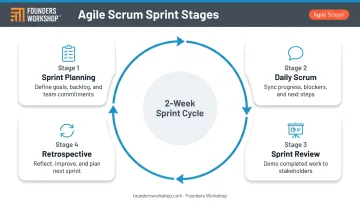
QA runs in parallel with development — not as a gate at the end. Founders Workshop uses dedicated testers throughout the Development phase (2–3 months). Automated testing has real limits; hands-on device testing catches UX issues that scripts miss.
Launch, Deployment, and Ongoing Support
Apple reviews 90% of app submissions in under 24 hours, organized around Safety, Performance, Business, Design, and Legal guidelines. Google Play requires setup through Play Console with policy compliance checks. These submission processes have real requirements — metadata, screenshots, compliance declarations — that benefit from a team that has navigated them before.
Post-launch, the work isn't done. Founders Workshop's D5 support model provides tiered maintenance packages — starting at $625/month for basic monitoring through higher tiers for active development support — covering:
- Performance monitoring and bug fixes
- Feature updates and app store maintenance
- Ongoing iteration based on user feedback
Most successful apps ship a v1, then improve — the D5 support structure keeps that cycle moving without requiring clients to rebuild a team after launch.
How to Choose the Right Nearshore Mobile App Development Partner
Vet for mobile-specific experience first. Look for a portfolio with apps similar in complexity, platform, and industry to your project. Check independent platforms like Clutch for verified reviews — not just vendor-curated case studies. Founders Workshop has delivered 200+ custom software products since 2008, with four solutions recognized by the Arizona Innovation Challenge.
Confirm time zone overlap and communication standards. Ask directly: What are your team's available hours? What tools do you use for daily collaboration? How are blockers escalated? A partner who can't answer these questions clearly is signaling how the project will actually run.
For founders especially, strategic thinking matters as much as technical skill. A partner who understands MVP scoping, product-market fit, and go-to-market timing is worth far more than a vendor that takes requirements and disappears. Founders Workshop's leadership team each bring 30+ years of entrepreneurial experience across 81 startups — that context shapes which features get built first and which get deferred.
Nail the contract basics upfront:
- Code ownership assigned explicitly to you from day one
- NDA covering product concepts and business logic
- Data security provisions appropriate to your industry (HIPAA compliance for healthcare, for example)
- Clear terms for IP if the engagement ends early
As WIPO notes, outsourcing creates IP pitfalls unless ownership, confidentiality, and access rights are addressed contractually. Founders Workshop states explicitly that clients hold the keys to their services and source code from day one, but always verify this in the actual agreement, not just the sales conversation.
Frequently Asked Questions
What is nearshore mobile app development?
Nearshore mobile app development means partnering with development teams in nearby countries — for US companies, primarily Latin America — who work in the same or similar time zones. It enables real-time collaboration at significantly lower cost than US-based teams, without the communication delays common in distant offshore arrangements.
How much does nearshore mobile app development cost?
Simple MVPs typically run $15,000–$50,000; mid-complexity apps $50,000–$150,000; enterprise-grade apps $100,000–$500,000+. LATAM nearshore teams cost substantially less per hour than US equivalents, and AI-assisted development workflows are compressing timelines and overall project costs further in 2026.
What is the difference between nearshore and offshore mobile development?
Nearshore means similar time zones and cultural alignment — LATAM teams for US companies share 4–8 hours of daily business-hour overlap. Offshore teams in India or Southeast Asia often have little to no overlap with US hours, which slows feedback cycles, increases rework, and extends timelines.
How long does it take to build a mobile app with a nearshore team?
Simple MVPs take roughly 3–6 months; mid-complexity apps 5–9 months; enterprise apps longer. A pre-vetted nearshore team can onboard in as little as 2 weeks — compared to 3–6 months for local hiring — meaning development can start much sooner after the decision is made.
Is Latin America a good nearshore destination for US companies?
LATAM is the strongest nearshore option for US companies. It offers 4–8 hours of daily time zone overlap, strong English proficiency, rapidly growing developer talent pools (Brazil alone has 5.4M+ GitHub developers), and cultural alignment with American business norms.
What should I look for when choosing a nearshore mobile app development partner?
Key criteria to evaluate:
- Mobile portfolio with verified client reviews
- Confirmed time zone overlap and clear communication practices
- Explicit IP and code ownership protections in the contract
- Strategic product expertise, not just technical execution
For founders building a first product, a partner with entrepreneurial experience can shape your roadmap and reduce costly pivots — not just ship code.