Introduction
Building software fast is expensive. A senior U.S. developer now commands a $133,080 median annual salary according to the Bureau of Labor Statistics' May 2024 data — and that's before benefits, recruiting fees, or equity. For a startup founder trying to get to market, staffing a full in-house engineering team can cost up to $1 million a year and take three to six months just to recruit.
That's the tension most founders know well: you need great software, fast, but you can't afford to build the team that makes it.
Nearshore Agile development has emerged as the answer — particularly for U.S. startups and SMBs tapping into Latin America's growing technical talent pool. The nearshore segment of software development outsourcing is forecast to grow at a 13.95% CAGR from 2026 to 2031. Cost parity, overlapping time zones, and a maturing Latin American tech ecosystem are driving that growth — and reshaping how U.S. founders build products.
Key Takeaways
- U.S. developer salaries average $133,080/year — nearshore Latin American teams can cost roughly a third of that
- 71% of software teams already use Agile, making it the standard way software gets built
- Time zone alignment with Latin America keeps standups, sprint reviews, and planning calls on your schedule — no 3 a.m. meetings
- Iterative sprint cycles mean founders see working software every 1–4 weeks, not months later
- The right nearshore partner delivers a documented process, senior developers, and a named point of contact — not a ticket queue
What Is Nearshore Agile Software Development?
Nearshore vs. Offshore
Nearshore outsourcing means partnering with development teams in geographically close countries that share similar time zones. For U.S. companies, that's Latin America — Mexico, Colombia, Argentina, Brazil, and beyond.
Offshore means distant countries with significant time zone gaps: India, Southeast Asia, Eastern Europe. The hourly rate looks lower on paper, but the real costs emerge in practice: delayed responses, miscommunication across time zones, and no direct access to the team building your product.
What Agile Actually Means
Agile is an iterative software development methodology built around flexibility, continuous collaboration, and short feedback loops. It was formalized in the Agile Manifesto in 2001, which established four core values:
- Working software over comprehensive documentation
- Customer collaboration over contract negotiation
- Responding to change over following a plan
- Individuals and interactions over processes and tools
Rather than planning everything upfront and building for months in silence, Agile teams work in short cycles — called sprints — delivering functional software at each stage. That continuous feedback loop only works when both sides can actually talk in real time — which is where nearshore location becomes the deciding factor.
The Combined Model
Nearshore Agile development brings these two ideas together: Agile teams who iterate in sprint cycles, located close enough to collaborate in real time with U.S. clients. For startups and SMBs, this matters because it solves the two biggest problems with outsourcing — losing visibility and losing speed.
Founders Workshop, for example, runs U.S.-based business analysts alongside its Latin American development team. Clients have a familiar point of contact while a senior technical team builds their product — in the same time zone.
Why Nearshore Agile Development Is Surging Right Now
Three structural shifts — a domestic talent shortage, normalized distributed work, and time zone math — have made nearshore Agile the default choice for U.S. startups and SMBs that need to ship fast without burning budget.
The U.S. Talent Shortage
The BLS projects 15% growth for software developer roles from 2024 to 2034, generating roughly 129,200 openings per year. Supply isn't keeping pace with demand, which means hiring domestically is both expensive and slow. For a bootstrapped startup, competing for that talent against funded tech companies is a losing battle.
Distributed Teams Are Now Normal
Before 2020, many founders hesitated to work with remote teams. That hesitation is largely gone. Digital.ai's 17th State of Agile Report found that 91% of respondents now work in fully distributed teams. The tooling, habits, and management practices for distributed Agile are mature — nearshore simply plugs into an existing operating model.
Time Zone Alignment Changes Everything
This is where nearshore beats offshore on more than just cost. Agile depends on real-time collaboration:
- Sprint planning requires shared context and back-and-forth
- Daily standups only work if everyone's awake
- Sprint reviews need client attendance and live feedback
- Retrospectives build team trust through candid conversation
That collaboration only works when everyone's online at the same time. A developer in Bogotá or Mexico City shares working hours with a founder in Phoenix or Austin. Teams in Asia or Eastern Europe often don't — which turns Agile ceremonies into async threads and pushes decisions back by 24 hours.
AI Is Amplifying Nearshore Output
AI development tools are compressing the cost-per-feature equation for nearshore teams. GitHub's 2022 research found that developers using Copilot completed a coding task 55% faster. Smaller, well-organized nearshore teams are now capable of output that previously required larger headcounts — which shifts the cost-value equation further in favor of nearshoring.
That productivity gain matters when choosing a development partner. Founders Workshop builds AI tooling directly into its development workflow — not as a talking point, but as a measurable factor in delivery speed and cost for each project.
Latin America's Talent Pool Is Deep
This isn't a limited labor market. Deloitte reports that Brazil and Mexico alone have over 2.2 million software engineering professionals and graduate more than 350,000 engineering students annually. That depth supports genuine team scaling — not just one-off hiring from a thin roster.
Key Benefits for Founders and SMBs
Significant Cost Savings
Nearshore Latin American teams can cost roughly a third of equivalent U.S.-based talent — a figure Founders Workshop applies directly across its staff augmentation engagements. Rate benchmarks from Clutch show U.S. development providers at $100–$149/hour, while Mexico and Colombia providers run $25–$49/hour.
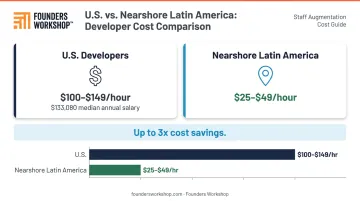
For a cash-conscious startup, that gap doesn't just reduce burn — it redirects capital toward product iteration, user acquisition, or the next funding milestone.
Faster Time to Market
Agile's sprint model (typically 1–4 weeks per cycle) means founders receive working, testable software incrementally. There's no waiting six months for a big reveal, only to discover you built the wrong thing.
ALBedFill, a senior care startup built through Founders Workshop's 5D Process, shipped its MVP in just three months. Booster Athletes launched in time for college football season despite requiring ten-plus custom integrations. Sprint-based delivery makes that kind of timing possible.
Real-Time Visibility and Control
Traditional outsourcing often means handing off requirements and waiting. Nearshore Agile works differently:
- Daily standups keep founders informed without lengthy status meetings
- Sprint demos show working software at the end of every cycle
- Retrospectives surface process issues before they compound
- Time zone alignment means questions get answered the same day
This is especially critical for founders without a technical co-founder. The structured feedback loop prevents the costly drift of building features nobody asked for.
Scalability Without Hiring Overhead
Nearshore Agile teams can scale with the project phase. Larger team for an MVP sprint, leaner team for post-launch maintenance. No recruiting lag, no severance, no HR overhead.
Founders Workshop applies talent fractionally based on budget, schedule, and scope — meaning clients aren't paying for a full team when a project is in a lighter phase. Full-time hires simply can't flex that way.
Built-In Risk Reduction
Agile's sprint structure surfaces bugs and misalignment before they compound:
- Each sprint includes testing — no final quality gate right before launch
- Clients review working software every cycle, not at the end of a long engagement
- Course corrections happen in week three, not month five
Founders Workshop amplifies this through its Definition phase, where UX/UI designers build clickable prototypes before a single line of production code is written. Founders validate ideas with real users or investors before committing to full development — a concrete way to eliminate the most expensive kind of mistake: building the wrong thing.
How Agile Works in a Nearshore Development Setting
The Sprint as the Core Unit
A Scrum sprint is timeboxed to one month or less — most nearshore teams run one to four week cycles. Each sprint moves through planning, development, testing, and review before the next one begins. Clients see real deliverables at every checkpoint, not just progress reports.
Agile Ceremonies in a Nearshore Context
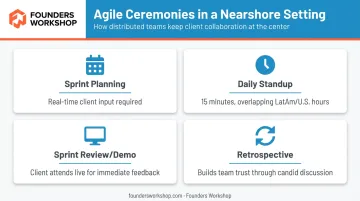
| Ceremony | Purpose | Nearshore Reality |
|---|---|---|
| Sprint Planning | Agree on what gets built this sprint | Requires real-time client input — time zone overlap is essential |
| Daily Standup | Keep the team synchronized | Works across LatAm/U.S. overlap hours; 15 minutes, daily |
| Sprint Review/Demo | Show working software to stakeholders | Client attends live; provides immediate feedback |
| Retrospective | Improve team process | Internal, but client insights welcome |
The 5 Stages of Agile Development
A nearshore Agile engagement typically moves through these stages:
- Define project goals, user value, and competitive positioning before a single line of code is written
- Translate business needs into user stories and a prioritized development roadmap
- Build features in sprints, with continuous client feedback and course-correction at each cycle
- Run unit, integration, and user acceptance testing before every release — not just at the end
- Iterate post-launch as user behavior and real-world product needs evolve
That progression maps directly onto how Founders Workshop structures its engagements. Each phase of the 5D Process (Discover, Define, Develop, Deploy, Dedicated Support) carries defined timeframes and client-visible deliverables, so there are no black-box stretches where work disappears and reappears weeks later.
Choosing the Right Agile Framework for Your Nearshore Team
Agile isn't a single methodology — it's a family of frameworks. The right choice depends on what you're building and where you are in the product lifecycle.
| Framework | Best For | Key Characteristic |
|---|---|---|
| Scrum | New product builds, MVP development | Fixed sprints, defined roles, regular ceremonies |
| Kanban | Ongoing maintenance, support work | Continuous flow, work-in-progress limits, less ceremony |
| Scrumban | Teams managing both features and live product | Hybrid — sprint structure with Kanban-style flow |
For founders building a new product, Scrum is the natural starting point. Its defined sprint cycles align with milestone-based delivery and make progress visible to investors and stakeholders. Digital.ai's 2024 report shows Scrum remains the leading team-level Agile framework at 63% usage — its sprint structure maps directly to investor milestones and stakeholder reviews.
As a product matures, the signals to shift frameworks become clear:
- Sprint backlogs fill with bug fixes and maintenance tickets rather than new features
- Release cycles become continuous rather than milestone-driven
- The team spends more time triaging than planning
That's when Kanban or Scrumban starts to make more sense than pure Scrum.
What to Look for in a Nearshore Agile Partner
Choosing the wrong partner is expensive. Here's what separates genuine Agile delivery from Agile in name only.
Proven Process and Delivery Maturity
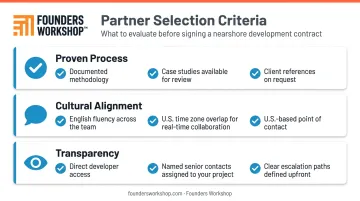
A strong partner documents their methodology — not just their willingness to work Agile. Look for case studies with specific timelines, client references, and evidence of repeatable delivery.
Founders Workshop's 5D Process is a concrete example: a structured framework with defined phases, timeframes, and deliverables at each stage. With 200+ completed projects since 2008 — four of which were recognized by the Arizona Innovation Challenge — the track record reflects consistent process execution across a wide range of project types and client needs.
Cultural Alignment and Communication Infrastructure
Technical skills matter. So does how a team communicates. Specifically, ask prospective partners:
- How do you handle sprint ceremonies with U.S.-based clients?
- What's your escalation path when an issue arises mid-sprint?
- How do you report status — and how often?
Partners whose teams speak fluent English, share U.S. business values, and have a U.S.-based point of contact reduce friction at every stage. Founders Workshop's model places U.S.-based business analysts in the client-facing role, with Latin American developers building in the same time zone.
Transparency and Direct Access to Builders
The best nearshore partners give clients direct access to the people building their software. Every Founders Workshop engagement includes a Project CTO, a Product Development Manager, and dedicated QA testers — not a single account manager bottleneck filtering every conversation.
Ask directly: who will I be talking to, and what's their seniority level? A vague answer usually means you'll be dealing with a project coordinator, not the people making technical decisions.
Frequently Asked Questions
What is nearshore software development?
Nearshore software development means partnering with development teams in geographically nearby countries that share similar time zones and cultural familiarity. For U.S. companies, this typically means Latin America — distinguishing it from offshore outsourcing, which involves distant countries with significant time zone and communication gaps.
What are the 4 types of Agile methodology for software development?
The four widely recognized Agile approaches are Scrum, Kanban, Lean, and Extreme Programming (XP). Scrum uses structured sprints; Kanban manages continuous flow; Lean eliminates waste; XP emphasizes engineering practices like pair programming. Most nearshore engagements run on Scrum or a Scrum-Kanban hybrid.
What are the 5 stages of Agile development?
The five stages are concept and ideation, requirements gathering, iterative development, testing and deployment, and maintenance and scaling. The cycle repeats continuously as the product evolves.
What are the 5 C's of Agile?
Five guiding principles in Agile practice are Clarity, Collaboration, Communication, Continuous Improvement, and Customer Focus. These reflect the behaviors that distinguish high-performing Agile teams and are best treated as practical priorities, not rigid rules.
Is nearshore Agile development a good fit for startups and SMBs?
Yes, and it's particularly well-suited to this stage. Nearshore Agile provides cost-efficient access to senior development talent, iterative delivery that reduces the risk of building the wrong thing, and the flexibility to scale the team up or down without the overhead of permanent hires.
How does nearshore Agile compare to hiring in-house developers?
Nearshore Agile typically offers faster team formation (weeks rather than months), lower cost, built-in delivery methodology, and flexible scaling. In-house hiring offers deeper long-term cultural integration but at significantly higher cost and longer ramp-up timelines, a trade-off most early-stage founders can't justify.