Introduction
Many founders spend six months and tens of thousands of dollars building a full product — only to launch it and hear crickets. No users, no traction, no product-market fit. The product wasn't technically broken. It just wasn't something the market wanted.
MVP application development exists to prevent exactly that. According to CB Insights, 35% of startups fail because there's no market need for their product — a problem an MVP is specifically designed to catch early. By shipping the leanest functional version of your software product first, you test your core assumptions with real users before full-scale development.
This guide is for entrepreneurs, startup founders, and SMB owners ready to take a software product idea to market without betting everything on an untested concept. By the end, you'll know how to build an MVP that validates fast, cuts waste, and gives you a real shot at product-market fit.
Key Takeaways
- An MVP is the simplest working version of your software product — built to test one core idea with real users, not ship a finished product
- According to CB Insights, 43% of failed startups cite poor product-market fit as a contributing factor — MVPs exist to catch this before it's too late
- The MVP process moves through six stages: define the problem, prioritize features, prototype, build, launch, then iterate based on real feedback
- Scope creep and skipping user research kill more MVPs than bad code ever does
- An experienced development partner can reduce time to market and help you avoid building the wrong thing
What Is an MVP in Application Development?
A Minimum Viable Product in application development is the simplest working version of a website or application that delivers real value to a specific group of users. As Eric Ries defines it, an MVP is "the version of a new product that enables the maximum amount of validated learning about customers with the least effort."
The emphasis is on learning — shipping a leaner product so you can gather real user feedback before investing in features that may not matter.
MVP vs. Prototype vs. Proof of Concept
These three terms get used interchangeably, but the distinction matters — each one answers a different question at a different stage:
| Term | Purpose | Tested With |
|---|---|---|
| Proof of Concept (PoC) | Tests technical feasibility | Internal team |
| Prototype | Tests design and user flows | Internal stakeholders or select users |
| MVP | Tests whether the product creates real market value | Actual users in the real market |
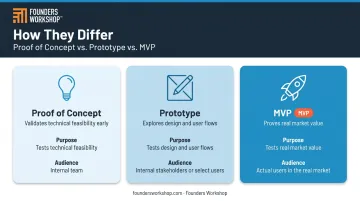
An MVP goes further than a PoC or prototype — it's a real, deployable product that real users interact with. It still needs to work reliably and deliver genuine value.
Types of Web MVPs
Choosing the right MVP format depends on the riskiest assumption you need to test:
- Landing page MVP — Validate demand before writing a single line of functional code. Buffer used a two-page site to confirm willingness to pay before building anything
- Single-feature MVP — Ship the one function that solves the core problem, nothing else
- Concierge MVP — Manually deliver the service to early users before automating it, testing whether the workflow creates real value
- No-code/low-code MVP — Use tools like Bubble or Airtable to validate demand without custom development
Why MVP Development Matters for Web Projects
The numbers on startup failure are sobering. The SBA's 2024 small business data shows only 49.2% of new employer establishments survive five years. And per CB Insights' analysis of VC-backed shutdowns, 43% of failed ventures were affected by poor product-market fit.
Building a full product before proving demand is the most expensive version of a mistake you could avoid in week two.
What Web Projects Specifically Demand of an MVP
Web products carry an additional validation challenge: you need to prove both the value proposition and the user experience simultaneously. In application development, UX friction is a product failure, not a design polish issue. If users can't complete the core action, their feedback tells you nothing useful about whether the idea has merit.
That's why application MVPs must clear a higher bar than a sketch or prototype. At minimum, they need to:
- Handle the primary user flow without dead ends
- Communicate value clearly before users hit a paywall or sign-up gate
- Load fast enough that friction doesn't masquerade as disinterest
- Give users one obvious next action at every step
How Early Traction Beats Any Pitch Deck
Airbnb started as a spare website built by two founders who needed to cover rent during the 2008 Democratic National Convention. Over 600 people booked non-hotel lodging through the site, with early listings ranging from $20 a night for an airbed to $3,000 for an entire house. That real-world signal — strangers will both list and book non-hotel accommodation — was the validation that justified building the full platform.
The pattern holds across successful software products: real users doing a real thing beats a compelling hypothesis every time. If your MVP can generate even a fraction of that kind of signal, you have something worth building on.
How to Build a Successful MVP Website: Step-by-Step
Each step here builds on the last. Skipping any phase increases the risk of building something nobody uses.
Step 1: Define the Problem and Target User
The process starts before any code is written. Founders must clearly define:
- The specific user pain point the MVP will solve
- The exact user segment experiencing that pain
- Initial hypotheses about user behavior and willingness to pay
Broad targeting kills MVPs. The product must serve one defined user with one defined problem — that constraint is what makes early feedback actionable.
Step 2: Conduct Market Research and Competitor Analysis
This step turns assumptions into evidence. Specifically:
- Run user interviews with 10–15 people in your target segment
- Map competitor offerings and identify what they consistently fail to address
- Review market data to confirm the gap is real and large enough to matter
Without this step, you're building on assumptions. The interviews alone will surface problems your product instincts never would.
Step 3: Prioritize Features Using a Framework
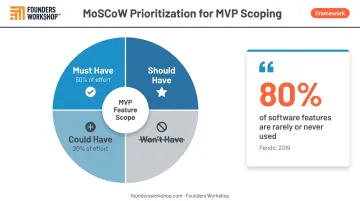
Feature prioritization is the discipline of deciding what gets cut. The MoSCoW framework — Must Have, Should Have, Could Have, Won't Have — is a practical tool for this. According to the Agile Business Consortium, "Must Have" requirements should typically account for no more than 60% of development effort, with "Could Have" items making up roughly 20%.
Why does this matter? Pendo's 2019 Feature Adoption Report, analyzing 615 products over three months, found that 80% of software features are rarely or never used. Most features built into v1 don't earn their place. The MoSCoW framework forces that conversation before development starts.
Aim for 2–5 core features in your MVP. Everything else goes on a future roadmap.
Step 4: Design Wireframes and User Flows
Wireframes define the interface structure and user journey without heavy visual design. This step answers: how will users move through the product to complete the core action?
Clean, intuitive UX at the MVP stage is non-negotiable. If users can't navigate the product, feedback centers on interface confusion — not whether the core value proposition works. Resolve UX early so your launch data actually tells you something useful.
Step 5: Build and Test the MVP
Choose a tech stack that's scalable but not over-engineered for the current scope. At this stage, the only goal is making core user flows functional and stable.
Activation rate: what percentage of signups complete the core action?
- Retention: do users return after day 1, day 7, day 30?
- Conversion: are users completing the action your business model depends on?
- Churn: who's leaving, and at what point in the journey?
Collect both quantitative data (analytics) and qualitative signals (user interviews, in-app feedback). Then run the Build-Measure-Learn loop: prioritize the changes with the highest signal, build them, and measure again.
Each iteration sharpens the product — and each cycle produces better data for the next decision.
Key Factors That Affect Your MVP's Success
Scope Discipline
The single biggest risk to an MVP is over-scoping. Every feature added at launch makes the build slower, more expensive, and harder to interpret. If three features ship and engagement is low, which one is the problem? Fewer features means clearer signals.
Quality of the Problem Definition
A vague problem produces a misdirected MVP. Founders who skip user research and jump to solution mode often build something technically solid but strategically off-target. The product works. It just doesn't solve a problem anyone cares enough about to pay for.
Speed vs. Stability
Launching fast is important, but shipping something broken is counterproductive. Performance matters from day one: as Google's research shows, as mobile page load time increases from 1 second to 10 seconds, bounce probability rises 123%. A slow or unstable MVP doesn't just frustrate users — it invalidates the test by making people leave before they experience the value proposition.
The practical answer: under-scope the feature set deliberately, then make sure what ships actually works.
Feedback Mechanisms
Speed and stability get users through the door — but an MVP only generates value if there's a deliberate plan to capture what they do next. That means:
- In-app feedback prompts
- Scheduled user interviews with early adopters
- Analytics tracking on every core user flow
- Clear criteria for what feedback triggers a pivot vs. an iteration
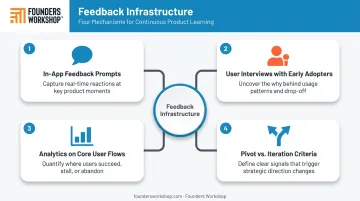
Without this infrastructure, you end up with usage data but no insight into why users stayed, churned, or never converted.
Common Mistakes in MVP Development
Most MVP failures trace back to a handful of predictable missteps. Knowing them in advance is half the battle.
"Minimum" doesn't mean broken. This is the most common misconception. Minimum refers to feature scope, not quality. Core features must work reliably — otherwise, user feedback reflects technical failure, not product-market fit.
The remaining three mistakes are less about mindset and more about execution:
- Waiting too long to launch. Reid Hoffman put it plainly in a 2017 LinkedIn essay: "If you're not embarrassed by the first version of your product, you've launched too late." Over-engineering before going live burns money, leaves assumptions untested, and produces a product increasingly disconnected from what users actually need.
- Treating the MVP as the final product. Some teams stop iterating after an initial launch shows mild positive signals. Early adoption is encouraging — but product-market fit requires sustained retention and growth. Keep the iteration loop running until the evidence is strong, not just promising.
- Launching without pre-defined KPIs. If there's no agreed-upon definition of "successful" before launch — in concrete, measurable terms — there's no basis for deciding what to improve, what to cut, or whether to pivot.
Frequently Asked Questions
What is an MVP in application development?
An MVP is the simplest functional version of a software product — built with only the core features needed to test a business idea with real users. The goal is to gather actionable feedback before committing to full-scale development.
How long does it take to build an MVP website?
Most application MVPs take 2–8 weeks for simple products and 1–4 months for more complex applications. Founders Workshop's 5D Process delivers market-ready MVPs in 3–6 months — if your scoping points longer, the feature set is too large.
How much does MVP application development cost?
Costs depend on complexity, team composition, and scope. Founders Workshop's fully managed MVP projects typically run $80,000–$350,000 for a 3–6 month engagement, with a nearshore development model that costs roughly a third of a comparable US-based team.
What is the difference between an MVP and a prototype?
A prototype tests design and user flows — typically not released to external users. An MVP is a real, deployable product released to early adopters to test whether the business idea creates actual value in the market.
How many features should an MVP have?
Limit an MVP to 2–5 core features focused entirely on solving the primary user pain point. Anything that doesn't directly serve that goal belongs on the roadmap for a later release, not in v1.
When should I hire an external team to build my MVP?
Hire an external partner when you lack in-house technical expertise, need to move fast, or want to avoid giving up equity to a technical co-founder. Founders Workshop typically starts within two weeks — no equity required.