The risk of building wrong is concrete. CB Insights' 2026 analysis of 431 VC-backed shutdowns found that 43% failed due to poor product-market fit and 70% ran out of capital. An MVP design agency helps founders avoid both by validating core product decisions before committing to full-scale development.
This post covers five agencies worth evaluating — a mix of NYC-based studios and remote partners — along with the criteria used to select them and practical guidance for choosing the right fit based on your stage.
Key Takeaways
- MVP design agencies combine UX/UI, product strategy, and often development to get a testable product in front of users fast
- 43% of VC-backed startups fail from poor product-market fit — the right agency partner reduces that risk before you burn through seed capital
- NYC agencies typically start at $10K–$25K for design work; nearshore partners can deliver the same quality at roughly one-third the cost
- Agencies were selected for startup track record, design + dev capability, pricing transparency, and Clutch ratings
- Founders Workshop's nearshore model offers MVP design and development at roughly one-third the cost of fully US-based teams
What Is an MVP Design Agency and Why Do NYC Startups Need One?
An MVP design agency does more than produce wireframes. The best ones combine UX research, product strategy, interface design, and front-end or full-stack development — giving founders a validated, testable product before they commit to a full build.
That distinction matters in New York specifically. With NYC companies raising $23.8B in VC funding in 2024 — 11.3% of nationwide venture capital — investors here have high expectations and short patience for products that haven't been tested with real users. Founders who skip validation and jump into full builds risk burning through runway chasing a product direction that users don't want.
The agencies below were selected with that risk in mind. Each one helps founders reach market faster by focusing on:
- Scoping the build to what users actually need
- Testing assumptions before committing to full development
- Keeping costs controlled without sacrificing product quality
Top MVP Design Agencies for Startups in New York
Selection criteria included: demonstrated startup track record, design and development capability under one roof, Clutch ratings and verified client feedback, pricing transparency, and fit for pre-seed to Series A founders — not just enterprise clients.
Perpetual
NYC-based full-service studio founded in 2012. Perpetual specializes in research-driven UX design paired with full-stack development — making it a strong fit for founders who want one team to own the product from discovery through deployment.
What sets them apart is how UX research gets integrated throughout the engagement rather than front-loaded into a single discovery sprint. That approach reduces costly rework at the development stage, which matters when budgets are tight.
| Category | Details |
|---|---|
| Services | UX/UI design, software development, product strategy, DevOps |
| Pricing Model | Project-based, minimum ~$25K; hourly rate $100–$149 |
| Clutch Rating | 4.9/5 across 96 reviews |
| Best For | Founders who need design and development under one roof with research baked in |
Designli
Startup-focused design and development agency with over 13 years of early-stage product experience. Designli was built specifically for early-stage founders who need to move from idea to working product without a months-long discovery process that delays actual progress.
Fixed-fee pricing removes the scope creep anxiety that plagues many first-time founders working with hourly shops. Their agile sprint model keeps momentum high between milestones.
| Category | Details |
|---|---|
| Services | UX/UI design, MVP development, product strategy, mobile apps |
| Pricing Model | Fixed-fee packages; minimum project ~$10K |
| Clutch Rating | 5.0/5 across 79 reviews |
| Best For | First-time founders who need a validated MVP prototype shipped quickly with predictable costs |
thoughtbot
Design-led development firm with a New York presence and a fully remote team spanning the Americas, Europe, and beyond. thoughtbot runs design sprints that feed directly into build decisions — so every development choice has user research behind it, not just assumptions.
Designers and engineers work in tandem from day one, which eliminates the hand-off delays that slow down most agency relationships. Particularly well-suited for SaaS and B2B product founders who need both UX rigor and technical execution in parallel.
| Category | Details |
|---|---|
| Services | UX/UI design, product strategy, software + mobile development, AI integrations |
| Pricing Model | Hourly $150–$199; minimum project ~$10K, most projects $50K+ |
| Clutch Rating | 4.9/5 across 39 reviews |
| Best For | Founders who want design thinking and agile engineering running together from MVP to scale |
AppMakers USA
New York-based boutique agency with offices at 47 W 14th St and a track record of 400+ apps and $1B+ raised collectively by client companies. AppMakers USA offers a client-first process with a dedicated project manager at each stage — making it easier to stay aligned without juggling multiple vendors.
Their two-week average design phase is faster than most agencies, and their work spans both consumer brands and enterprise tools.
| Category | Details |
|---|---|
| Services | UX/UI design, mobile app development, apps, AI integrations, product strategy |
| Pricing Model | Monthly packages from ~$5K; full-cycle projects starting at $10K |
| Clutch Rating | 5.0/5 across 98 reviews |
| Best For | Mobile-first startups that want hands-on collaboration and fast prototype-to-launch timelines |
Founders Workshop
Arizona-based software innovation firm founded in 2008. Founders Workshop delivers full-cycle MVPs — UX design, development, AI integration, and business strategy — without requiring founders to give up equity.
The leadership team (CEO Vincent Serpico, CPO Wayne Neale, COO Michael Vanderslice) brings 30+ years of combined experience as founders, investors, and business owners. They've worked with 81 startups and owned 31 businesses — which means they scope MVPs as operators, not just builders.
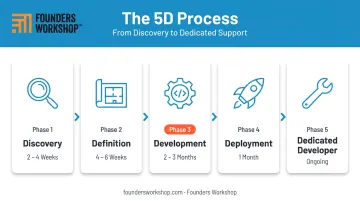
The proprietary 5D Process guides every engagement through five phases:
- Discovery (2–4 weeks) — Feature scoping, business model development, technology stack planning
- Definition (4–6 weeks) — Clickable prototype, UX/UI designs, architecture spec
- Development (2–3 months) — Agile build using the approved roadmap
- Deployment (1 month) — Launch support, cloud hosting, monitoring
- Dedicated Developer (ongoing) — Maintenance, bug fixes, feature iterations
For NYC founders weighing cost, the nearshore model is the key differentiator. Latin American development teams deliver at roughly one-third the cost of fully US-based teams — with the same time zone, language, and cultural alignment. That cost structure makes senior-level product leadership accessible at a price point that fits seed and pre-seed budgets.
Real MVP examples from the 5D Process include:
- ALBedFill (senior care) — MVP delivered in three months
- Booster Athletes (content monetization) — Complex mobile app with 10+ integrations launched in time for college football season
- HomeKey (home management) — AI-enabled backend with a consumer-friendly UX
- rDigz (real estate) — Competitive platform helping realtors compete against Zillow
| Category | Details |
|---|---|
| Services | MVP design + development, UX/UI, AI integration, product strategy, staff augmentation |
| Pricing Model | Custom project pricing; typical MVP range $80K–$350K; nearshore model at ~⅓ of NYC agency rates |
| Best For | Budget-conscious NYC founders who want senior-level product leadership and proven MVP execution without NYC overhead costs |
How We Chose the Best MVP Design Agencies for NYC Startups
Many founders pick an agency based on portfolio aesthetics or name recognition alone. That's a mistake at the MVP stage, where startup-specific experience matters more than brand size.
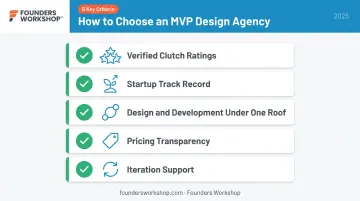
Evaluation criteria used:
- Verified Clutch ratings with published, third-party client reviews
- Pre-seed to Series A track record — not just enterprise portfolios
- Combined design and development capability to reduce hand-off risk
- Published rates or clear pricing models as a prerequisite
- Support for customer discovery and iteration, not just one-time delivery
Some agencies were excluded regardless of reputation or portfolio size:
- Enterprise-only portfolios with no startup or seed-stage work
- Studios lacking verified third-party reviews
- Agencies whose pricing floors rule out most seed-stage budgets
- Vendors who treat UX as a one-time deliverable rather than an ongoing process
The focus was identifying teams that understand what a pre-revenue founder actually needs — a clear process, a focused product, and a partner who respects the runway.
Conclusion
Choosing an MVP design agency in New York comes down to fit: the right process, genuine startup experience, and a pricing model that protects your runway for what comes after launch.
A pre-seed founder validating an idea has different needs than a Series A team redesigning an existing product. The right agency should understand that distinction before they propose a single line of scope.
That's the foundation behind Founders Workshop's 5D Process — built by a leadership team with 30+ years of experience as founders, investors, and operators across 200+ software projects. For New York startups weighing NYC agency rates, Founders Workshop delivers at roughly one-third the cost without sacrificing the strategic depth early-stage products need. Schedule a Discovery Call to explore fit for your product.
Frequently Asked Questions
What is the 80/20 rule in UX design?
The 80/20 rule (Pareto Principle) in UX design means roughly 80% of users rely on only 20% of a product's features. MVP designers should focus on identifying and perfecting that critical 20% before expanding functionality. NN/g recommends prioritizing the features responsible for the majority of user value before building anything else.
What is the 60-30-10 rule in UX design?
The 60-30-10 rule is a color proportion guideline in UI design: 60% dominant or background color, 30% secondary color, and 10% accent. It creates visual hierarchy and brand consistency without overwhelming the user, making it a practical tool for maintaining clarity in MVP interfaces.
How much does MVP design cost for a startup in New York?
NYC-based agency projects typically start at $10K–$25K for design-only work and can reach $100K+ for design plus development. Remote or nearshore partners can deliver comparable quality at lower rates. Founders Workshop's nearshore model, for example, typically delivers at around one-third of local NYC agency rates.
What is the difference between an MVP design agency and a full-service product studio?
MVP design agencies focus on the fastest path to a testable, market-ready product — prioritizing core user flows and validation. Full-service product studios typically offer broader services like branding, marketing strategy, and long-term product management, often at higher minimum engagement thresholds.
How long does it take to design an MVP?
A focused MVP design engagement typically takes 4–12 weeks depending on complexity. Wireframes and clickable prototypes are often deliverable in 4–6 weeks; full design plus development generally runs 3–6 months. Founders Workshop's 5D Process covers Discovery through Deployment within that range.
Should a New York startup hire a local agency or work with a remote partner?
Local agencies offer proximity and in-person collaboration but come with higher cost floors. Remote or nearshore partners can match quality and responsiveness at lower rates. For most early-stage founders, the deciding factors are budget and communication fit — in-person meetings rarely make or break the engagement.