Introduction
Banking's relationship with AI has moved well past the experimental phase. According to Gartner, 85% of customer service leaders planned to explore or pilot customer-facing conversational GenAI in 2025 — and financial institutions are driving a significant share of that adoption.
The pressure is real. Customers expect instant answers, 24/7 availability, and the ability to complete transactions without sitting on hold. Legacy infrastructure and compliance requirements make that hard to deliver at scale.
Conversational AI closes the gap. It handles high-volume, repeatable interactions — balance checks, card freezes, fraud alerts, loan status updates — without proportional staffing costs, while maintaining the audit trails and authentication controls that regulators require.
This article covers the best conversational AI banking platforms in 2026, how they were evaluated, and what to prioritize when choosing one. Whether you're running a large institution or building a fintech product from scratch, what separates genuine banking-grade solutions from general-purpose AI retrofitted for finance matters more than vendor marketing suggests.
Key Takeaways
- Conversational AI uses NLP and machine learning to handle banking interactions via chat or voice — balance inquiries, transfers, fraud disputes — without human agents
- Leading platforms combine multi-turn conversation handling with compliance controls: audit trails, MFA, and data residency options
- Top solutions: Rasa, IBM watsonx Orchestrate, Google Cloud CCAI, Nuance (Microsoft), and Kore.ai — suited to different bank sizes and deployment models
- Key selection criteria: compliance architecture, core banking integration depth, omnichannel reach, and escalation design
- Banks building differentiated products should weigh off-the-shelf speed-to-market against the control a custom build provides
What Is Conversational AI in Banking?
Conversational AI in banking refers to AI-powered systems that let customers interact with their financial institution using natural language — through chat, voice, or messaging — rather than phone trees or static forms.
The distinction from legacy rule-based chatbots matters. Traditional bots follow rigid decision trees and break down the moment a customer phrases something unexpectedly.
Conversational AI uses intent recognition and context retention across multiple turns. More importantly, it can execute real banking actions — initiating transfers, freezing cards, opening dispute tickets, or pulling account-specific data — within a single conversation.
Core Use Cases Driving Adoption
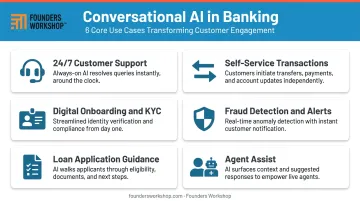
The highest-impact use cases in 2026 are the ones that drain support resources most:
- 24/7 customer support — balance inquiries, transaction history, branch/ATM locators
- Self-service transactions — transfers, bill payments, card activation and freezes
- Digital onboarding and KYC — document collection, identity verification flows
- Fraud detection and proactive alerts — anomaly notification, dispute initiation
- Loan application guidance — pre-qualification, document checklists, status updates
- Agent assist — real-time transcription and guidance for human agents handling complex cases
Today's platforms have moved well beyond intent-matching. Agentic AI can now coordinate multi-step workflows across backend systems — a shift that changes what's possible for institutions of any size.
Best Conversational AI Banking Solutions in 2026
These platforms were shortlisted based on documented real-world banking deployments, compliance readiness, integration depth, and specificity of financial services support — not general-purpose AI adapted for banking.
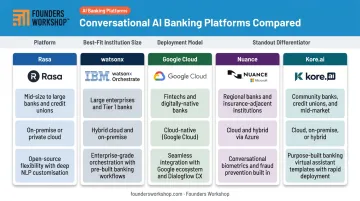
Rasa
Rasa is an open-source conversational AI platform with an enterprise tier (Rasa Pro) built for regulated industries. Its most cited banking deployment is N26, where Rasa's Neon assistant went from idea to production in just four weeks, handling 20–30% of customer service requests across five languages.
Rasa Pro runs on-premises or on private Kubernetes/OpenShift infrastructure. Rasa's product privacy policy explicitly states it does not process personal data as part of its products, which means banks under strict GDPR or data residency requirements can deploy it without a compliance exception.
Its CALM (Conversational AI with Language Models) architecture pairs deterministic logic for compliance-critical paths with LLM flexibility for natural conversation. That combination directly reduces the risk of unpredictable AI behavior on regulated transactions.
| Attribute | Details |
|---|---|
| Best For | Mid-to-large banks and fintechs needing full data sovereignty and customizable conversation flows |
| Deployment Model | On-premises, private cloud, or hybrid (no third-party data exposure) |
| Key Banking Features | Multi-turn context management, native voice support, omnichannel (WhatsApp, SMS, web, app, phone), full-context escalation handoff |
IBM watsonx Orchestrate
IBM watsonx Orchestrate functions as an agentic control plane that coordinates multiple tools, data sources, and human agents within a single orchestrated workflow. For large banks with complex legacy infrastructure, that orchestration layer is the core value proposition.
IBM's compliance framework is substantial. The IBM Cloud for Financial Services framework includes 608 control requirements across 21 control families, initially built on NIST 800-53 standards. The Granite model family supports the explainability requirements that regulators increasingly expect when AI influences customer-facing decisions.
The platform integrates natively with IBM's financial services cloud and supports existing mainframe infrastructure, a practical consideration for institutions where replacing core systems isn't viable.
| Attribute | Details |
|---|---|
| Best For | Large banks with complex legacy infrastructure and strict governance requirements |
| Deployment Model | IBM Cloud, on-premises, or hybrid; IBM Financial Services Cloud meets major regulatory standards |
| Key Banking Features | Agentic AI orchestration, explainable AI outputs, native core banking and CRM integration, agent assist with real-time transcription |
Google Cloud CCAI / Dialogflow CX
Google Cloud's Contact Center AI (CCAI) bundles Dialogflow CX for virtual agents and Agent Assist for human-agent support, powering conversational banking at serious scale. Wells Fargo's "Fargo" assistant was built on Google Cloud AI, with architecture designed to keep Wells Fargo data within Wells Fargo's own systems. Third-party reporting (via VentureBeat) puts Fargo's interaction count at over 245 million, though Google and Wells Fargo have not published that figure in primary sources.
CCAI's differentiator is Google's NLP and speech infrastructure. Google's platform supports over 100 languages and dialects, making it a strong choice for banks operating across multiple markets. For high call-center volumes, the combination of AI virtual agents handling routine calls and Agent Assist surfacing context during escalations creates measurable reductions in handle time.
The platform integrates with major contact center infrastructure: Avaya and Twilio are documented in Dialogflow CX integration guides; Genesys and Cisco are verified Google Cloud partners.
| Attribute | Details |
|---|---|
| Best For | Banks with large call center operations seeking to deflect high-volume voice and chat interactions |
| Deployment Model | Google Cloud; integrates with Genesys, Avaya, Cisco, and Twilio |
| Key Banking Features | Voice-native NLU, real-time agent assist, multilingual support (100+ languages), Dialogflow CX visual flow builder |
Nuance Communications (Microsoft)
Nuance, now part of Microsoft, has one of the longest track records in financial services voice AI. Its Gatekeeper product uses passive voice biometrics to authenticate callers through natural conversation, eliminating security questions and reducing fraud risk before calls even reach an agent.
Microsoft verifies that Gatekeeper can detect fraudulent calls before they reach a contact center, reduce average call handling time, and integrate with Dynamics 365 Customer Service. As part of Microsoft, the platform connects to Azure OpenAI Service for GenAI-enhanced conversation and Microsoft 365 for internal agent workflows.
For banks already running Microsoft infrastructure, the integration depth is a genuine advantage rather than a marketing claim.
| Attribute | Details |
|---|---|
| Best For | Banks prioritizing voice channel automation, voice biometric fraud prevention, and Microsoft ecosystem integration |
| Deployment Model | Microsoft Azure; hybrid options for regulated markets |
| Key Banking Features | Passive voice biometrics (Gatekeeper), IVR modernization, GenAI-enhanced virtual assistant, Azure OpenAI integration, Dynamics 365 connectivity |
Kore.ai
Kore.ai offers the most banking-specific out-of-the-box solution on this list. Its BankAssist product launched with 200+ prebuilt retail banking use cases covering account management, loan servicing, card operations, fraud resolution, and wealth management inquiries.
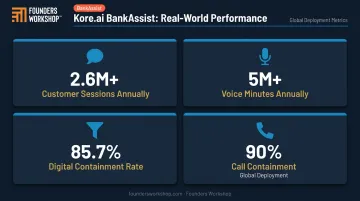
The metrics from live deployments are the strongest in this comparison. A U.S. regional bank case study reports 2.6 million+ customer sessions and 5 million+ voice minutes annually, with 85.7% digital containment and 42.4% voice containment. A separate global banking deployment across 65 million credit card customers achieved 90% call containment. Pre-integrated connectors for Jack Henry, Fiserv, and FIS reduce the integration work for banks running common core systems.
Kore.ai was named a Leader in the Forrester Wave for Conversational AI in Q2 2024, receiving top scores across 12 evaluation criteria.
| Attribute | Details |
|---|---|
| Best For | Community banks, credit unions, and mid-market institutions seeking faster deployment with pre-built banking workflows |
| Deployment Model | Cloud (AWS, Azure, GCP) or on-premises; pre-certified for banking regulatory environments |
| Key Banking Features | BankAssist pre-built flows, no-code/low-code flow editor, pre-integrated core banking connectors, built-in CSAT and containment analytics |
Key Features to Look For in a Banking Conversational AI Platform
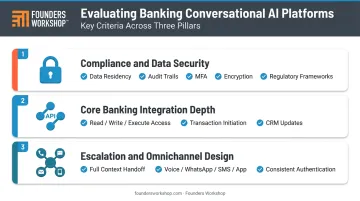
Most conversational AI platforms are built for general-purpose use — not the compliance constraints, integration depth, and escalation demands of financial services. Three evaluation areas tell you whether a platform is actually ready for banking:
Compliance and Data Security Architecture
Start here before evaluating anything else. A platform that can't meet your compliance baseline isn't a platform — it's a liability. Look for:
- On-premises or private cloud deployment for data residency requirements
- Automatic interaction logging for complete audit trails
- Consistent MFA enforcement on every transactional request
- Encryption of data in transit and at rest
- Alignment with applicable frameworks — GDPR, NIST 800-53, or the EU AI Act's high-risk AI requirements for creditworthiness and financial decisions
Core Banking Integration Depth
There's a significant difference between a platform that can surface information and one that can execute actions. Look for systems that can retrieve account data, initiate transactions, trigger fraud workflows, and update CRM records — all within a single conversation and with proper authorization at each step. Read-only API access won't cut it. Production banking deployments require write and execute permissions across core systems, not just data retrieval.
Escalation Design and Omnichannel Consistency
Poor escalation design is where customer satisfaction collapses. Prioritize platforms that:
- Transfer full conversation context to human agents during handoffs (customers should never repeat themselves)
- Support the channels your customers actually use — voice, WhatsApp, in-app chat, SMS
- Maintain consistent authentication and context across all channels
How We Chose the Best Conversational AI Banking Solutions
The common mistake in platform evaluation is prioritizing demo performance over operational readiness. These five platforms were selected based on documented banking deployments, compliance track record, integration depth, and banking-specific feature sets — not general-purpose AI retrofitted for financial services.
Analyst validation supports the shortlist. Here's how each platform stacks up across major analyst frameworks:
| Platform | Recognition |
|---|---|
| IBM | Leader — 2025 IDC MarketScape (General-Purpose Conversational AI) |
| Leader — 2025 IDC MarketScape; Leader — 2025 Gartner Magic Quadrant | |
| Kore.ai | Leader — 2025 IDC MarketScape; Leader — Forrester Wave |
| Microsoft | Major Player — 2025 IDC MarketScape |
| Rasa | Selected on direct banking deployment evidence, not analyst placement |
Evaluation factors weighted in this selection:
- Regulatory compliance posture and deployment model flexibility
- Banking-specific use case coverage out of the box
- Multi-channel and multilingual capability
- Quality of escalation and human handoff design
- Evidence of measurable outcomes in live banking environments
Banks and fintechs building differentiated products may find that off-the-shelf platforms fall short of the integration depth their product roadmap actually requires. Core banking system connections, custom compliance workflows, and proprietary data pipelines are areas where packaged solutions routinely hit their limits.
That gap is where custom development earns its place. Founders Workshop has helped financial services and fintech clients design and build AI-powered solutions through its 5D Process — a structured approach that addresses core system integration from the start, not as an afterthought.
Conclusion
The best conversational AI banking solution is the one that fits your compliance environment, existing infrastructure, customer channel preferences, and realistic implementation timeline — not the one with the longest feature list.
- Rasa and IBM suit large enterprises with complex governance and data residency requirements
- Google CCAI fits high-volume voice and contact center operations with multilingual needs
- Nuance is strongest for Microsoft-ecosystem banks prioritizing voice channel security
- Kore.ai delivers faster deployment for mid-market institutions and community banks
Before committing, test platforms against real banking scenarios — edge cases, slang-heavy queries, regulated escalation flows — and bring compliance and security teams into the evaluation from day one.
Whether you're a fintech building from scratch or an established institution replacing legacy IVR, the integration depth and compliance architecture you build in at the start determines how much the system can actually do for customers in production.
Founders Workshop has been helping financial services and fintech companies build custom AI-driven software since 2008. If a purpose-built solution would outperform an off-the-shelf platform for your use case, reach out to discuss your architecture requirements.
Frequently Asked Questions
What is the difference between conversational AI and a traditional banking chatbot?
Traditional chatbots follow rigid, pre-scripted decision trees and break when customers phrase things unexpectedly. Conversational AI uses NLP and machine learning to understand intent, retain context across multiple turns, and execute real banking actions — making it capable of handling far more complex and varied interactions at scale.
Which conversational AI banking solution is best for small banks or credit unions?
Kore.ai's BankAssist is the strongest fit for smaller institutions, thanks to its 200+ pre-built banking flows and pre-integrated connectors for core systems like Jack Henry and FIS. Community banks with simpler, high-volume needs may also find cloud-hosted Dialogflow CX a manageable starting point.
How does conversational AI in banking ensure regulatory compliance and data security?
Core protections include:
- On-premises or private cloud deployment for data residency
- Automatic interaction logging for audit trails
- Consistent MFA enforcement on transactional requests
- Encryption of data in transit and at rest
Platforms like Rasa and IBM watsonx are built specifically for regulated industries with these controls included.
What are the most common use cases for conversational AI in banking in 2026?
The highest-impact use cases are 24/7 customer support and balance inquiries, self-service transactions (transfers, bill pay, card activation), fraud detection and proactive alerts, digital onboarding and KYC, and agent assist for human agents handling complex escalations.
How long does it typically take to implement a conversational AI solution for a bank?
Timelines vary significantly. Rasa's N26 deployment went from idea to production in four weeks for a targeted use case. Enterprise deployments with deep core system integration typically require three to six months. Custom-built solutions may take longer but offer greater long-term flexibility and proprietary integration depth.
Can conversational AI handle complex banking tasks like loan applications or fraud disputes?
Modern agentic AI platforms can guide customers through multi-step workflows — loan pre-qualification, document collection, dispute initiation — but success depends on deep backend integration, well-designed escalation paths to human agents, and thorough regulatory testing before going live.