Introduction
Most enterprise software projects don't fail because the team executed poorly. They fail because the organization built the wrong product at full scale — committing millions in budget, months of development, and significant organizational capital before confirming that anyone actually needed what was built.
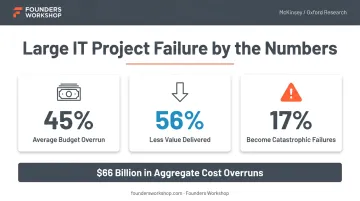
A McKinsey and Oxford study of 5,400+ large IT projects found that the average project ran 45% over budget, 7% over schedule, and delivered 56% less value than predicted. Seventeen percent became "black swans" — with budget overruns exceeding 200%.
MVP development is built to prevent exactly this outcome. But applying it inside an established enterprise is a different challenge than applying it in a 10-person startup. Organizational dynamics, compliance requirements, legacy systems, and stakeholder structures all change what "minimum viable" actually means.
If you lead product, innovation, or technology at an established enterprise, this guide is for you. It covers:
- What enterprise MVP development actually is
- Why it works differently at scale than in a startup
- How to execute it step by step
- When it may not be the right fit
Key Takeaways
- Enterprise MVP development builds the smallest functional product version that validates a key business assumption — before committing to full-scale investment
- Unlike startup MVPs, enterprise MVPs must account for stakeholder buy-in, legacy integration, and compliance from day one
- The five core steps: validate and align stakeholders, prioritize features, prototype, build with Agile, then launch and iterate
- Key enterprise-specific challenges include managing expectations around an intentionally limited release, ensuring scalability, and integrating with legacy systems
- MVP development isn't always the right approach; highly regulated environments and commoditized use cases may need a different path
What Is Enterprise MVP Development?
An MVP — Minimum Viable Product — is the first working version of a product built with only the features necessary to solve a core problem and collect validated feedback from real users. It isn't a rough draft or a beta — it's a deliberate learning tool designed to generate evidence, not just output.
Enterprise MVP development applies this approach inside organizations that carry more financial accountability, more organizational complexity, and more stakeholder scrutiny than a typical startup. The goal is the same: prove that a product concept addresses a real need before committing full budget and infrastructure to a complete build.
That means it isn't a corner-cutting exercise, a prototype with no path to production, or an excuse to skip proper engineering standards. The key distinction from full product development is intentional scope limitation. Enterprise MVP development forces teams to identify the single most important use case, build only that, and generate real evidence about whether it works.
The logic applies equally to internal tools and workflow systems. Many enterprises apply MVP thinking not just to external product launches but to departmental software, automation systems, and operational tools — where the same logic holds: validate before you invest at scale.
Why Enterprises Need MVP Development
Risk Reduction First
Enterprises face a genuine tension. There's pressure to innovate and launch new digital products faster. But there's also greater financial accountability, brand risk, and organizational complexity than any startup faces.
The McKinsey/Oxford data makes the risk concrete: 17% of large IT projects become catastrophic budget failures, and the aggregate cost overruns in their study reached $66 billion. Unlike a startup that can pivot quickly and cheaply, an enterprise that launches a failed full-scale product absorbs reputational damage, wasted budget, and significant organizational disruption.
MVP development addresses this directly. By validating core assumptions early — with a fraction of the investment — enterprises avoid the worst outcomes before they're locked in.
How Enterprise MVPs Differ from Startup MVPs
Here's where they diverge:
| Dimension | Enterprise MVP | Startup MVP |
|---|---|---|
| Primary purpose | Stakeholder validation + risk reduction | Market fit discovery |
| Budget | Larger, with formal approval cycles | Lean, founder-controlled |
| Decision speed | Slower, multi-stakeholder | Fast, founder-driven |
| Target audience | Internal users or enterprise customers | External market |
| Scalability requirements | Must be built in from day one | Often deferred initially |
| Compliance requirements | High in regulated industries | Lower for most early builds |
| Risk tolerance | Low — brand and budget exposure is high | Higher — pivoting is expected |
Enterprise MVPs are more complex to build. They're still far less costly than a full-scale product launch.
Getting to Market Faster — Even with Approval Cycles
Even accounting for internal approval cycles, an MVP gets something functional in front of real users faster than a complete product build. That matters. McKinsey's Developer Velocity research found that top-quartile software development organizations achieved 4–5x faster revenue growth and 60% higher total shareholder returns compared to bottom-quartile peers over a five-year period.
For enterprises, that gap is compounding. Organizations that validate assumptions early don't just ship faster on a single product — they build institutional knowledge, reduce approval friction on future initiatives, and widen their lead over competitors still waiting for full builds to complete.
How to Build an Enterprise MVP: Step by Step
Building an enterprise MVP is an iterative, research-driven process. Each stage reduces uncertainty before the next investment is made. Here's how it works in practice.
Step 1: Validate the Idea and Align Stakeholders
Enterprise MVP development starts before any design or code. It starts with user research.
The goal is to confirm that the problem is real and worth solving — through user interviews, surveys, and usability feedback from existing tools. In enterprise environments, assumptions about what "users need" are often shaped by internal politics rather than actual user behavior. Research cuts through that.
Stakeholder alignment is the other uniquely enterprise challenge here. Decision-making involves multiple leaders across business units, IT, legal, and finance. Getting buy-in early means framing the MVP correctly — not as an incomplete product, but as a risk-reduction mechanism that protects the organization's investment.
Founders Workshop's Discovery phase (typically two to four weeks) is structured specifically for this moment — helping enterprises define goals, prioritize user features, and identify technical integrations before any development budget is committed.
Step 2: Define and Prioritize Core Features
Research attributed to the Standish Group suggests that 45% of software features are never used and 19% are rarely used — meaning nearly two-thirds of what typically gets built provides little or no value to users. Feature bloat is expensive, and it's one of the primary reasons enterprise software projects run over time and budget.
This step forces a hard question: what does the MVP actually need?
Two frameworks work particularly well in stakeholder-heavy environments:
- MoSCoW (Must/Should/Could/Won't have) — categorizes features by necessity, making it easier to cut without executive debate
- RICE (Reach/Impact/Confidence/Effort) — scores features objectively, reducing the influence of internal politics on prioritization decisions
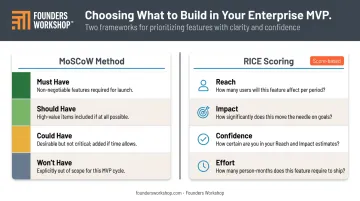
When feature decisions are based on scoring rather than seniority, it's easier to defend what gets cut from the MVP — and what belongs on the future roadmap.
Step 3: Design and Prototype
Design moves in two stages: wireframes, then prototype.
Wireframes are low-fidelity, low-cost representations of layout and flow. They let teams test navigation logic and information architecture without writing a line of code. A high-fidelity prototype goes further — simulating the actual user experience well enough for meaningful usability testing.
The investment in this stage pays back disproportionately. IBM research citing NIST data found that a defect costing 1x to fix during design costs up to 30x to fix after release. Catching design and flow problems before development begins isn't just good practice — it's one of the highest-ROI activities in the entire project.
Test the prototype with a small group of real users before development begins. Even five to eight usability sessions will surface the issues that would otherwise become expensive mid-build corrections.
Step 4: Build Using Agile Methodology
A Software Requirements Specification (SRS) document comes first — translating validated features into functional and non-functional requirements that serve as the authoritative blueprint for the development team and the primary mechanism for controlling scope creep.
Why Agile fits enterprise MVPs:
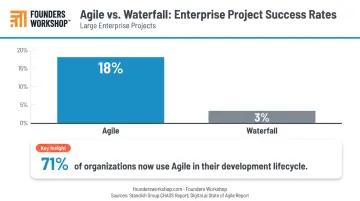
Digital.ai's 17th State of Agile Report found that 71% of organizations now use Agile in their software development lifecycle, with 63% using Scrum at the team level. The reason is straightforward: short sprints enable rapid iteration, early testing, and the flexibility to adjust course based on feedback without derailing the entire project.
For large enterprise projects specifically, the Standish Group's CHAOS Report found 18% success for Agile versus just 3% for waterfall. That gap makes methodology choice a strategic decision, not just an implementation detail.
Tech stack considerations for enterprises:
Unlike startups that can choose any stack freely, enterprise MVPs must remain compatible with existing systems and infrastructure. Building on incompatible technology creates integration debt that compounds quickly at scale.
Founders Workshop's 5D Process — which moves systematically from Discovery through Definition, Development, Deployment, and Dedicated Support — is specifically designed to take enterprise ideas through this stage, with a Project CTO actively managing technical architecture and a Product Development Manager serving as the primary client contact throughout.
Step 5: Launch, Collect Feedback, and Iterate
The feedback loop must be designed before launch, not after. Define the metrics you'll track during the MVP phase before any users touch the product:
- Usage data — which features are being used, which are being ignored
- Task completion rates — are users accomplishing what the product is designed to help them do
- User satisfaction indicators — NPS, direct feedback, support request volume
- Feature adoption — how quickly new users reach the core value moment
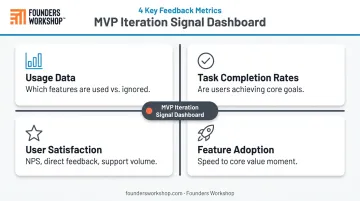
These signals determine where iteration focuses next — and whether the MVP has validated the core assumption or surfaced a need to pivot. If adoption is low on a feature you bet heavily on, that's not a failure; it's exactly the kind of intelligence the MVP was built to produce.
Key Challenges Unique to Enterprise MVP Projects
Managing Stakeholder Expectations
Enterprise leaders often expect feature-complete products and resist intentionally limited releases. The solution is proactive communication throughout the project — not just at launch.
Frame the MVP as a validation mechanism, not a reduced-quality deliverable. Three practices help shift that perception:
- Frame the MVP explicitly as a validation mechanism with a clear post-launch roadmap
- Schedule regular updates to keep stakeholders informed between milestones
- Show evidence of what the data will prove before asking for patience
When leaders understand they're seeing Version 1 of an evidence-based product, resistance typically drops significantly.
Scalability from Day One
This is where enterprise MVPs diverge sharply from startup MVPs. Startups sometimes defer scalability decisions until they've validated market fit. Enterprises cannot.
An enterprise MVP — whether internal or customer-facing — may immediately face large user loads and data volumes. Building with modular architecture and cloud infrastructure (AWS, Azure, Google Cloud) from the start allows features and capacity to expand without rebuilding the foundation. According to McKinsey research on technical debt, 10–20% of new-product technology budgets are already diverted to address technical debt from prior architectural decisions. That's a cost that compounds when the underlying architecture wasn't built to scale.
Founders Workshop builds on AWS infrastructure, providing scalable cloud hosting with 24/7 monitoring as part of their deployment process. And scalable architecture only holds up if it connects cleanly to what already exists — which leads to the next challenge.
Legacy System Integration
Enterprise MVPs almost always need to connect with existing ERP systems, internal databases, or legacy platforms — many of which don't have accessible or well-documented APIs. Underestimating this challenge is one of the most common reasons enterprise MVP timelines and budgets overrun.
A thorough systems audit before development begins is non-negotiable. It identifies integration points, API availability, data format requirements, and the connectors that need to be built. Teams experienced in enterprise integrations — building connected workflows, executive dashboards, and customer portals against existing enterprise stacks — navigate this complexity more efficiently than those encountering it for the first time.
Compliance and Security Requirements
Enterprises in regulated industries — healthcare, fintech, financial services — face strict requirements around data privacy, security standards, and regulatory compliance. These cannot be retrofitted into the MVP after the fact.
HHS enforcement data shows that HIPAA compliance failures have generated over $144 million in settlements since the OCR began tracking enforcement. For financial platforms, IBM's 2024 breach cost research found average breach costs reaching $4.88 million globally, with mega-breaches running far higher.
Build compliance in from the first sprint, not as a post-launch checklist. Remediating security gaps in a live product costs far more — in dollars and in operational disruption — than planning for them upfront.
When an MVP May Not Be the Right Approach
When Full Regulatory Approval Is Required First
In certain regulated environments, no version of the product can reach any user — even in a limited pilot — without complete compliance certification. MVP methodology assumes you can learn from real users early. If that's structurally impossible, consider a phased internal testing approach or a proof-of-concept model instead.
When Organizational Dynamics Prevent Iteration
The MVP model's core premise is launch lean, learn fast, and iterate. If the organizational environment requires a fully defined, fully approved, fully documented product before any development budget is released, the methodology is structurally mismatched.
The right response is to work on changing the internal process and decision-making culture before committing to an iterative approach. Forcing MVP methodology into a bureaucratic approval environment doesn't accelerate learning — it just adds frustration.
When a Mature Off-the-Shelf Solution Already Exists
If the use case is well-defined, widely served by existing enterprise software, and not a source of competitive differentiation, building a custom MVP is likely a waste of resources compared to configuring an existing platform.
Custom MVP development earns its cost when:
- The product concept is novel or unproven in the market
- Existing platforms can't accommodate the organization's specific workflows
- The capability is a direct source of competitive differentiation
If a major ERP or CRM vendor already solves the problem adequately, a custom build is the wrong starting point.
Frequently Asked Questions
What is MVP development in business?
MVP development is the practice of building the smallest functional version of a product that delivers core value and allows real user testing. Rather than committing full resources to a complete build, teams launch a deliberately limited product, collect feedback, and use that evidence to guide what gets built next.
How is enterprise MVP development different from startup MVP development?
Enterprise MVPs require formal stakeholder buy-in, must be scalable and integration-ready from day one, often target internal users rather than external customers, and operate within stricter compliance and budget approval frameworks. They're more complex to execute than startup MVPs — but still far faster and cheaper than full enterprise product launches.
How much does it cost to build an enterprise MVP?
Costs vary widely, but most enterprise MVPs fall between $25,000 and $500,000 depending on complexity, features, and team location. Founders Workshop's projects typically run $80,000–$350,000 for a 3–6 month build — and nearshore development teams can reduce that cost to roughly one-third of fully onshore US rates.
How long does it take to build an enterprise MVP?
Well-scoped enterprise MVPs typically take three to six months from discovery to initial launch, depending on product complexity, approval cycles, and team size. Agile approaches compress this timeline significantly — and consistently outperform waterfall on large-project success rates.
What are the biggest challenges of enterprise MVP development?
Managing stakeholder expectations around an intentionally limited release, ensuring scalability and legacy system integration from day one, and navigating compliance requirements in regulated industries are the most common pressure points. All three require deliberate planning upfront — not workarounds discovered mid-build.
Should enterprises build their MVP in-house or outsource it?
Both paths are viable, but outsourcing is often faster and more cost-efficient — particularly when internal product development capacity is limited. Building an in-house team typically takes three to six months to recruit and approaches $1 million annually in salaries and benefits. When evaluating an external partner, prioritize domain expertise, a proven delivery process, clear IP ownership terms, and demonstrated experience with enterprise-scale integrations.