Introduction
Most startup founders hit the same wall: a clear product vision, no straightforward path to build it, and a growing list of bad options. Hire a technical co-founder and give up 30–50% of your company. Assemble an in-house team and spend $750K–$1M per year before shipping a single feature. Or go cheap offshore and risk ending up with unusable code that needs a complete rewrite.
The stakes are real. CB Insights' analysis of 400+ startup post-mortems found that 43% cited poor product-market fit — and the Startup Genome project found that 74% of high-growth startups failed from premature scaling, often by over-investing in technology before demand was proven.
Getting the build decision right — and finding the right partner to execute it — is often the difference between a funded MVP and a dead company. This guide walks through what custom software development is, when it makes sense over off-the-shelf tools, what it costs, how the process works, and how to pick a partner who won't burn your runway.
Key Takeaways
- Custom software is built specifically for your users and workflows — unlike SaaS tools that force you to adapt to their limitations
- Costs range from under $30K for a simple MVP to $200K+ for a full-featured platform, depending on scope and team location
- A structured process (discovery → prototype → agile sprints → launch) keeps builds on time and on budget
- Nearshore Latin American development cuts costs by 30%+ versus U.S. rates, while maintaining timezone overlap and communication quality
- Top mistakes: over-building v1, chasing a technical co-founder when a dev partner will do, and ignoring IP ownership clauses in contracts
What Is Custom Software Development (and Why It Matters for Startups)
Gartner defines custom software development as professional services engaged to design, build, modernize, or iterate applications and software products to meet unique business needs. In practice, the software is built around your specific users, workflows, and business model — shaped by your needs, not a vendor's feature roadmap.
This is the core contrast with COTS (commercial off-the-shelf) software. NIST defines COTS as ready-made IT products available for purchase by the general public — think Salesforce, QuickBooks, or Shopify. These tools are built for the broadest possible audience, which means they're nobody's perfect fit.
Why Custom Development Is Uniquely Relevant to Startups
Startups often operate in markets where no existing tool solves the exact problem. When your software does something existing products can't replicate, it becomes a competitive moat — not just a utility.
A few scenarios where this plays out:
- The software is the product. If you're building a SaaS platform, marketplace, or app-based service, you're not buying tools to run your business — you're building the thing you sell.
- Your workflow is proprietary. Competitive advantage often lives in how you do something. Off-the-shelf tools expose that workflow to your competitors (and your vendor).
- No existing solution fits. Niche industries, specialized services, and emerging markets rarely have purpose-built tools. Custom software fills that gap.
Custom development also doesn't always mean starting from scratch. It can mean extending an existing platform through APIs and integrations to create functionality that's entirely proprietary. Founders Workshop, for example, has built enterprise integration projects connecting disparate systems through APIs, executive dashboards, and customer portals — giving clients a unified operational picture that no single off-the-shelf tool provided.
Custom Software vs. Off-the-Shelf Solutions: Making the Right Call
Most founders approach this decision from the wrong angle — defaulting to custom too early, or sticking with SaaS tools too long. The right answer depends entirely on where your startup is right now.
The Core Tradeoff
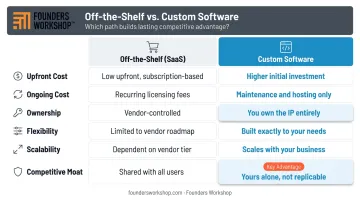
| Off-the-Shelf (SaaS) | Custom Software | |
|---|---|---|
| Upfront cost | Low | Higher |
| Ongoing cost | Monthly/annual licensing | Maintenance and support |
| Ownership | None — you're renting | Full — you own the code |
| Flexibility | Limited to vendor roadmap | Built exactly to your specs |
| Scalability | Vendor-dependent | Scales with your needs |
| Competitive moat | Minimal | Strong |
When Custom Software Is the Right Call
- The software itself is what you're selling
- No existing tool solves your specific problem well enough
- Your internal workflows are a source of differentiation you want to protect
- You've validated demand and are ready to invest in a proprietary solution
When Off-the-Shelf Makes More Sense
- You're still validating whether anyone wants what you're building
- The software is supporting infrastructure, not your core product
- A SaaS tool can cover 80% of your needs at a fraction of the cost
Many successful startups begin with off-the-shelf tools precisely to test demand cheaply. Once they've proven a market exists, they invest in custom development to own the solution and outperform competitors who are still stitching together SaaS subscriptions.
The MVP Middle Path
An MVP (Minimum Viable Product) is the practical answer to "when do I start building custom software?" It's a purposefully scoped product — built only to prove your core value proposition, not to ship every feature you've imagined. Build only the features that prove your core value proposition. Validate with real users. Then expand deliberately based on what you learn.
Ownership is what makes this investment worthwhile long-term. With custom software, no vendor can change pricing, kill a feature you depend on, or shut down and take your product with them. That risk is real with SaaS, and it grows more costly the further you scale.
How Much Does Custom Software Development Cost?
Costs vary significantly by scope, team location, and complexity. Here's what the data shows.
Cost Ranges by Project Type
Based on GoodFirms' 2026 Custom Software Development Cost Survey:
| Project Type | Cost Range | Timeline |
|---|---|---|
| Simple MVP / small project | Under $30,000 | 1–3 months |
| Medium complexity app | $30,000–$100,000 | 3–6 months |
| Large / full-featured platform | $100,000–$200,000+ | 6–12 months |
| Complex enterprise application | $250,000–$500,000+ | 12–18+ months |
Founders Workshop's own project history reflects this range — builds have started at $25K and extended to nearly $1M for multi-year engagements. The average Clutch-tracked project runs around $132K over 13 months.
How Team Location Affects Cost
Developer rates vary dramatically by geography:
- U.S. agencies: $100–$149/hour (Clutch data)
- U.S. median software developer wage: ~$63/hour (BLS, May 2024)
- Latin America nearshore providers: $25–$99/hour depending on country and seniority
Accelerance reports that Latin American nearshore teams deliver savings of over 30% compared to U.S. rates. Founders Workshop's nearshore model — U.S.-based project leadership paired with Latin American development teams — achieves costs at roughly one-third of what a fully domestic team would run.
Agency vs. Freelancers vs. In-House
Geography shapes your rate — but your hiring model shapes everything else about how the project gets built and managed:
- Agency: Consistent quality, established process, faster ramp-up. Higher cost than freelancers, but lower risk of mid-project abandonment or inconsistent output.
- Freelancers: Lower hourly rate, but no team infrastructure, no QA, no project management. Works for very small, well-defined tasks.
- In-house engineers: Maximum control, but $750K–$1M annually in salaries and benefits before you've shipped anything. A 3–6 month recruiting cycle adds more delay.
The Real Cost of Choosing on Price Alone
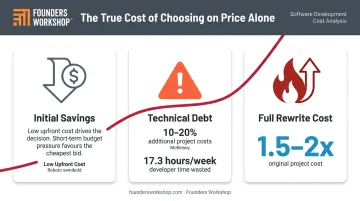
McKinsey found that companies pay an additional 10–20% on top of project costs to address technical debt. Stripe's developer research found developers spend 17.3 hours per week on maintenance — including 3.8 hours per week specifically on bad code. When a cheap provider delivers an unusable codebase, those "savings" vanish — and a full rewrite typically runs 1.5–2x the cost of doing it right the first time.
The Custom Software Development Process, Step by Step
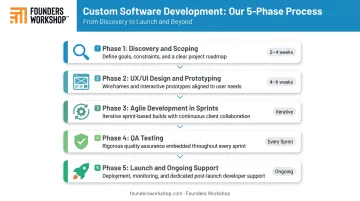
Phase 1: Discovery and Scoping
Before any design or code begins, the business problem gets defined, user needs get mapped, and scope gets locked down. Discovery is where projects earn — or lose — their best chance at success.
Founders Workshop's Discovery phase (2–4 weeks) produces a budget, feature-priority list, technical integration map, and monetization model. PMI research identifies poor requirements management as a leading cause of project failure — skipping or rushing discovery is the single most expensive mistake a startup can make.
The deliverable is a decision: exactly what gets built, and exactly why.
Phase 2: UX/UI Design and Prototyping
Before a line of code gets written, designers build wireframes and clickable prototypes — interactive mockups that let you navigate screens as if the product already exists.
This phase (4–6 weeks at Founders Workshop) catches design problems when they're cheap to fix. Founders use prototypes to validate with early users, present to investors, and lock in stakeholder alignment. Changes to a prototype take hours. Changes to shipped code take days or weeks.
Phase 3: Agile Development in Sprints
Agile development — breaking work into short, iterative cycles — outperforms waterfall by a wide margin. Mountain Goat Software's accessible summary of the Standish Group CHAOS report found agile projects succeeded roughly 3x as often as waterfall projects.
In practice, this means:
- Scope each sprint (typically 2 weeks) around specific, shippable features
- Build and test within the sprint
- Demo working software to the founder
- Incorporate feedback before the next sprint begins
This approach kills the "big reveal" failure mode, where a team builds for months and delivers something that misses the mark entirely.
Phase 4: QA Testing
Testing runs through every sprint — not just at the end. Founders Workshop QA testers conduct manual testing before deployment because automated testing alone misses many real-world UX issues that only surface with human interaction.
Each sprint's QA pass typically covers:
- Functional testing against defined acceptance criteria
- Edge cases and error state handling
- Cross-device and cross-browser behavior
- User flow validation before demo
Quality assurance is built into the process, not bolted on at the end.
Phase 5: Launch and Ongoing Support
Real users expose edge cases, performance issues, and feature gaps that no amount of testing predicts. Launch is a milestone, not a finish line — post-launch support is as important as the build itself.
Founders Workshop's D5 Dedicated Developer phase provides 80–160 hours per month of ongoing support, with tiered packages starting at $625/month. One client, WellPsyche, has maintained this relationship for eight years — from early MVP through full-scale operation.
How to Choose the Right Custom Software Development Partner
Essential Criteria for Startup Founders
- Startup-specific experience. Enterprise development is a different discipline. Startups need speed, flexibility, and partners who understand constrained runway. Ask specifically: how many startup MVPs have you shipped, and what happened to them?
- Transparent, structured process. A partner without a defined process is a risk, not a resource. Ask to see the methodology before you sign anything.
- Relevant tech stack expertise. The partner's preferred technologies should match your product's requirements — not the other way around.
- Verified third-party reviews. Clutch lists 350,000+ providers with identity-verified reviews. G2 has 3M+ reviews from verified users. Both are reliable signals of consistent delivery — or consistent failure.
Red Flags to Watch For
- Agrees to every feature request without pushback on scope
- Promises unusually fast timelines or below-market rates
- Vague or inconsistent communication during the sales process
- No portfolio of startup-specific work with traceable outcomes
What Separates a Partner from a Vendor
Avoiding those red flags gets you to the shortlist. Getting to the right choice means understanding the deeper distinction: a vendor executes your feature list. A partner challenges it.
The best development partners think about your business model, your market, and your users — not just your backlog. They push back on scope when it doesn't serve the goal. They flag business model risks alongside technical ones.
Our leadership team has worked at 81 startups and owns or has owned 31 businesses. That experience shapes how we prioritize scope in Discovery, how we structure handoffs, and how we make post-launch calls. Our 5D Process was built across 200+ engagements to reduce wasted builds and get founders to a market-ready product faster.

Common Mistakes Startups Make in Custom Software Development
Over-Building Version One
The 80/20 principle applies here: roughly 80% of user value comes from 20% of features. Most founders want everything in version one. That instinct is understandable. It's also consistently expensive.
An MVP should answer one question: does the core value proposition work? Build only what's needed to answer that question. Validate with real users. Then expand based on what you learn, not what you assumed.
The Technical Co-Founder Trap
Many founders spend months — sometimes years — searching for the perfect technical co-founder. The cost isn't just time. Carta's 2024 Founder Ownership Report found that Series A founders at median-stage startups retain roughly 37% equity by the time they raise. A technical co-founder brought on during a moment of desperation can easily absorb another 20–40 points of that — before you've proven the business.
A specialized development partner with startup experience can serve the same function — without equity dilution, with an established team, and with the ability to start in weeks instead of months.
Neglecting IP Ownership
This is a legal issue that trips up founders who focus on speed. The U.S. Copyright Office's guidance on works made for hire establishes that code written by a contractor doesn't automatically belong to the client — it requires an explicit written agreement.
Every development contract must clearly address:
- Full ownership of all source code assigned to your company
- Transfer of design assets, documentation, and third-party licenses
- No retained rights or liens by the development firm
- Written confirmation before work begins — not after delivery
Founders Workshop builds this into every engagement from day one — clients receive full repository access and ownership of all deliverables, with no vendor lock-in.
Frequently Asked Questions
What is the 80/20 rule in software development?
The 80/20 rule (Pareto Principle) in software development holds that roughly 80% of a product's value comes from 20% of its features. Startups use this principle to focus only on the highest-impact features first, avoiding over-engineering before demand is validated.
How much does it cost to develop custom software?
Costs vary widely by complexity and team location. Simple MVPs typically run under $30,000, mid-complexity apps fall between $30,000–$100,000, and full-featured platforms often exceed $100,000–$200,000+. Nearshore development teams in Latin America can reduce costs by over 30% compared to fully U.S.-based teams.
Should a startup build custom software or use off-the-shelf tools first?
It depends on whether the software is the product itself or supporting infrastructure. Many successful startups begin with off-the-shelf tools to validate demand cheaply, then invest in custom development once they've proven a market exists and need full control over the product experience.
How long does it take to build custom software for a startup?
A focused MVP typically takes 3–6 months with an experienced team. For instance, ALBedFill's MVP was delivered in three months through Founders Workshop's 5D Process. More complex platforms can take 9–18 months. How clearly you define scope during discovery heavily shapes the timeline.
Do I need a technical co-founder to build custom software?
No. A specialized development partner with startup experience can serve this function without requiring equity. Partners bring established teams, proven processes, and the ability to start quickly — advantages a co-founder still finding their footing rarely matches.