Introduction
Two founders pitch the same idea to two different development firms. One quote comes back at $35,000. The other is $280,000. Both are for "the same app."
This happens constantly — and it's not because one vendor is lying. Application costs genuinely vary by an order of magnitude based on feature complexity, design requirements, team model, and compliance obligations. A founder who doesn't understand these variables will either underspend and ship something that won't scale, or overspend on features nobody needs yet.
This guide covers:
- Realistic pricing tiers for common app types
- The factors that push costs up or down
- What founders routinely miss when budgeting
- How to estimate the right number for your specific situation
Key Takeaways
- Simple apps cost $10,000–$50,000; mid-complexity apps $50,000–$150,000; enterprise-grade systems $150,000–$500,000+
- Biggest cost drivers: feature complexity, UI/UX customization, team location, and third-party integrations
- Scope an MVP first if budget is tight — nearshore development cuts US overhead costs significantly
- Annual maintenance costs 10–20% of your original build cost, so factor it into your budget before you launch
How Much Does It Cost to Build an Application?
Application pricing has no fixed answer. The same core concept — say, a marketplace where buyers and sellers transact — can cost $40,000 or $400,000 depending on how it's scoped, who builds it, and what infrastructure it requires.
What goes wrong most often: founders get one quote, assume it's representative, and build a budget around it. Then scope creep hits.
According to GoodFirms' 2026 custom software development survey, 65.6% of respondents said scope changes increased their project cost by 10–25%. That's before maintenance, hosting, or post-launch feature work.
The three tiers below reflect how cost scales with scope, complexity, and compliance requirements.
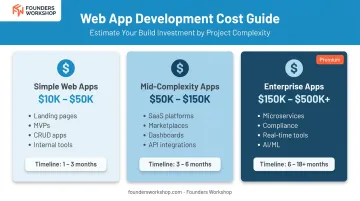
Simple Applications ($10,000–$50,000)
What fits here:
- Landing pages with form capture or basic lead flows
- Early-stage MVPs with limited features and no complex backend logic
- Simple CRUD applications (create, read, update, delete data)
- Internal tools with a single user role and minimal integrations
Typically included: Basic UI, limited user flows, minimal third-party connections
Typically excluded: Custom design work, scalable infrastructure, external API integrations
Best for: Validating an idea before committing larger budget, or launching a first version to collect real user feedback
Mid-Complexity Applications ($50,000–$150,000)
What fits here:
- SaaS platforms with user authentication and role-based access
- Marketplaces with buyer/seller flows and payment processing
- Dashboards with data visualization and reporting
- Apps with multiple API integrations (CRMs, payment processors, mapping)
Typically included: Custom UI/UX, responsive design, third-party integrations, structured database architecture
Typically excluded: Enterprise security layers, high-load infrastructure, AI/ML features
Best for: Early-stage SaaS products, startup MVPs built for investor demos, or internal business tools replacing manual processes
Timeline: 3–6 months with a cross-functional team
Complex and Enterprise Applications ($150,000–$500,000+)
What fits here:
- Enterprise platforms with microservices architecture
- Apps requiring HIPAA, PCI DSS, or SOC 2 compliance
- Real-time collaboration tools or high-load systems
- AI-powered features, custom ML models, or large-scale data processing
Typically included: Multi-region infrastructure, advanced security architecture, compliance audits, and 6–18+ month timelines with larger teams
Typically excluded: Off-the-shelf components — nearly everything at this tier is custom-built
Cost drivers: AI/ML development can add up to 30% to project cost, and compliance certifications (HIPAA, PCI DSS, SOC 2) each carry their own audit and implementation overhead
Best for: Mature startups scaling a proven product, or enterprises replacing legacy systems
Key Factors That Affect App Development Cost
Pricing is shaped by technical, operational, and business decisions. Change any one of them and your budget shifts, sometimes by a wide margin.
App Complexity and Feature Scope
Feature count and sophistication is the single largest cost driver. A simple CRUD app with basic user flows might take 500 development hours. Add real-time sync, custom analytics, and AI-powered recommendations, and that same app becomes 2,500–5,000 hours.
, driven entirely by usability improvements.
Development Team Model and Location
Where your team sits has the biggest impact on hourly rate — but hourly rate and total project cost aren't the same thing. That distinction matters more than most buyers expect.
| Team Model | Typical Hourly Rate | Key Trade-offs |
|---|---|---|
| US in-house team | $120–$250/hr | Full overhead, benefits, slow to hire |
| Offshore (India/Southeast Asia) | $25–$50/hr | Timezone gaps, communication risk, variable quality |
| Nearshore (Latin America) | $40–$80/hr | Same-timezone collaboration, strong English proficiency |
Offshore rates look attractive until you factor in rework from miscommunication, timezone delays on blockers, and quality issues that surface post-launch. Accelerance's 2026 outsourcing research confirms that low hourly rates frequently produce higher total project costs once rework and delays are factored in.
That's the tradeoff Founders Workshop is built around. The firm's nearshore Latin American model delivers at roughly one-third the cost of US-based teams while maintaining same-timezone availability for US clients — a meaningful operational difference from distant offshore alternatives.
Third-Party Integrations and APIs
Each integration adds development hours for setup, testing, error handling, and ongoing maintenance. A payment processor like Stripe, a CRM connection to Salesforce, a mapping layer through Google Maps — none of these are plug-and-play at the application level.
The costs compound quickly:
- Every integration needs to be built, tested, and documented
- Each one adds a dependency that requires maintenance as APIs update
- Some integrations carry their own subscription costs on top of development effort
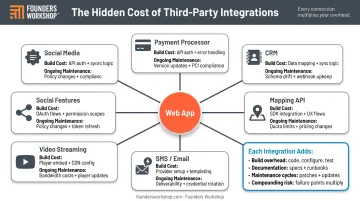
Founders Workshop's Booster Athletes project required 10+ custom integrations covering athlete payments, video streaming, SMS/email notifications, and social features — a real example of how fast integration scope compounds on a single platform.
Security, Compliance, and Non-Functional Requirements
Regulated industries carry costs that go beyond developer hours. These are organizational and infrastructure expenses that must be planned for as separate line items:
- HIPAA compliance: HIPAA Journal estimates mid-range compliance costs at $80,000–$120,000 — covering policies, technical safeguards, staff training, and audits
- PCI DSS compliance: Stripe estimates small businesses pay $1,000–$10,000 annually for PCI compliance activities including self-assessment questionnaires and approved scanning
Skipping these requirements at build time and trying to retrofit them later costs significantly more. Security architecture is far cheaper to build in from the start than to add after launch.
Full Cost Breakdown: Beyond the Build Price
The build price is only part of what a app actually costs. Founders who budget only for development are often surprised by what follows.
Discovery and Design (One-Time)
A structured discovery phase — requirements gathering, architecture planning, UX prototyping — prevents the expensive scope changes that derail projects mid-build. PMI data shows projects that spend less than 5% of their total budget on requirements processes see 80–200% cost overruns, while investing 8–14% typically keeps overruns below 60%.
A standalone discovery typically runs $5,000–$20,000 and takes 2–6 weeks. Founders Workshop's D1 Discovery phase covers goal definition, feature prioritization, integration planning, technology stack recommendations, and optional UX wireframing — delivered in 2–4 weeks before any development commitment.
Development and Launch (One-Time)
The core build cost follows the tier structure above. Add to that:
- QA testing (typically 10–15% of development budget)
- Deployment setup and cloud infrastructure provisioning
- Initial hosting configuration across staging and production environments
Hosting and Infrastructure (Recurring)
Cloud hosting costs scale with usage. AWS, Google Cloud, and Azure all publish pricing calculators — the right number depends on your architecture, traffic volume, storage needs, and data transfer.
Simple apps on a managed service like Google Cloud Run can run as low as $12–$50/month. Larger applications with databases, redundancy, and multiple environments typically run $500–$5,000+/month. Model these costs against your architecture before launch — surprises here are avoidable.
Maintenance and Updates (Recurring)
Post-launch maintenance — bug fixes, security patches, platform updates, performance monitoring, feature additions — typically costs 10–20% of the original development budget annually, per GoodFirms 2026 data.
For a $100,000 app, that's $10,000–$20,000 per year. Skipping it isn't a budget move — apps handling real users and transactions build up security vulnerabilities and technical debt fast.
Founders Workshop offers tiered monthly maintenance packages starting at $625/month (up to 5 hours) with 24/7 server monitoring, database backup, and ongoing support across dev, design, and QA. That predictable monthly cost is usually far cheaper than emergency fixes or reactive rebuilds.
Lower-Cost vs. Higher-Cost Applications: What's the Real Difference?
The cheapest app and the right app are rarely the same thing. But spending on features no one needs is equally common. The real question is: what's the right level of investment for your current stage?
Compare lower-cost and higher-cost builds across three dimensions:
| Dimension | Lower-Cost Build | Higher-Cost Build |
|---|---|---|
| Scalability | May hit performance limits under user growth | Architected for load, horizontal scaling |
| Security | Basic measures; compliance not addressed | Security layers built in; audit-ready |
| Maintainability | Template or minimal architecture; harder to extend | Modular codebase; easier to add features over time |
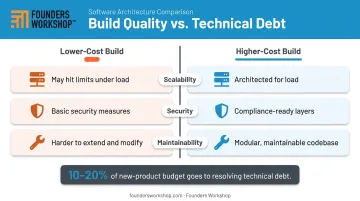
McKinsey research found that 10–20% of new-product technology budget is typically diverted to resolving technical debt — meaning teams that cut corners early end up paying for it through ongoing development slowdowns.
This isn't a binary choice between cheap and expensive. A lean MVP at $30,000–$50,000 is often the right call at launch — but only when the architecture can actually support what comes next. Cutting scope through discipline (deferring non-essential features) is a smart strategy; cutting cost through shortcuts (skipping tests, ignoring modularity, choosing the cheapest vendor) is what creates the debt you'll pay back later.
How to Budget Smarter for Your Application
Start with an MVP mindset
Identify the smallest version of the product that can validate your core assumption or generate initial revenue. An MVP approach can reduce initial development costs by 30–50% while producing real user data that informs every subsequent spending decision.
CB Insights' analysis of startup post-mortems consistently identifies lack of product-market fit as a top failure reason. The only way to test for it is to ship a working product and learn from real users.
Go through structured discovery before budgeting
Attempting to estimate costs without documented scope, wireframes, and architecture planning leads to unreliable quotes and expensive mid-project changes. PMI data shows that requirements investment directly determines whether overruns land at 200% or stay under 60% — so planning isn't optional, it's the variable that controls your budget.
Founders Workshop's 5D Process (Discovery, Definition, Development, Deployment, Dedicated Support) helps founders translate ideas into well-scoped, accurately estimated projects. The first two phases, Discovery and Definition, are designed to de-risk the project before development begins — including clickable prototypes that let founders validate with customers and investors before a single line of code is written.
Factor total cost of ownership, not just build cost
Build a 24-month cost model before committing to a vendor or approach. Include:
- Discovery and design (one-time)
- Core development and launch (one-time)
- Hosting and infrastructure (monthly × 24)
- Maintenance and support (annual × 2)
- Contingency buffer (15–20% of build cost)
- Third-party API subscription costs
Founders who model the full 2-year cost make better vendor and feature decisions — and rarely get blindsided by the infrastructure and maintenance bills that follow a cheap build quote.
Frequently Asked Questions
How much does custom app development cost?
Custom app development typically ranges from $25,000 for a basic custom build to $300,000+ for a complex platform, depending on feature scope, team location, and compliance requirements.
What is the average cost to build a app from scratch?
The average cost for a mid-complexity app built by a professional team sits between $50,000 and $150,000. Simple MVPs can come in under $50,000, while enterprise-grade systems regularly exceed $500,000. Clutch's 2026 data puts the average professional software development project at approximately $132,000.
How long does it take to develop a application?
Simple apps typically take 1–3 months; mid-complexity apps 3–6 months; complex enterprise applications 6–18+ months. Timeline and cost move together: a longer build means more development hours billed, not a better product.
What is the cheapest way to build a app?
Three moves that cut cost without cutting corners:
- Start with a scoped MVP rather than a full feature set
- Use third-party services for non-core functionality instead of building from scratch
- Work with a nearshore team for competitive rates without the timezone friction of distant offshore engagements
How much does app maintenance cost per year?
Annual maintenance typically runs 10–20% of the original development cost, covering bug fixes, security updates, hosting management, and platform compatibility. This recurring cost should appear in your initial budget, not as a surprise after launch.
Should I hire in-house developers or outsource my app?
In-house teams offer control but carry high overhead — Founders Workshop estimates $750,000–$1 million annually in salaries and benefits for an equivalent in-house team. For most startups and SMBs, outsourcing or a nearshore partnership delivers faster team assembly, lower cost, and flexibility that in-house hiring simply can't match.