The problem is that "AI consulting" covers an enormous range — from a solo advisor handing over a readiness report after two weeks, to a large consultancy running a six-month, multi-department transformation. Confusing the two is where most budgeting mistakes start.
This guide breaks down what AI consultants actually charge in 2026, what drives prices up or down, which hidden costs to plan for, and how startups and SMBs can find the right expertise without overpaying for capabilities they won't use.
Key Takeaways
- AI consulting ranges from $2,000–$25,000 for entry-level assessments to $150,000–$500,000+ for full transformation engagements
- Hourly rates run $100–$150/hr for junior consultants and $300–$500+/hr for senior specialists
- Four factors drive cost most: engagement type, experience level, geography, and whether strategy includes implementation
- Hidden costs — platform licensing, integration, and ongoing maintenance — add 30–50% on top of the headline consulting fee
- Startups and SMBs get the best ROI from boutique or nearshore firms that cover both strategy and build
How Much Does an AI Consultant Cost in 2026?
There's no standard price tag because there's no standard product. A "$50,000 AI engagement" might mean a boutique firm delivering your first working automation workflow, or a large consultancy wrapping up a strategy deck — same number, completely different outputs.
Most budgeting errors happen in one of two directions: companies underbudget because they price the cheapest option they can find, then hit surprise charges when implementation turns out to be out of scope — or they overpay for Big 4 credentials their 30-person company doesn't need.
Here's how the market actually breaks down by tier.
Entry-Level / Assessments ($2,000–$25,000)
What's typically included:
- AI readiness audit across existing systems and workflows
- Prioritized use-case list with initial effort estimates
- Basic implementation roadmap
- Timeline: 2–4 weeks; no implementation work included
Best for: Founders and small businesses validating whether AI fits their operations before committing larger budget. This is a scoping product, not a build.
Mid-Range / Strategy + Initial Build ($25,000–$75,000)
What's typically included:
- Use-case strategy and platform selection
- First workflow builds or API integrations
- Team training and handoff documentation
- Timeline: 6–12 weeks
Some firms pair strategy with a senior development team in a single engagement, covering AI discovery through to a market-ready build. Founders Workshop operates this way, running the full scope through their 5D Process with implementation included. That structure matters: hiring a strategy firm and a development firm separately for the same scope often doubles the cost and creates handoff gaps between teams.
Best for: SMBs and startups ready to move from planning to their first AI-powered workflow or product feature.
Full Transformation / Enterprise ($75,000–$500,000+)
What's typically included:
- Multi-department deployment and change management
- Custom integrations and executive dashboards
- Ongoing optimization and performance monitoring
- Timeline: 6–18 months
Large consultancies and Big 4 firms sit at the top of this range. MBB firms don't publish their senior consulting rates publicly, but third-party estimates place blended rates around $300–$500 per consultant-hour, per industry data cited by The Street.
Ideal for mid-market companies or funded startups undertaking organization-wide AI adoption with internal teams capable of absorbing and sustaining the work.
Key Factors That Drive AI Consulting Costs
Cost is determined less by the word "AI" and more by four variables: what type of engagement it is, who's doing the work, where they're based, and how the pricing is structured.
Engagement Type and Scope
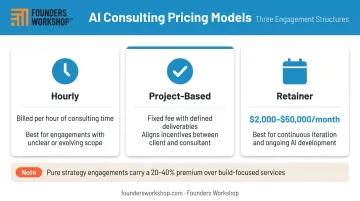
The three pricing models each carry different risk profiles:
| Model | Structure | Best When |
|---|---|---|
| Hourly | Billed per hour worked | Scope is genuinely unclear at the start |
| Project-based | Fixed fee, defined deliverables | Scope is well-defined; aligns incentives |
| Retainer | $2,000–$50,000/month ongoing | You need continuous access and iteration |
Pure strategy engagements without implementation typically carry a 20–40% premium over build-focused services. Advisors who won't write code are paid entirely for judgment — and scope creep beyond a defined roadmap can turn a $30,000 engagement into $55,000.
Experience Level and Specialization
Rate tiers by experience, using marketplace and industry proxies:
- Junior (0–3 years): $100–$150/hr
- Mid-level (3–7 years): $150–$300/hr
- Senior/Specialist (7+ years): $300–$500+/hr
Domain specialization in healthcare, fintech, or regulated industries typically adds 20–40% on top of base rates.
The highest-value consultants bridge technical depth and business strategy. Purely technical consultants cost less but often miss the organizational changes required for AI to actually stick.
That gap has real consequences: Gartner reports that at least 50% of generative AI projects are abandoned after proof of concept, with poor data quality, unclear business value, and inadequate change management cited as leading causes — not model capability.
Geography and Delivery Model
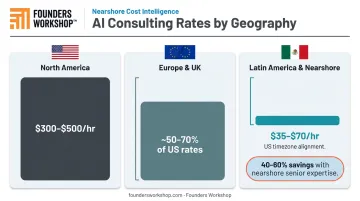
Where your consultant is based shapes cost as much as experience level does. Geography creates some of the largest rate differences in the market:
- US-based senior consultants: $300–$500/hr
- Western European equivalents: roughly 50–70% of US rates
- Latin American nearshore specialists: $35–$70/hr (with US-market experience and timezone alignment)
Nearshore AI consulting has grown because it gives startups and SMBs access to senior expertise at 40–60% below US rates — without the communication lag of offshore delivery.
Founders Workshop, for example, operates with Latin American development teams in the same timezone as US clients, with the cultural alignment that offshore models typically lack. Their nearshore staff augmentation model runs consistently at one-third the cost of equivalent US teams.
The Full Cost Breakdown: Beyond the Consulting Fee
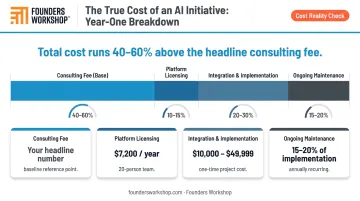
The consulting fee is only one line item. Most companies discover the others after the proposal is signed. Total year-one cost of an AI initiative routinely runs 40–60% higher than the headline number.
Platform and Tooling Costs
Current per-seat pricing for major AI platforms:
| Platform | Current Pricing |
|---|---|
| Microsoft 365 Copilot | $30.00/user/month (annual commitment) |
| ChatGPT Business | $20/user/month |
| Claude Team | $25/member/month (or $20 billed annually) |
For a 20-person team using Microsoft 365 Copilot, that's $7,200/year before a single custom integration — a cost that rarely appears in consulting proposals.
Integration and Implementation Costs
Off-the-shelf AI tools rarely plug directly into existing business systems. Custom API work, data preparation, and workflow design are typically billed separately or excluded entirely from strategy-only engagements.
Clutch's June 2026 AI pricing guide reports that many AI development projects on their platform fall in the $10,000–$49,999 range, with an average project cost of approximately $120,000 and a typical timeline around 10 months. That's a useful SMB-scale benchmark for integration work beyond the initial consulting scope.
Ongoing Maintenance and Optimization
One-time integration costs are only half the picture. Once deployed, AI systems require ongoing attention: model drift corrections, workflow updates as your products evolve, performance monitoring, and usage policies.
Underestimated maintenance is one of the top reasons AI projects get quietly shelved after launch. A practical rule of thumb: budget 15–20% of your initial implementation cost annually for upkeep. For a $50,000 integration, that's $7,500–$10,000 per year — plan for it from day one, not after the first system failure.
How to Budget Smarter for AI Consulting
Start with the outcome, not the technology
Define success in business terms before speaking to any firm. Hours saved per week. Error rate reduced by X%. Revenue unlocked from a new workflow. Vague objectives are the single biggest driver of scope creep and cost overruns — and they're entirely preventable.
Match the engagement type to your actual stage
A startup validating its first AI feature needs a focused pilot, not a company-wide transformation strategy. McKinsey's research supports starting with faster-to-implement use cases that require fewer data points and less organizational coordination than broader deployments.
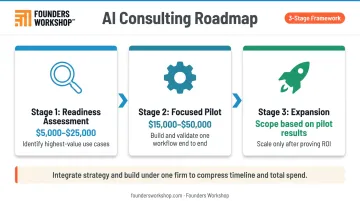
Typical staged approach:
- Readiness assessment ($5,000–$25,000) — identify highest-value use cases
- Focused pilot ($15,000–$50,000) — build and validate one workflow end to end
- Expansion (scope based on pilot results) — only after proving ROI at the pilot level
Evaluate firms that combine strategy and build
Paying separate firms for AI strategy and AI development often doubles total cost and introduces handoff risk — the strategy firm delivers recommendations that the development team then has to interpret and re-scope. Working with a firm that runs both under one process compresses timeline and total spend.
Founders Workshop's 5D Process (Discovery, Definition, Development, Deployment, and Dedicated support) is one example of this integrated approach — covering AI exploration through to a working build within a single continuous process, with no vendor handoff in between.
Watch for red flags in proposals
Before signing any statement of work, scan for these patterns — each one consistently drives costs up without proportional value:
- No defined success metrics in the statement of work
- Change management treated as a final training module rather than integrated throughout
- Retainer structures with no defined deliverables or review checkpoints
- Strategy-only scope with implementation "to be determined" after delivery
Frequently Asked Questions
What is the hourly rate for an AI consultant?
Hourly rates range from $100–$150/hr for junior consultants to $300–$500+/hr for senior specialists, with some named expert consultants charging significantly more for ad hoc advisory sessions. Project-based pricing is increasingly preferred because it ties cost to outcomes rather than hours logged.
What's the difference between an AI consultant and an AI developer?
An AI consultant focuses on strategy, roadmapping, and identifying use cases, while an AI developer builds and integrates the actual systems. Some firms offer both under one engagement, which reduces total cost and eliminates the handoff risk between separate strategy and build vendors.
How much should a startup budget for AI consulting in 2026?
Most startups spend $10,000–$50,000 on an initial AI engagement. A focused readiness assessment combined with a pilot implementation targeting one high-impact use case is the most cost-effective starting point before committing to broader deployment.
Is AI consulting worth it for small businesses?
Yes — when scoped to a specific use case. Small businesses see the strongest returns on high-volume repetitive tasks where automation ROI is measurable. The risk is overspending on broad transformation before proving value at the pilot level.
What should be included in an AI consulting engagement?
A complete engagement should cover:
- Discovery and needs assessment
- Strategy and tool selection
- Implementation or a detailed handoff plan
- Team training and defined success metrics
- Change management woven throughout — not bolted on at the end
Are there cheaper alternatives to US-based AI consulting firms?
Nearshore Latin American consultants with US-market experience typically charge 40–60% less than US equivalents, while offering timezone and cultural alignment that pure offshore models can't match. Boutique firms that combine strategy and build under one engagement also tend to cost less than hiring separate strategy and development vendors.