Introduction
You have a product idea that solves a real problem. But between that idea and a working product in front of real users, there's a process most founders have never navigated before, and that gap between "concept" and "launched" is where most startups burn through their runway before reaching users.
CB Insights found that 42% of analyzed startup failures cited "no market need" as the primary cause. Those weren't execution failures. They were validation failures — products built before anyone confirmed users actually wanted them.
MVP development services exist to solve exactly that problem. Rather than jumping from idea to full product build, a structured MVP process guides founders through discovery, scoping, design, and iterative development until reaching the earliest point where real users can validate the core hypothesis.
What follows covers the end-to-end MVP development process: what each phase involves, what separates a well-executed MVP from a budget drain, and what to look for in a development partner.
Key Takeaways
- An MVP is the earliest deployable version of your product — built to generate validated user feedback, not to be feature-complete.
- A professional MVP service covers the full build lifecycle, from discovery and scoping through design, development, and deployment.
- Skipping early validation is the leading cause of MVPs that miss product-market fit.
- The right partner combines a repeatable build process with real founder experience, not just technical execution.
What Is the MVP Development Process?
Eric Ries defines an MVP as "the version of a new product which allows a team to collect the maximum amount of validated learning about customers with the least effort." That definition matters because it reframes the goal: an MVP isn't a trimmed-down finished product — it's a learning instrument.
The MVP development process is the structured sequence of phases that transforms an unvalidated idea into a deployable, user-tested product with the minimum feature set required to generate real market feedback.
How an MVP Differs from Related Concepts
These three terms get conflated constantly. They're not interchangeable:
| Concept | Purpose | Deployable? |
|---|---|---|
| Proof of Concept (POC) | Tests technical feasibility | No |
| Prototype | Visualizes and tests the user experience | No |
| MVP | Generates validated customer feedback from real use | Yes |
A prototype helps you visualize the product before building it. A POC answers "can this technically work?" An MVP answers "do real users want this, and will they use it?" Only the MVP puts a working product in users' hands and returns actionable data.
That data is only useful when feedback is honest — and honest feedback requires a product that actually works. As Pragmatic Institute points out, an MVP is not simply the smallest collection of features, and it's not a buggy or half-baked release. Quality still matters — frustrated early users generate noise, not signal.
Why Founders Use a Professional MVP Development Service
The Cost of Building Without a Framework
Non-technical founders face a specific problem: without a structured process, every build decision defaults to "add more features." Scope expands. Timelines stretch. Budget disappears before real users ever see the product.
This isn't just a startup problem. PMI's 2021 Pulse of the Profession linked wasted investment directly to poor project performance including scope creep and missed milestones. A disciplined development partner enforces the scope boundaries that founders find hardest to hold on their own.
What a Specialized Service Brings Beyond Coding
A strong MVP development partner contributes more than technical capacity:
- Business analysis — translating vague ideas into testable hypotheses
- Feature prioritization — separating what must be in v1 from what can wait
- UX strategy — designing for user behavior, not just visual appeal
- Go-to-market alignment — building toward a launch that can actually acquire users
Founders Workshop's leadership team — CEO Vincent Serpico, CPO Wayne Neale, and COO Michael Vanderslice — bring over 30 years of experience each as founders, business owners, and investors, with collective exposure to 81 startups and 31 owned businesses. That background means MVP decisions get stress-tested against real market conditions, not just engineering constraints.
Retaining Equity
Bringing on a technical co-founder to fill a capability gap typically costs founders up to 50% equity — before a single line of code is written. Working with an experienced development partner eliminates that trade-off entirely. Carta's founder ownership data shows the median founding team retains roughly 56% of fully diluted equity by seed — a figure that shrinks fast when equity-for-development deals are made early.
How the MVP Development Process Works: From Ideation to Deployment
A well-structured MVP engagement moves through discrete, interdependent phases, not directly from "idea" to "build." Each phase has defined outputs that gate the next.
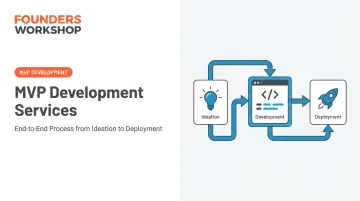
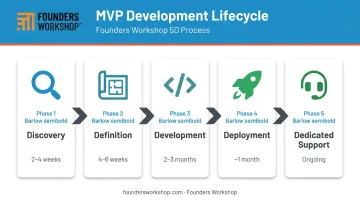
Founders Workshop's 5D Process covers exactly this: Discovery → Definition → Development → Deployment → Dedicated Support. For most products, the full arc from Discovery to Deployment runs 3–6 months, depending on complexity and decision speed.
Discover: Define the Problem and Validate the Opportunity
Duration: 2–4 weeks
This phase happens before a single line of code is written. The focus is on:
- Defining short and long-term product goals
- Identifying and prioritizing the features that deliver real user value
- Exploring monetization models and revenue streams
- Validating the core hypothesis the MVP will test
At Founders Workshop, clients work with a dedicated Project Champion, a seasoned entrepreneur who helps de-risk the project before committing to development. Optional services at this stage include customer research, competitive analysis, UX exploration, and AI integration assessment.
The output: a solid foundation that allows for realistic scoping and cost estimation before any design or development work begins.
Define: Scope Features and Establish the Product Roadmap
Duration: 4–6 weeks
This phase translates validated insights into a prioritized feature list and a product roadmap. The critical discipline is ruthless scoping: keep only what's required to test the core value proposition, and document everything else for future iterations.
During this phase, clients work with a dedicated Designer and Project Manager to:
- Design wireframes and interface concepts
- Architect the backend infrastructure
- Determine the technology stack
- Produce a clickable prototype: a fully interactive mock-up clients can test with stakeholders, investors, or early customers before development begins
That prototype also gates the next decision point. Before any development budget is committed, founders can validate the experience and secure buy-in, reducing the risk of building in the wrong direction.
Why Architecture Decisions Here Carry Long-Term Consequences
UX and technical architecture decisions happen during the Definition phase, and they carry significant downstream consequences. Platform choices, data models, and integration patterns established here directly affect development speed, scalability, and future maintenance costs.
Poor decisions at this stage create technical debt that compounds with every subsequent iteration. CISQ estimates accumulated U.S. software technical debt at approximately $1.52 trillion, a figure driven largely by architectural shortcuts made under early-stage pressure.
Develop: Build the Core Product Iteratively
Duration: 2–3 months
The development phase follows an agile processreliable, reducing development time without sacrificing quality.
QA testing runs concurrently with development. Founders Workshop's dedicated QA testers manually validate the product throughout the build, ensuring it's ready for public use before the Deployment phase begins.
Deploy: Launch, Measure, and Iterate
Duration: ~1 month
Deployment is the beginning of the feedback loop, not the finish line.
What this phase involves:
- Environment setup and infrastructure configuration
- Cloud hosting with 24/7 server monitoring
- Staged rollout to initial users
Post-launch, three metrics tell you whether the MVP is doing its job:
- Activation rate: are users completing core actions?
- Retention: are they coming back?
- Engagement: are they using the features that test your hypothesis?
Founders Workshop's Dedicated Support phase extends this work: 80–160 hours per month of ongoing developer time covering monitoring, feature updates, performance optimization, and product consulting. One client, WellPsyche, has maintained this support relationship for over 8 years, from startup through scaling.
Key Factors That Affect Your MVP Development Outcome
| Factor | What it affects |
|---|---|
| Problem clarity | Vague problem definitions produce undefined scope and feature bloat |
| Team process discipline | Unstructured teams produce fragile foundations that are expensive to build on |
| Budget and timeline realism | U.S. onshore hourly rates typically run $100–$149/hr; nearshore Latin American teams deliver the same output quality at $35–$50/hr — roughly one-third the cost |
| Founder engagement | Rapid iteration requires active input at each milestone — slow decisions extend timelines and inflate costs |
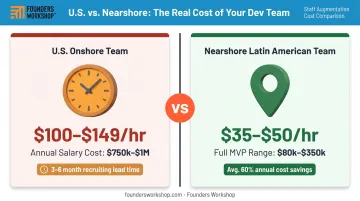
Those rate differences add up fast. Founders Workshop's nearshore model puts full MVP development in the $80k–$350k range for 3–6 months — compared to building an equivalent in-house U.S. team, which typically runs $750k–$1M annually in salaries alone, with a 3–6 month recruiting lead time before work even begins.
Common MVP Development Mistakes and Misconceptions
Overbuilding Before Validation
The most expensive mistake founders make is adding features beyond the core test case. Every feature added before validation delays time-to-market without improving learning outcomes. The word "minimum" is intentional: it forces you to isolate exactly what needs to be tested and nothing more.
Treating Deployment as the Finish Line
Launching without a plan to measure outcomes is equivalent to running an experiment with no intent to read the results. The real value of an MVP is the feedback loop it generates. The launch is just the trigger, not the goal.
Confusing Cheap with Fast
Cutting costs by using junior teams or skipping discovery doesn't speed up delivery — it creates technical debt that slows down every subsequent iteration. Moving efficiently means using a proven process with experienced people — Founders Workshop's 5D framework, for instance, is specifically designed to avoid the rework cycle that sinks early-stage builds. The shortcuts that save money in week one typically cost three times as much to fix in month six.
Common signs a team cut the wrong corners:
- Undefined scope leading to feature creep mid-build
- No QA pass before deployment
- Missing discovery phase, so core assumptions were never stress-tested
- Junior developers handed architecture decisions without oversight
Frequently Asked Questions
What is end-to-end MVP development and launch support?
End-to-end MVP development covers every phase from initial discovery and scoping through design, development, deployment, and post-launch iteration — not just the build phase after requirements are handed off. It includes the strategic work upfront and the iteration support that follows launch.
What is the first step in the MVP development process?
Discovery and problem validation. This means defining the target user, the core problem being solved, and the assumption the MVP will test. Design and development follow only after that foundation is in place.
What is MVP, MMP, and MMF?
An MVP (Minimum Viable Product) is the earliest deployable version that generates user feedback. An MMP (Minimum Marketable Product) is the smallest version worth charging for. An MMF (Minimum Marketable Feature) is the smallest feature increment that delivers standalone user value.
How long does it take to build an MVP?
Most MVPs move from discovery to deployment in 3–6 months, depending on product complexity, team size, and decision speed during scoping. Founders Workshop's 5D Process is structured to hit that window — provided scope is defined clearly at the outset.
How much does MVP development typically cost?
U.S. onshore custom software developers typically charge $100–$149/hr. Nearshore Latin American teams — like those Founders Workshop staffs — deliver comparable quality at roughly one-third that rate. Full MVP engagements typically range from $80k to $350k depending on scope and complexity.
How do I know if my MVP is ready to launch?
An MVP is ready to launch when it delivers its core value proposition end-to-end without critical errors and you have defined success metrics in place to evaluate whether your core assumption was validated.